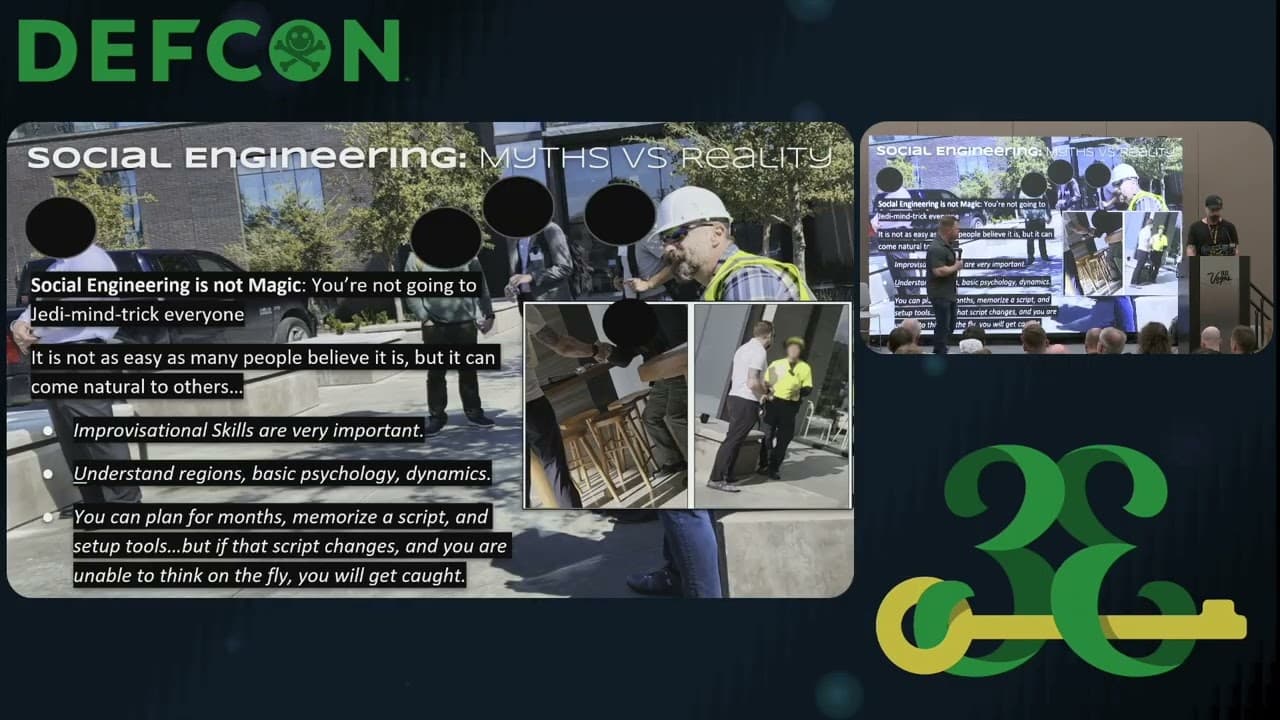
A Day in the Life of a Security Analyst
This talk provides an overview of the daily responsibilities and operational workflows of a blue team security analyst. It covers the triage and incident response process for security alerts, the importance of project-based work for improving defensive tools and documentation, and the role of a security analyst as a subject matter expert for the business. The presentation emphasizes the necessity of continuous learning and professional development for maintaining effective security operations.
Beyond the Basement: Why Blue Team Operations Are the Real Security Frontier
TLDR: Most security research focuses on the flashy, offensive side of the house, but the vast majority of industry roles are in blue team operations. This post breaks down the daily reality of a security analyst, moving past the "hacker in a hoodie" trope to focus on the critical work of alert triage, process optimization, and serving as a technical bridge for the business. Understanding these operational workflows is essential for any researcher who wants to build tools or findings that actually survive in a production environment.
Security conferences are saturated with red team content. We spend hours dissecting the latest RCE, debating the merits of a new C2 framework, or watching live demos of privilege escalation. Yet, if you look at the actual distribution of labor in the industry, the red team is a rounding error. The overwhelming majority of security professionals are in the trenches of blue team operations. If you want your research to have a lasting impact, you need to understand how these teams actually function, because they are the ones who will either operationalize your findings or ignore them entirely.
The Reality of Alert Triage
The core of a security analyst's day is not sitting in a dark room waiting for a nation-state actor to trip a wire. It is a constant, high-volume grind of alert triage. Modern infrastructure generates an ungodly amount of noise. When an analyst receives an alert from a SIEM or an endpoint protection platform, the work is just beginning.
The process is rarely as simple as "alert equals incident." It is a multi-stage workflow: triage, assignment, confirmation, and resolution. A common scenario involves a vulnerability scan flagging a misconfiguration in a web server, such as an outdated version of WordPress or a deprecated TLS implementation. The analyst must confirm the finding, determine if it is a false positive, and then coordinate with the development team to push a fix. This requires technical depth, but it also requires the ability to communicate risk to people who do not spend their lives thinking about exploit chains.
Projects: The Hidden Engine of Defense
If alert triage is the daily maintenance, project work is the architectural improvement. A security team that only responds to alerts is a team that is slowly losing. Effective blue teams dedicate significant time to improving their tooling and processes.
Take the example of email security. When an organization deploys a new email protection suite, the default configurations are rarely sufficient. Analysts have to figure out how to implement effective banners—those yellow warning tags that appear when an email originates from outside the organization. The challenge is finding the balance between being helpful and being annoying. If the banner is too long, users ignore it. If it is too short, it is ineffective.
This is where the "Five Whys" analysis comes into play during postmortems. When a P1 incident occurs, you do not just fix the immediate issue. You analyze the root cause to ensure the incident cannot happen again. This often leads to updating the Incident Response Plan, which is a living document that must be kept concise. A sixteen-page document is useless in the middle of a crisis. A one-page cheat sheet taped to the wall of the help desk is a force multiplier.
The Analyst as a Subject Matter Expert
One of the most underrated aspects of the blue team role is the function of the security analyst as a subject matter expert for the rest of the business. You will be asked questions that seem simple but carry massive risk. A user might ask, "Is it okay to store passwords in a shared Excel document?"
The answer is obviously no, but if you simply say "no," you have failed. You have to provide an alternative. You point them toward a password manager and explain the risk of credential exposure. When a CEO asks, "Do I really need to restart my computer to install updates?" you do not lecture them on the theory of patch management. You explain that sixty percent of attacks involve unpatched software, and a reboot is the fastest way to reduce their personal risk profile. You frame the security requirement in terms of business continuity and risk reduction.
The Necessity of Continuous Study
Cybersecurity is not a static field. If you stop learning, you become a liability. We encourage our team to dedicate an hour every day, or a half-day every week, to focused study. This is not just about keeping up with the latest CVEs; it is about mastering the fundamentals that do not change.
If you are a junior analyst, your path is clear: get your Security+ or Network+ and keep building. The specific credential matters less than the habit of learning. We provide training materials and reimburse for certifications because we know that a team that is actively learning is a team that is harder to compromise.
The next time you are developing an exploit or writing a bug bounty report, ask yourself how a blue team would actually handle that finding. Would it trigger a high-fidelity alert, or would it get lost in the noise? Would the remediation be a simple configuration change, or would it require a massive architectural overhaul? The best researchers are the ones who understand the operational constraints of the people they are trying to protect. If you can make the blue team's life easier, you will find that your work has a much longer shelf life.
Vulnerability Classes
OWASP Categories
Up Next From This Conference


Similar Talks
The Dark Side of Bug Bounty
Social Engineering A.I. and Subverting H.I.