
Alice in Kernel Land: Lessons Learned from the eBPF Rabbit Hole
This talk explores the security landscape of eBPF, focusing on vulnerabilities within the verifier, JIT compiler, and runtime components that can lead to local privilege escalation. The researchers demonstrate how to build a custom, coverage-guided fuzzer to identify subtle logic bugs that traditional kernel fuzzers might miss. The presentation concludes with a practical demonstration of a local privilege escalation and container escape exploit. The authors also release their custom fuzzer, 'Buzzer', as an open-source tool for the community.
Breaking the Kernel: Exploiting eBPF Verifier Logic Bugs for Privilege Escalation
TLDR: Researchers at Black Hat 2023 demonstrated that the Linux kernel's eBPF verifier is a high-value target for local privilege escalation due to its immense complexity and subtle logic flaws. By building a custom, coverage-guided fuzzer named Buzzer, they identified multiple vulnerabilities that bypass safety checks to allow out-of-bounds memory access. Pentesters should prioritize auditing eBPF programs in environments where unprivileged users or containers have access to
CAP_BPForCAP_SYS_ADMINcapabilities.
Modern Linux security relies heavily on eBPF to provide safe, high-performance observability and networking. However, the complexity of the eBPF verifier—a component responsible for ensuring that user-provided bytecode cannot crash the kernel or access unauthorized memory—has turned it into a massive attack surface. When the verifier makes a wrong assumption about the state of a program, it effectively hands an attacker the keys to the kernel.
The Verifier as an Attack Surface
The verifier is essentially a static analyzer that attempts to prove the safety of eBPF programs before they are JIT-compiled and executed. With over 17,000 lines of code in kernel/bpf/verifier.c, it is a prime candidate for logic bugs. The research presented at Black Hat 2023 highlights that these bugs often stem from the verifier's attempt to optimize its analysis. To maintain performance, the verifier uses pruning techniques to skip analysis on code paths it deems "safe" or unreachable. If an attacker can craft a program that forces the verifier to miscalculate the bounds of a register or mispredict a branch, they can bypass these safety checks entirely.
One of the most critical findings involves how the verifier handles scalar register ranges. For instance, CVE-2020-27194 was caused by miscalculations of 32-bit ranges derived from 64-bit registers. Even after developers attempted to patch this by tracking 32-bit ranges separately, the complexity of the fix introduced new edge cases. Similarly, CVE-2021-3490 demonstrated that logic errors in handling bitwise operations like AND, OR, and XOR could lead the verifier to generate an incorrect state for the program, effectively blinding it to potential out-of-bounds access.
Fuzzing for Logic Bugs
Traditional kernel fuzzers like syzkaller are excellent at finding "loud" memory corruption bugs, such as kernel panics or obvious use-after-free conditions. However, they often struggle to identify the subtle, silent logic errors that characterize modern eBPF vulnerabilities. To bridge this gap, the researchers developed Buzzer, a custom, coverage-guided fuzzer designed specifically for the eBPF verifier.
Buzzer operates by generating syntactically valid eBPF programs that are semantically designed to challenge the verifier's assumptions. Instead of just flipping random bits, the fuzzer constructs programs with a tree-like structure, ensuring that each instruction is correctly encoded and that the program has a clean exit path. By injecting random arithmetic operations and jumps, Buzzer forces the verifier to track register states through complex paths.
To detect these bugs, the researchers implemented a clever verification strategy. They rely on the fact that if the verifier deems a program safe, it guarantees that all memory accesses are within bounds. The fuzzer writes a "magic value" to a specific location in an eBPF map at the end of execution. If the value retrieved from user space does not match the expected result, it proves that the verifier's static analysis was flawed, confirming an out-of-bounds write occurred.
Real-World Impact and Exploitation
For a pentester, these vulnerabilities are gold. If you encounter a target environment where a user or a container has been granted CAP_BPF or CAP_SYS_ADMIN, you have a direct path to local privilege escalation. The researchers demonstrated this by turning a verifier logic bug into a full container escape. The exploit flow typically involves:
- Leaking kernel memory addresses to defeat KASLR.
- Identifying the
task_structof the target process. - Patching the process credentials to gain root privileges.
This technique is a textbook example of T1068: Exploitation for Privilege Escalation. In a standard engagement, you might not need to write a custom fuzzer, but you should definitely be looking for eBPF programs running with elevated privileges. If you see a service or a container using eBPF for telemetry or networking, check the capabilities. If the environment allows loading custom eBPF programs, you have a high-probability vector for escalation.
Defensive Considerations
Defending against these attacks is difficult because the vulnerabilities exist within the kernel's own security logic. The most effective mitigation is to minimize the attack surface by strictly limiting who can load eBPF programs. Ensure that kernel.unprivileged_bpf_disabled is set to 1 on all production systems. Furthermore, leverage Linux Security Modules (LSM) like SELinux or AppArmor to restrict the actions that eBPF programs can perform, even if they are successfully loaded.
The research into eBPF security is still in its infancy. As the kernel continues to adopt eBPF for more critical tasks, the incentive for attackers to find these "rabbit hole" vulnerabilities will only grow. If you are serious about kernel security, start by auditing the verifier's handling of complex branch logic and register tracking. The bugs are there; you just need the right fuzzer to find them.
Vulnerability Classes
Target Technologies
Attack Techniques
All Tags
Up Next From This Conference
A New Attack Interface In Java Applications
Inference Attacks on Endpoint Privacy Zones in Fitness Tracking Social Networks
Abusing Azure Active Directory: From MFA Bypass to Listing Global Administrators
Similar Talks

We are currently clean on OPSEC: The Signalgate Saga
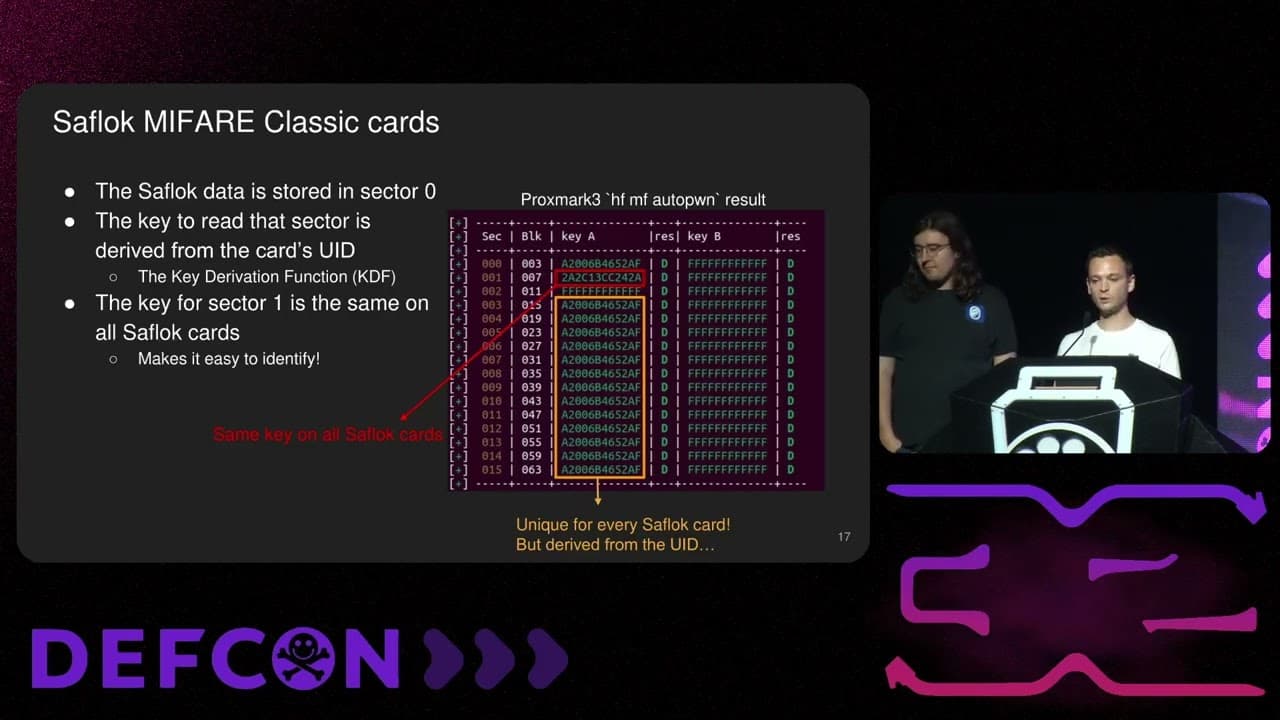
Unsaflock: Unlocking Millions of Hotel Locks
