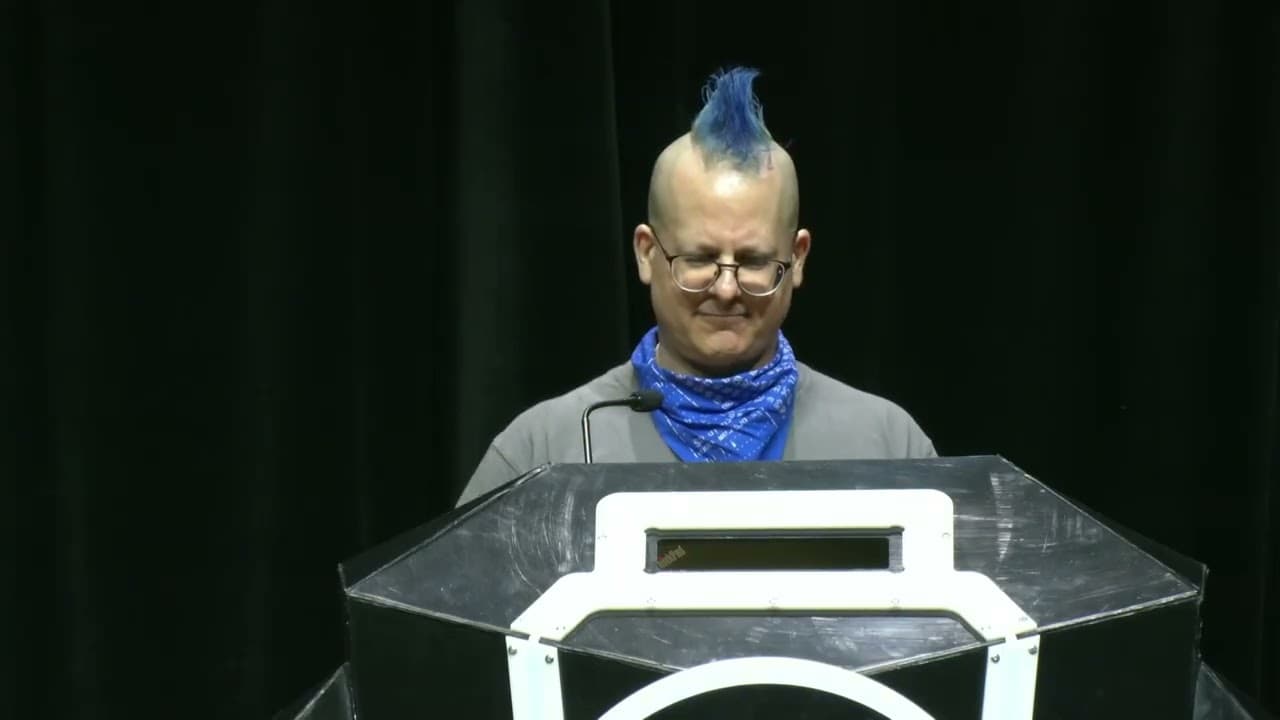
Engaging The Next Generation of Cybersecurity Enthusiasts
This talk discusses the use of 'Security Zines' as a pedagogical tool to simplify complex cybersecurity concepts for developers and non-technical staff. The speaker demonstrates how visual, hand-drawn flyers can effectively communicate vulnerabilities like Server-Side Template Injection (SSTI), Insecure Direct Object Reference (IDOR), and JSON Web Token (JWT) misconfigurations. The presentation highlights the effectiveness of this approach in increasing engagement and retention compared to traditional training methods.
Visualizing Vulnerabilities: Why Hand-Drawn Zines Beat Static Reports
TLDR: Security documentation is often ignored by developers because it is dense, dry, and disconnected from their daily workflow. By using hand-drawn "Security Zines" to visualize complex attack chains like Server-Side Template Injection (SSTI) and Insecure Direct Object Reference (IDOR), researchers can bridge the communication gap between offensive findings and developer remediation. This approach turns abstract vulnerabilities into concrete, memorable mental models that actually drive security improvements.
Security researchers spend weeks finding a critical bug, only to have the resulting report sit in a Jira backlog for months. We write for auditors and compliance officers, yet we expect developers to read our findings and understand the underlying risk. This disconnect is a primary reason why the same classes of vulnerabilities—Injection, Broken Access Control, and Identification and Authentication Failures—persist in production environments year after year.
The problem is not that developers don't care about security. The problem is that our delivery mechanism is broken. A 50-page PDF report is not a tool for learning; it is a barrier to entry. If you want to see real change, you have to meet developers where they are, using formats that are actually digestible.
The Mechanics of Visualizing Exploits
The core of this research is simple: stop writing walls of text and start drawing the data flow. When you are explaining a vulnerability like Server-Side Template Injection (SSTI), the technical nuance is often lost in a sea of jargon. Instead, map the request. Show the client input, the server-side template engine, and the resulting execution.
Consider a standard SSTI scenario in a Python/Jinja2 environment. A developer might not immediately grasp why {{7*7}} is dangerous, but they will understand a diagram showing how their application takes user-supplied data, treats it as a template, and executes it as code.
# The vulnerable pattern
from flask import render_template_string
@app.route("/hello")
def hello():
    name = request.args.get('name')
    return render_template_string("Hello " + name)
When you draw this, you aren't just showing the code. You are showing the path of the payload. By visualizing the transition from a standard HTTP POST request to the server-side rendering process, you make the vulnerability tangible. You show the developer exactly where the sanitization is missing.
Why This Works for Pentesters
During a red team engagement or a bug bounty hunt, you are often tasked with explaining your findings to a team that is already overwhelmed. If you provide a "Zine"—a single-page, hand-drawn visual guide—you give the developer a cheat sheet they can keep on their desk.
Take Insecure Direct Object Reference (IDOR). The concept is straightforward, but the implementation flaws are often subtle. A visual guide that contrasts "Good Access Control" with "Bad Access Control" using simple stick figures and arrows is infinitely more effective than a paragraph describing the lack of server-side authorization checks.
When you present this to a lead developer, you aren't just pointing out a bug. You are providing a mental model for how they should be building their authorization logic in the future. You are teaching them to think like an attacker without forcing them to read a textbook.
The Human Element of Security
Phishing is the classic example of a "human" vulnerability that technical training fails to address. We send out automated simulations, and employees click the links anyway. Why? Because the training is boring.
If you want to stop phishing, you have to explain the why behind the attack. Show them the difference between amazon.com and annazon.com in a visual format that highlights the deception. When you use a Zine to explain that an attacker is just a person trying to trick them, you change the dynamic. You move from "don't click this" to "here is how they are trying to manipulate you."
Moving Beyond the Report
The goal of any security engagement should be to leave the target environment more resilient than you found it. If your report is never read, you have failed. If your findings are misunderstood, you have failed.
Start experimenting with your own documentation. Next time you find a critical vulnerability, don't just write the PoC. Draw the attack chain. Keep it simple. Keep it visual. If you can explain the vulnerability to a non-technical stakeholder in a single page, you have a much higher chance of getting that fix prioritized.
We are in the business of breaking things, but we are also in the business of building better systems. If you can make your research accessible, you make it actionable. That is the only way to move the needle on security. Stop filing reports and start building resources that your colleagues will actually bookmark and share. The next time you are on a test, try sketching out your findings. You might be surprised at how much more receptive your engineering team becomes when they can actually see the problem.
Vulnerability Classes
Target Technologies
Attack Techniques
Up Next From This Conference

A New Attack Interface In Java Applications
Inference Attacks on Endpoint Privacy Zones in Fitness Tracking Social Networks

Abusing Azure Active Directory: From MFA Bypass to Listing Global Administrators
Similar Talks

Kill List: Hacking an Assassination Site on the Dark Web
Exploiting Shadow Data in AI Models and Embeddings