History and Significance of the TTBR and PEASWG
This talk provides a historical overview of the Top-to-Bottom Review (TTBR) and the Post-Election Audit Standards Working Group (PEASWG), which were critical initiatives for evaluating the security of electronic voting systems. The speaker details how these efforts exposed profound vulnerabilities in Direct-Recording Electronic (DRE) voting machines, including physical security flaws and potential for malicious code injection. The presentation emphasizes the shift in election security strategy from seeking perfect software to implementing robust, evidence-based practices like risk-limiting audits. It highlights the importance of independent expert review and the necessity of maintaining physical and procedural security for election infrastructure.
Beyond the Black Box: Why Physical Access Remains the Ultimate Privilege Escalation
TLDR: The Top-to-Bottom Review (TTBR) of electronic voting systems exposed that even the most "secure" digital infrastructure often relies on trivial physical security controls. By demonstrating that standard hardware like Phillips-head screwdrivers could bypass physical locks to access internal components, researchers proved that software-level security is meaningless without physical integrity. For modern pentesters, this serves as a critical reminder that the most sophisticated exploit chain is often rendered obsolete by a simple, physical bypass.
Security researchers often get lost in the weeds of remote code execution, memory corruption, and complex chain-based exploits. We spend our days hunting for the perfect payload to bypass a WAF or trigger a buffer overflow in a proprietary binary. Yet, the most effective way to compromise a system remains exactly what it has always been: physical access. The history of the Top-to-Bottom Review (TTBR) in California, as detailed in recent discussions at DEF CON 2025, provides a masterclass in why we must never ignore the physical layer of the OSI model.
The Illusion of Digital Security
When we talk about voting systems, we are often discussing Direct-Recording Electronic (DRE) machines. These systems were marketed as the future of democracy—efficient, paperless, and supposedly secure. However, the TTBR revealed a fundamental flaw in this logic: the assumption that a locked plastic shell constitutes a security boundary.
The research conducted during the review process showed that these machines were essentially general-purpose computers running in a kiosk mode. The "security" was provided by a simple lock on a clamshell case. As the researchers demonstrated, the lock was a security theater. Because the hinges and screws were accessible, a standard screwdriver could open the case in seconds. Once inside, an attacker had direct access to the motherboard, USB ports, and memory card slots.
This is not a theoretical vulnerability. It is a failure of Insecure Design. If your threat model assumes that an attacker cannot open the box, you have already lost. For a pentester, this is the equivalent of finding a server rack in an unlocked closet. You don't need to burn a zero-day if you can just plug in a malicious USB drive or swap out a storage medium.
The Mechanics of the Bypass
The attack flow identified in these systems highlights a recurring theme in hardware security. By gaining physical access, an attacker can perform T1552-unsecured-credentials extraction or inject malicious code directly into the boot sequence. In the case of the DRE machines, the lack of an immutable audit trail meant that once the physical boundary was breached, the integrity of the entire election result was compromised.
Consider the implications for your own engagements. If you are testing an IoT device or a point-of-sale terminal, do you stop at the network interface? The TTBR teaches us that if you can access the hardware, you can often bypass the software. A simple command like this, if executed via a serial console or a compromised bootloader, can often dump the entire filesystem:
# Example of a common hardware-level dump command
dd if=/dev/mmcblk0 of=/tmp/backup.img bs=4M
Once you have the image, you are no longer constrained by the device's UI. You can analyze the binary, find hardcoded keys, or modify the firmware to create a persistent backdoor.
Real-World Applicability
You might think this is limited to voting machines, but the same principles apply to any "black box" hardware. Whether it is a smart meter, a medical device, or a corporate printer, the physical design is almost always the weakest link. During a red team engagement, your goal is to find the path of least resistance. If the software is hardened, look at the casing. Are there exposed debug ports? Is the storage encrypted at rest?
The shift in strategy from "perfect software" to Risk-Limiting Audits (RLAs) is the only sane way to handle this. We must assume the hardware will be compromised. By implementing statistical methods to verify the paper trail against the digital count, we create a system that is resilient even when the digital layer is fully subverted.
The Defensive Reality
Defenders need to stop treating physical security as a separate, lower-priority domain. If your infrastructure is not physically hardened, your digital security controls are just suggestions. Use tamper-evident seals, disable unused ports, and implement full-disk encryption with hardware-backed keys. Most importantly, build systems that are "software independent"—meaning an undetected change or error in the software cannot cause an undetectable change or error in the election outcome.
We are not just fighting the last battle; we are trying to anticipate the next set of problems. The next time you are staring at a locked device, don't just look for a software vulnerability. Look for the hinge. The most elegant exploit is often the one that requires nothing more than a basic tool and a bit of curiosity. Keep testing, keep breaking things, and never assume the box is as secure as the vendor claims.
Vulnerability Classes
Target Technologies
Attack Techniques
All Tags
Up Next From This Conference
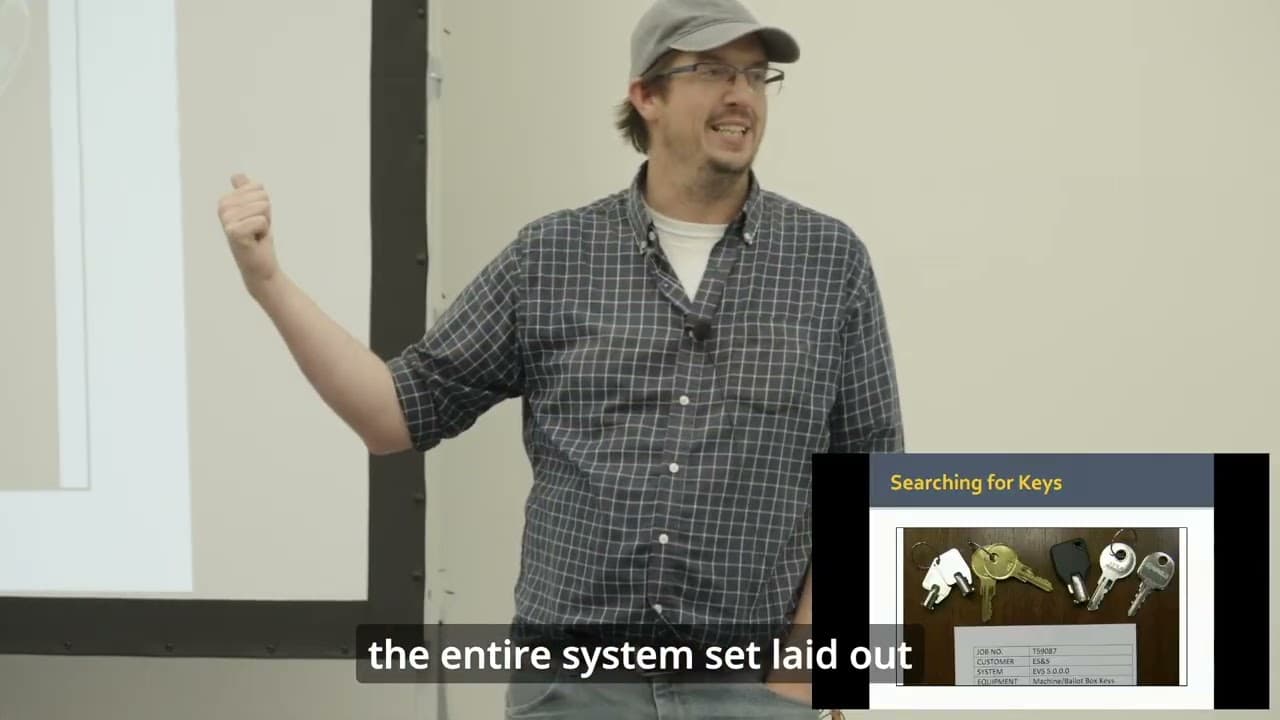
The Fortress Island of Voting System Physical Security
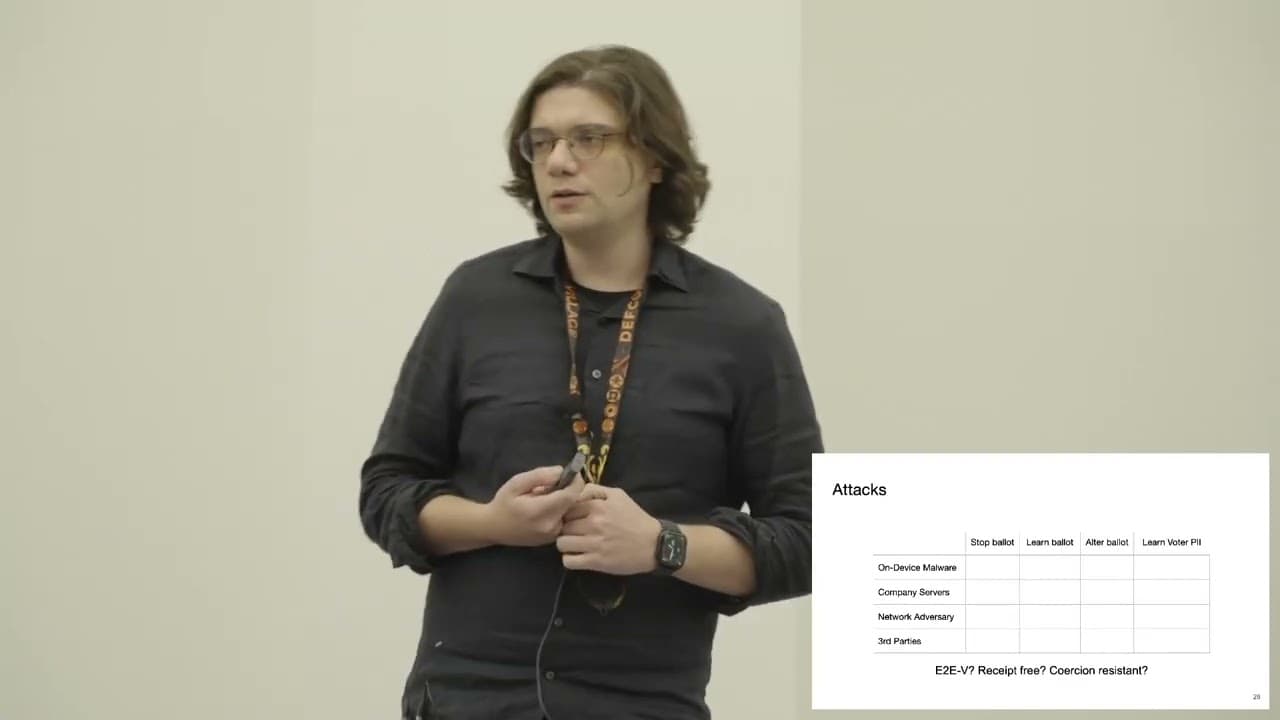
It's Not Safe Yet: Online Voting in Practice
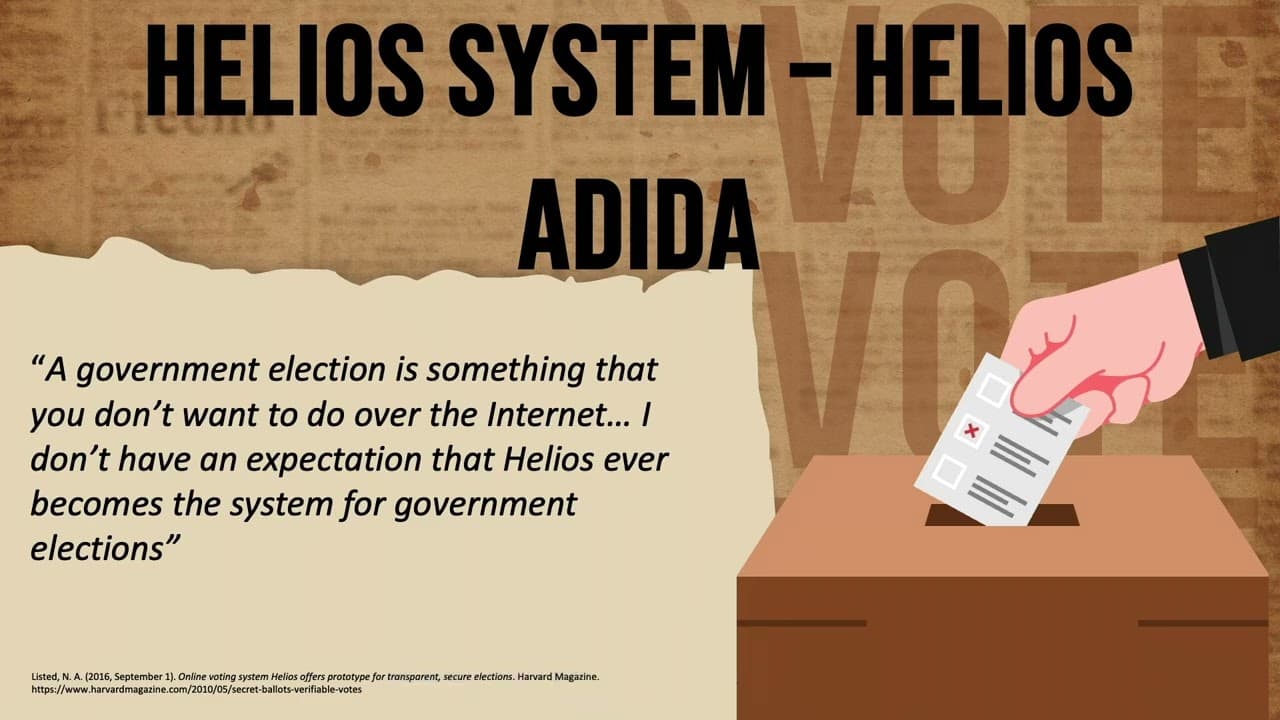
Is End-to-End Verifiability a Magic Bullet for Internet Voting?
Similar Talks
Unmasking the Snitch Puck: The Creepy IoT Surveillance Tech in the School Bathroom
Optical Espionage