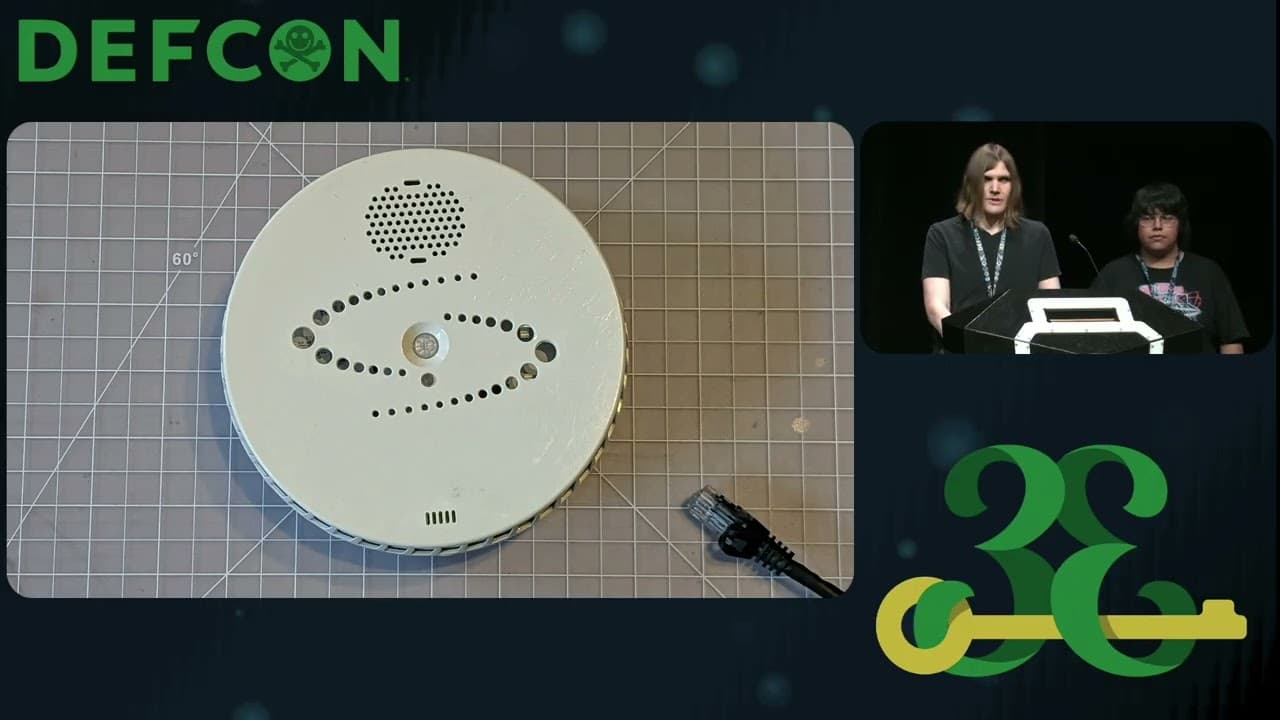
Inside Dash Cam: Custom Protocols and Discovered Zero-Days
This presentation demonstrates multiple zero-day vulnerabilities discovered in various dash cam models, including shell script execution, stack buffer overflows, and OS command injection. The researchers analyze custom communication protocols, firmware update mechanisms, and boot logic to identify these security flaws. The talk provides a practical methodology for performing security assessments on IoT devices, including firmware extraction and dynamic debugging. The findings highlight the critical need for robust input validation and secure communication practices in consumer IoT hardware.
Exploiting Custom Protocols and Boot Logic in Modern Dash Cams
TLDR: Researchers at DEF CON 32 demonstrated how to compromise consumer dash cams by exploiting insecure boot scripts, stack buffer overflows in RTSP handling, and custom communication protocols. These vulnerabilities allow attackers to gain root access, execute arbitrary commands, and bypass authentication mechanisms. Pentesters should prioritize auditing custom binary protocols and boot-time configuration files when assessing IoT hardware.
Consumer IoT devices are notorious for shipping with "developer-friendly" backdoors that never make it to the production-hardened state. The recent research presented at the IoT Village at DEF CON 32 on dash cam security is a masterclass in why we cannot trust the proprietary protocols running on these devices. While we often focus on web-based vulnerabilities, the real-world risk here is physical and privacy-related. If an attacker can gain root access to a dash cam, they control a microphone and camera inside a vehicle, effectively turning a security device into a surveillance tool for the adversary.
The Anatomy of the Compromise
The researchers analyzed nine different dash cam models, categorizing them by their connectivity methods: Bluetooth, Wi-Fi hotspot, and cloud-based communication. The most critical findings centered on how these devices handle firmware updates and boot-time initialization.
One of the most straightforward attack vectors discovered was the abuse of the boot process. Many of these devices execute shell scripts from the SD card during startup. By placing a malicious test.sh file on the SD card, an attacker can force the device to execute arbitrary commands with root privileges as soon as it boots. This is a classic example of CWE-553, where the command execution environment is not properly restricted.
The researchers also identified significant flaws in how these devices handle the RTSP protocol. By crafting malicious RTSP requests, they triggered stack buffer overflows, leading to CWE-121. This allows an attacker to overwrite the program counter and hijack the execution flow. When you combine this with the lack of address space layout randomization (ASLR) on many of these embedded Linux systems, chaining gadgets becomes trivial for a motivated attacker.
Reverse Engineering Custom Protocols
What makes this research particularly useful for the community is the breakdown of custom binary protocols. Many vendors assume that because their protocol is proprietary, it is secure. This is a dangerous fallacy. The researchers used GDB and BusyBox to debug the main binaries on the device, allowing them to map out the request/response structures.
For example, they found that several vendors use a custom format for commands sent from the mobile app to the dash cam. By capturing traffic with tcpdump, they identified that these packets often lack any form of cryptographic signing or even basic authentication. The following structure was observed in one of the analyzed protocols:
00 00 00 01 | 0b 8b 00 08 | 00 00 00 00
In this case, the first four bytes are dummy data, followed by a two-byte command number, and then the parameters. Because the device does not validate the source of these packets, an attacker on the same network can simply replay these packets to trigger functions like cmd=format_sd or rec_start. This is a textbook case of CWE-287, where the device fails to verify the identity of the requester.
Practical Implications for Pentesters
If you are tasked with testing an IoT device, stop looking for web vulnerabilities first. Start by extracting the firmware using binwalk. If the firmware is not encrypted, you have already won half the battle. Once you have the filesystem, look for the startup scripts in /etc/init.d/ or similar directories. If you see scripts that reference files on external storage, you have a potential path to code execution.
During your engagement, use Nmap to identify open ports, but don't stop at the service banners. If you find a proprietary port, use a tool like Frida to hook the application on the mobile device. This allows you to see the data before it is sent over the wire, which is often the fastest way to reverse-engineer a custom protocol without having to spend hours in a disassembler.
Defensive Hardening
For the blue team, the solution is simple but rarely implemented: treat all external input as malicious. If your device supports SD cards, the boot process must be cryptographically signed. If you are using a custom protocol for mobile app communication, you must implement mutual TLS (mTLS) or at least a robust session-based authentication mechanism. Relying on "security through obscurity" by using a proprietary protocol is not a strategy; it is a liability.
The research presented at DEF CON 32 serves as a reminder that the barrier to entry for compromising IoT devices is lower than many manufacturers believe. As researchers, we need to keep pushing for better standards in embedded development. If you are working on a similar device, start by auditing your boot scripts and ensuring that your binary protocols are not just proprietary, but actually authenticated. The next time you pick up a piece of hardware, don't just look for what it does. Look for what it allows you to do when you start asking the wrong questions.
Vulnerability Classes
Target Technologies
Attack Techniques
All Tags
Up Next From This Conference
Breaking Secure Web Gateways for Fun and Profit
Listen to the Whispers: Web Timing Attacks That Actually Work
Abusing Windows Hello Without a Severed Hand
Similar Talks
Kill List: Hacking an Assassination Site on the Dark Web
Hacking Apple's USB-C Port Controller