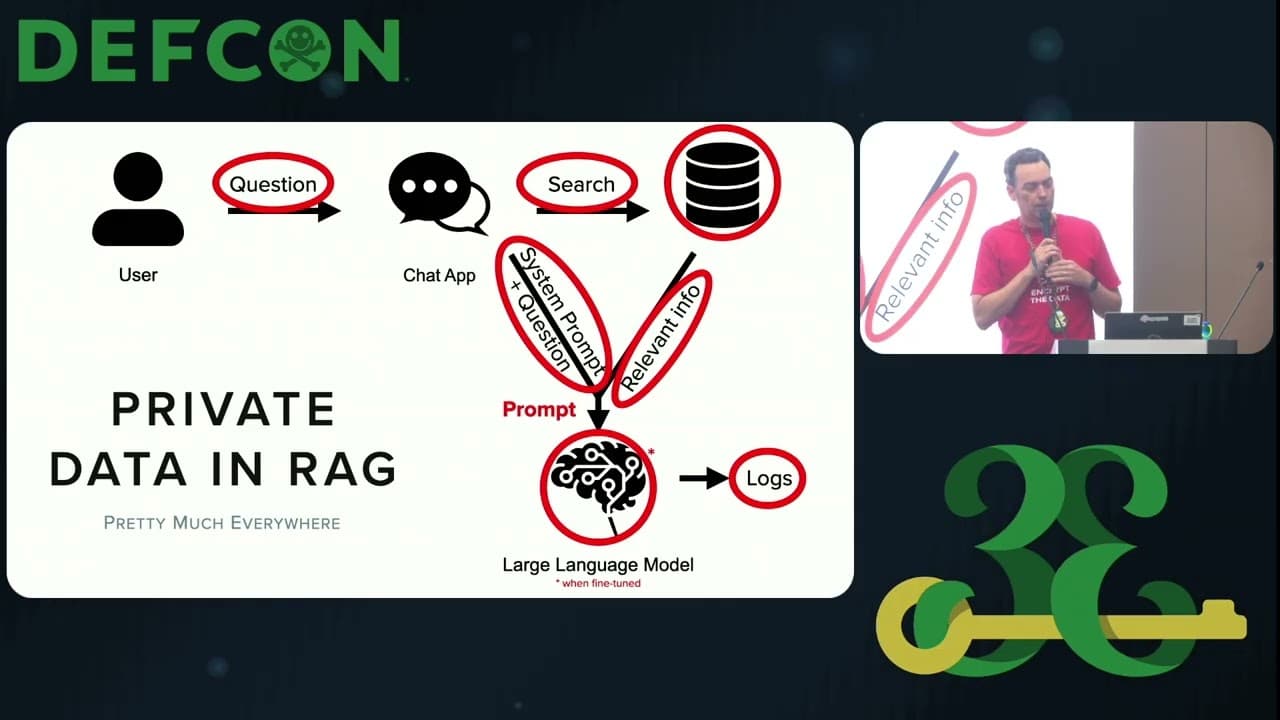
Our Security Skills Are Unbalanced: Effective Communication for Security
This talk addresses the critical gap in communication between security professionals and business leadership, emphasizing the need to quantify risk using threat intelligence. It demonstrates how to map technical vulnerabilities, such as MFT exploitation, to business objectives to secure executive buy-in. The speaker provides a framework for using the MITRE ATT&CK matrix to prioritize security investments based on impact and exposure. The presentation focuses on strategic alignment rather than specific exploit code.
Why Your MFT Infrastructure is the Easiest Path to Ransomware
TLDR: Managed File Transfer (MFT) software is frequently exposed to the internet and handles highly sensitive data, making it a prime target for attackers. Recent incidents involving CVE-2023-0669 demonstrate how easily these platforms can be compromised to facilitate data exfiltration and ransomware deployment. Security teams must prioritize these assets in their threat modeling and ensure they are not just another forgotten, internet-facing box in the DMZ.
Security professionals often obsess over the latest zero-day in a browser or a complex chain of vulnerabilities in a web application. While those are important, the most effective path to a full domain compromise is often the most boring piece of infrastructure in the network. Managed File Transfer (MFT) software is the perfect example. It sits at the intersection of business-critical data and internet exposure, yet it rarely receives the same scrutiny as a customer-facing web portal.
The MFT Attack Surface
MFT platforms are designed to move data between internal systems and external business partners. By definition, they must be accessible. They are often deployed in the DMZ, configured with broad network access to internal file shares, and managed by service accounts with high privileges. If you are a pentester, you know exactly what this looks like: a single point of failure that, if compromised, provides immediate access to the crown jewels.
Attackers understand this architecture better than most internal security teams. When they target an MFT solution, they are not looking for a complex exploit chain. They are looking for T1190—Exploit Public-Facing Application. Once they gain a foothold, they move quickly to T1059—Command and Scripting Interpreter, often using the MFT service account to execute commands directly on the underlying Windows or Linux host.
The mechanical reality of these attacks is straightforward. An attacker identifies a vulnerable MFT instance, exploits a remote code execution vulnerability, and drops a web shell. Because the MFT service is already running with the necessary permissions to read and write files across the network, the attacker does not need to perform complex privilege escalation. They are already in the position to perform T1078—Valid Accounts, using the service account to traverse the network, harvest credentials, and eventually deploy ransomware.
Mapping Technical Risk to Business Impact
The biggest failure in modern security is the inability to communicate this risk to the people who sign the checks. When you tell a CISO that you found a vulnerability in an MFT server, they might hear "a bug in a file transfer tool." They do not hear "a direct path to a multi-million dollar ransomware event."
To bridge this gap, you have to stop talking about the vulnerability and start talking about the business objective. Use the MITRE ATT&CK framework not as a checklist for your report, but as a language to describe the attacker's path to the company's goals. If the company's goal is to protect revenue, show how an MFT compromise leads to data exfiltration, which leads to extortion, which leads to a direct hit on the bottom line.
When you are on an engagement, do not just report the RCE. Map it. Show the path from the internet-facing MFT instance to the domain controller. If you can demonstrate that the MFT service account has read access to the Active Directory database or sensitive cloud storage buckets, you have successfully quantified the risk. This is how you get security initiatives funded. You are not asking for money to patch a server; you are asking for money to close a massive, high-impact hole in the business's defensive perimeter.
Defensive Priorities
Defending MFT infrastructure requires a shift in focus from perimeter security to internal visibility. You cannot rely on the vendor to keep the software secure. You must assume that an attacker will eventually find a way in.
- Restrict Network Access: If the MFT server does not need to talk to the domain controller, ensure it cannot. Use micro-segmentation to isolate the MFT instance from the rest of the internal network.
- Monitor Service Accounts: The service account running the MFT software is the most dangerous account in your environment. Monitor its behavior for any activity that deviates from standard file transfer operations. If it starts spawning
cmd.exeorpowershell.exe, you are already being compromised. - Audit Exposure: Use tools like Shodan to see what the rest of the world sees. If your MFT interface is exposed to the entire internet, you are inviting trouble. If it must be exposed, put it behind a robust authentication proxy or a VPN.
The Path Forward
We are currently in an era where cybercrime is a highly profitable, scalable business. Attackers are not just throwing random exploits at the wall; they are targeting the infrastructure that provides the highest return on investment. MFT platforms are high-value, high-exposure assets that are consistently under-defended.
Stop treating these systems as "just another server." Treat them as the critical infrastructure they are. If you are a researcher, look for the next CVE-2023-0669 in these platforms. If you are a pentester, make them the first target on your list. The gap between a technical vulnerability and a business disaster is smaller than you think, and it is our job to make sure the business understands that before the attackers do.
CVEs
Vulnerability Classes
Tools Used
Target Technologies
Attack Techniques
OWASP Categories
Up Next From This Conference
Similar Talks
Kill List: Hacking an Assassination Site on the Dark Web
Counter Deception: Defending Yourself in a World Full of Lies