Preparing the Long Journey for Data Security
This presentation analyzes the evolving landscape of data security in China, focusing on the shift from perimeter-based defense to data-centric security models. It details the regulatory framework, including the Cyber Security Law and Data Security Law, and discusses the implementation of data classification, categorization, and privacy-enhancing technologies. The speaker highlights the challenges of achieving automated data governance and the role of emerging technologies like federated learning and secure multi-party computation in protecting data throughout its lifecycle.
Data Security at Scale: Why Perimeter Defense is Failing
TLDR: Modern data security is shifting from network-level perimeter defense to data-centric models, driven by massive regulatory changes and the rise of cloud-native architectures. This transition forces organizations to implement granular data classification and privacy-enhancing technologies like secure multi-party computation. For researchers and pentesters, this means the focus is moving away from simple network exploitation toward bypassing data-access controls and manipulating data-processing pipelines.
Security researchers often get tunnel vision, focusing on the latest RCE or a clever bypass in an authentication flow. While those bugs are critical, the broader architectural shift happening in enterprise data security is arguably more consequential for the next five years of offensive research. The industry is moving away from the "castle and moat" model—where once you are inside the network, you own the data—toward a model where data itself is the perimeter.
This shift is not just a marketing trend. It is being forced by aggressive regulatory frameworks, such as the Data Security Law of the People's Republic of China, which treats data as a fundamental factor of production. When governments mandate that data must be classified, categorized, and protected throughout its entire lifecycle, the attack surface changes. For a pentester, this means that finding a way to exfiltrate data now requires navigating complex, automated data-access controls rather than just finding an open SMB share.
The Death of Perimeter-Only Security
Traditional security testing often stops at the network boundary. If you can reach a database, you try to dump it. If you can reach an API, you try to fuzz it. But as organizations move toward data-centric architectures, they are deploying tools like Cloud Access Security Brokers (CASB) and automated data-classification engines. These tools are designed to detect and block unauthorized access to sensitive data, even if the attacker has valid credentials or network access.
The real-world risk today is that these controls are often implemented in a fragmented way. You might have a robust CASB policy for your cloud storage, but your on-premise ERP system remains a blind spot. During an engagement, the most effective path is often identifying the "seams" between these security layers. If a company uses a centralized data-management platform to enforce access, that platform becomes the single point of failure. If you can compromise the management plane, you effectively bypass the data-centric controls for the entire organization.
Technical Realities of Data-Centric Defense
One of the most interesting developments is the push for Secure Multi-Party Computation (SMPC) and federated learning. These techniques allow organizations to process data without ever decrypting it in a central location. From an offensive perspective, this is a massive hurdle. You can no longer rely on simple memory dumping to extract cleartext data. Instead, you have to look for vulnerabilities in the implementation of the computation logic itself.
Consider the Data-Clock approach mentioned in recent research. By using a local sandbox to isolate data access, the system prevents malware from touching the actual data. If you are testing such a system, your goal is no longer to "break the sandbox" in the traditional sense. You are looking for side-channel attacks or logic flaws in the API that handles the data requests. If the API allows you to request data in a way that leaks information about the underlying dataset—even if the data itself is encrypted—you have achieved a successful exfiltration.
Where Pentesters Should Look
During your next assessment, stop treating the database as the final destination. Start treating it as a component of a larger data-processing pipeline. Look for:
- Data Classification Gaps: Are there datasets that are marked as "public" but contain metadata that could be used to reconstruct sensitive information?
- API Logic Flaws: Does the data-access API enforce the same level of security as the primary application? Often, internal APIs used for data analytics are less scrutinized than the public-facing ones.
- Credential Stuffing on Management Planes: If a company uses a centralized platform to manage data access, that platform's admin credentials are the keys to the kingdom.
The defensive side is also evolving. Defenders are moving toward Data Loss Prevention (DLP) solutions that are integrated directly into the application layer, rather than just sitting on the network edge. This makes it harder to use traditional exfiltration techniques like DNS tunneling or large-scale HTTP POST requests.
The Path Forward
We are entering an era where the "long journey for data security" is becoming a reality for every major enterprise. The days of relying on a firewall to protect your data are numbered. As a researcher, you need to adapt your methodology. The vulnerabilities of the future will not be found in the network stack; they will be found in the logic that governs how data is accessed, processed, and shared.
Start digging into the documentation for the data-governance tools your clients are using. Understand how they classify data and what the automated enforcement mechanisms look like. If you can find a way to trick the classification engine into mislabeling a sensitive dataset as "public," you have found a vulnerability that no firewall can stop. The game is changing, and the researchers who understand the data layer will be the ones finding the most critical bugs.
Vulnerability Classes
Tools Used
Target Technologies
Attack Techniques
OWASP Categories
All Tags
Up Next From This Conference

A New Attack Interface In Java Applications
Inference Attacks on Endpoint Privacy Zones in Fitness Tracking Social Networks

Abusing Azure Active Directory: From MFA Bypass to Listing Global Administrators
Similar Talks

Surveilling the Masses with Wi-Fi Positioning Systems
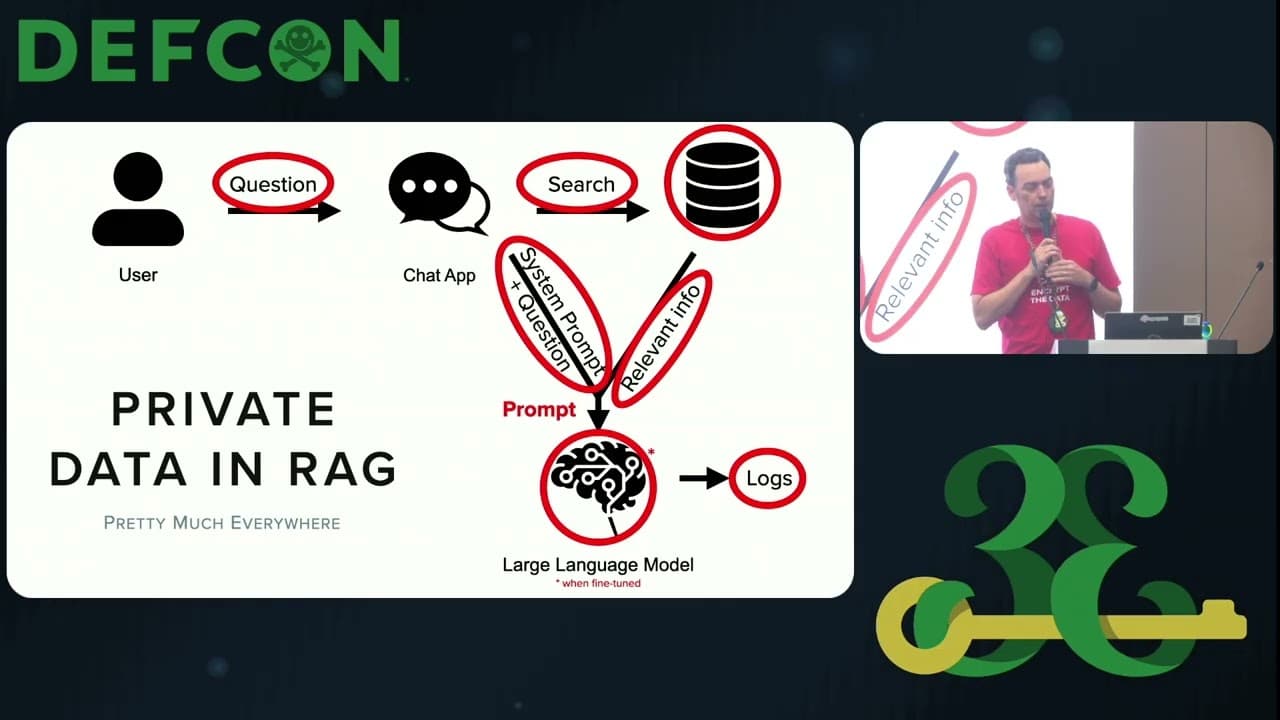
Exploiting Shadow Data in AI Models and Embeddings