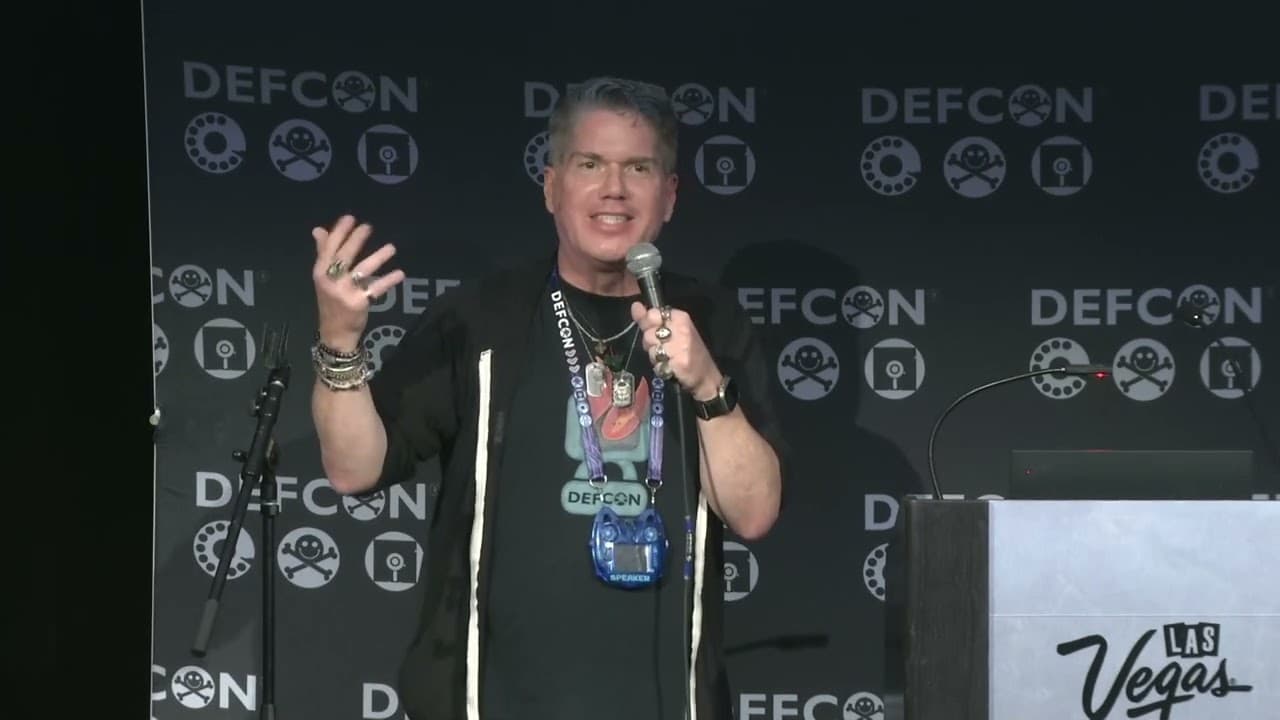
Stranger in a Changed Land
This talk provides a high-level retrospective on the evolution of cybersecurity defense strategies from the perspective of a long-term practitioner. It examines the interplay between offensive and defensive operations, emphasizing that effective security requires systemic information management rather than just technical point solutions. The speaker argues that defense is an economic and psychological challenge, and that successful mitigation requires aligning incentives and understanding the attacker's operational patterns.
Why Your Defensive Strategy is Failing Against Modern Attackers
TLDR: Most organizations treat cybersecurity as a series of point-in-time technical fixes rather than a continuous information management problem. Attackers do not rely on magic; they exploit predictable patterns in human behavior, configuration, and resource allocation. To actually improve, you must stop treating defense as a secondary concern and start mapping your defensive posture against the attacker's economic and operational incentives.
Security research often focuses on the "how"—the specific exploit chain, the bypass, or the zero-day. We spend our careers obsessing over the mechanics of a buffer overflow or the nuances of a cross-site scripting payload. Yet, after fifteen years in the trenches, it is clear that the most dangerous vulnerabilities are not in the code, but in the strategy. If you are a pentester or a researcher, you know that finding a bug is the easy part. Getting that bug fixed, and ensuring the underlying systemic issue is addressed, is where the real work happens.
The Myth of the Magical Attacker
We often talk about "threat actors" as if they are omnipotent wizards capable of bypassing any control at will. This narrative is dangerous because it encourages a defeatist attitude. In reality, attackers are constrained by the same things we are: budgets, time, and risk tolerance. They do not perform magic. They perform reconnaissance, they identify a path of least resistance, and they execute a repeatable pattern.
When you look at the MITRE ATT&CK framework, you see a map of these patterns. Attackers are looking for T1592 to gather information about your organization and T1595 to scan for vulnerabilities. They are not inventing new physics; they are simply better at managing the information flow than the defenders are. If you treat the attacker as a magician, you will always be one step behind. If you treat them as a business entity with a P&L statement, you can start to predict their next move.
Defense as an Information Management Problem
Cybersecurity is not an event, a tool, or a training module. It is an information machine. Every vulnerability you find is a data point. If that data point does not move through your organization to a decision-maker who has the authority and the budget to fix it, you have failed.
Many of us in the industry are guilty of "red teaming" for the sake of the report. We find a critical vulnerability, we document it, we present it, and we move on. But if the organization does not have a process to translate that finding into a configuration change, a policy update, or a resource reallocation, the vulnerability remains. The verb that matters is not "share"—it is "translate." You must translate the technical risk of a CVE-2024-21413 into a business risk that a non-technical leader can understand. If you cannot do that, you are just shouting into the void.
The 80/20 Rule of Defensive Choices
We have a limited number of defensive choices, and we often waste them on low-impact activities. The Pareto Principle applies here with brutal efficiency: 80% of your security impact comes from 20% of your defensive efforts.
When you are on an engagement, look at the client's environment. Are they spending their time on high-value configuration management, or are they chasing ghosts in the logs? Most organizations are doing the latter. They are obsessed with the latest shiny tool while their basic hygiene—patch management, identity access control, and network segmentation—is in shambles. As defined by the OWASP Top 10, the most common vulnerabilities are still the ones that have been around for decades. We are not losing because we lack tools; we are losing because we lack the discipline to execute the basics.
Why Your Red Team Might Be a Distraction
Red teaming is a fantastic way to test your defenses, but it can also be a massive distraction. When a company brings in a red team, the focus often shifts to the "game" of the engagement. Everyone wants to see if the red team can get "domain admin." While that is a valid test, it often ignores the reality of how a real attacker operates.
A real attacker is not trying to win a game; they are trying to achieve a goal with minimal effort. If they can get what they want by compromising a low-level service account or a misconfigured cloud bucket, they will do that every time. They don't care about your "crown jewels" if the path of least resistance leads elsewhere. As a pentester, your job is to show the client that path. If you only focus on the high-profile, complex attack chains, you are doing your client a disservice. Show them the boring, mundane, and highly effective ways they are currently exposed.
Moving Forward
The next time you are writing a report, ask yourself: "Am I just listing bugs, or am I providing a roadmap for change?" Your goal should be to make the attacker's job as expensive and uncertain as possible. Attackers hate uncertainty. They hate having to guess whether a specific payload will trigger an alert or if a specific path is monitored.
Stop trying to solve the entire problem at once. Pick one area—identity, configuration, or patch management—and build a system that makes that area resilient. Use the CIS Controls as a starting point, not a destination. They provide a prioritized set of actions that actually move the needle. The goal is not to be perfect; the goal is to be better than you were yesterday. And remember, you are part of a larger ecosystem. The information you gather, the bugs you find, and the strategies you develop are all part of a collective effort to make the digital world a slightly less dangerous place. Keep digging, keep translating, and keep pushing for the systemic changes that actually matter.
Attack Techniques
Up Next From This Conference
Breaking Secure Web Gateways for Fun and Profit
Listen to the Whispers: Web Timing Attacks That Actually Work