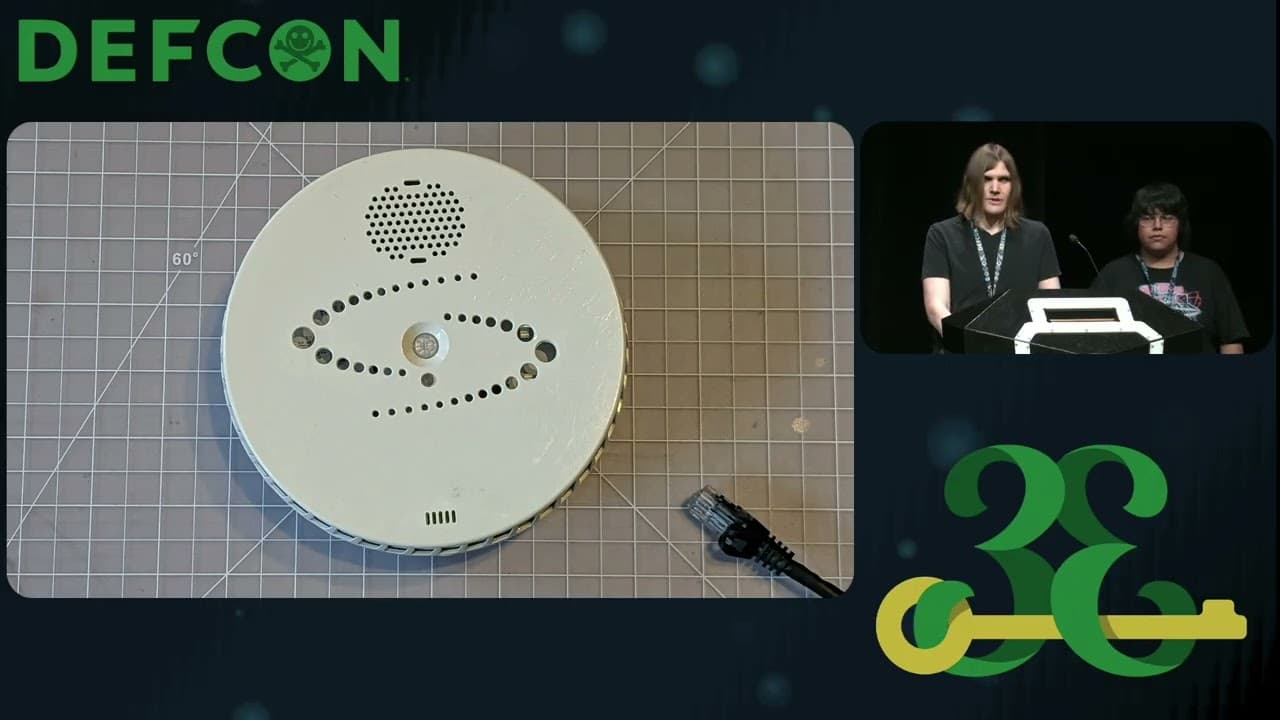
Your Smartcard is Dumb: A Brief History of Hacking Access Control Systems
This talk demonstrates various physical and electronic attack techniques against common smartcard-based access control systems, including magstripe, proximity cards, and NFC-based memory cards. It highlights vulnerabilities such as unencrypted Wiegand protocols, predictable key management, and side-channel analysis of embedded microcontrollers. The speaker emphasizes the importance of secure hardware design and the potential for modern smartphones to act as more secure, multi-functional alternatives to traditional access cards. The presentation includes practical demonstrations of bypassing maglocks and cloning vulnerable RFID credentials.
Why Your Office Badge Is Just a Vulnerable Microcontroller
TLDR: Most corporate access control systems rely on legacy RFID and NFC cards that lack robust encryption, making them trivial to clone with tools like the Flipper Zero. This talk breaks down the mechanical and electronic weaknesses of these systems, from unencrypted Wiegand protocols to side-channel attacks on embedded microcontrollers. For security professionals, the takeaway is clear: stop treating physical access as a solved problem and start auditing your facility's badge readers as rigorously as your web applications.
Physical security is often the neglected stepchild of a penetration test. We spend weeks hunting for blind SQL injection or complex deserialization chains, yet we walk through the front door of a high-security facility by simply waving a piece of plastic. The reality is that most access control systems are essentially high-school-level electronics projects that have been deployed at scale. They are not designed to withstand a motivated researcher, and they certainly are not designed to withstand the current generation of portable hardware hacking tools.
The Anatomy of a Failure
At the heart of the problem is the Wiegand protocol. It is an ancient, unencrypted, two-wire communication standard that connects the card reader to the controller board. When you tap your badge, the reader sends a stream of pulses representing the card's ID. Because there is no handshake or encryption, any device capable of sniffing or replaying these pulses can impersonate a valid credential.
The attack surface expands significantly when you look at the cards themselves. Proximity cards operating at 125 kHz are essentially broadcast beacons. They do not require a challenge-response mechanism; they simply dump their ID whenever they are within range of an electromagnetic field. If you are performing a red team engagement, you do not need to get close to the target. A high-gain antenna hidden in a backpack or a briefcase can sniff these IDs from several feet away, allowing you to clone the credential onto a blank card or a device like the Flipper Zero in seconds.
Moving Beyond Simple Cloning
While proximity cards are the low-hanging fruit, the research presented highlights that even "smarter" cards like the MIFARE Classic are fundamentally broken. These cards use proprietary, weak encryption that has been reverse-engineered to the point of triviality. Using tools like mfcuk, a researcher can brute-force the keys required to read the card's memory sectors.
The technical nuance here lies in the side-channel analysis of the card's microcontroller. By monitoring power consumption or timing variations during cryptographic operations, an attacker can extract the secret keys. Once you have the keys, you have full read and write access to the card. You are no longer just cloning an ID; you are modifying the data stored on the card, which can include balance information for cashless payment systems or specific access levels for restricted areas.
The Hardware Reality
The most compelling part of this research is the shift toward using smartphones as secure, multi-functional alternatives to traditional badges. Modern smartphones contain a Secure Element, a tamper-resistant chip that acts as a hardware-backed vault for cryptographic keys. Unlike a standard proximity card, the Secure Element can perform complex, asymmetric cryptographic operations.
When you use your phone for access, you are not just broadcasting an ID. You are engaging in a challenge-response protocol where the phone proves its identity without ever exposing the underlying private key. This is the same technology that powers mobile payments. If a company were to move their access control infrastructure to leverage these secure elements, they would effectively eliminate the threat of cloning.
Defensive Realities for the Enterprise
If you are a security lead or a consultant, your immediate priority should be an audit of the card readers currently deployed in your environment. If your readers are still using 125 kHz proximity technology, you are effectively operating without any meaningful access control. The transition to high-frequency, encrypted cards like MIFARE DESFire or HID iCLASS SE is mandatory.
However, even with encrypted cards, the implementation matters. If the system is configured to fall back to legacy protocols for compatibility, you have not actually improved your security posture. You have simply created a more complex system that is still vulnerable to the same old attacks.
For the pentester, the next time you are on-site, look at the reader. If it is a legacy model, do not just assume it is secure because it looks modern. Check the frequency, look for the Wiegand wiring, and test for replay vulnerabilities. The industry has spent years ignoring the physical layer, and it is time we started treating it with the same level of scrutiny we apply to our digital infrastructure. Access control is not just about keeping people out; it is about ensuring that the credentials we issue are actually tied to the people who hold them. If you cannot verify the integrity of the badge, you cannot verify the identity of the user.
Vulnerability Classes
Tools Used
Target Technologies
Attack Techniques
OWASP Categories
All Tags
Up Next From This Conference
Breaking Secure Web Gateways for Fun and Profit
Listen to the Whispers: Web Timing Attacks That Actually Work
Abusing Windows Hello Without a Severed Hand
Similar Talks
Kill List: Hacking an Assassination Site on the Dark Web
Hacking Apple's USB-C Port Controller