Cybersecurity Policy and National Security
This talk discusses the intersection of national security, cybersecurity policy, and the role of private industry in defending critical infrastructure. It highlights the challenges of attribution, the impact of ransomware on public services, and the necessity of public-private partnerships in threat intelligence sharing. The speakers emphasize the importance of proactive vulnerability management and the potential for AI-driven tools to assist in defensive security operations.
The Strategic Failure of Ransomware Response and the Myth of Attribution
TLDR: Ransomware attacks against critical infrastructure are not just technical failures but systemic ones that expose the fragility of our digital supply chain. While attribution remains a political theater, the real issue for researchers and defenders is the lack of standardized, rapid recovery protocols across fragmented sectors. Pentesters should shift focus from simple perimeter exploitation to mapping the blast radius of supply chain dependencies that allow a single breach to paralyze entire regional services.
Modern cybersecurity discourse is obsessed with the "who" while ignoring the "how" of systemic collapse. When we look at the recent wave of attacks against water and power infrastructure, the industry often defaults to a tired narrative of state-sponsored actors. While the geopolitical implications are real, the technical reality is far more mundane and dangerous. We are seeing a pattern where attackers leverage T1190-exploit-public-facing-app to gain an initial foothold, followed by T1486-data-encrypted-for-impact to force a ransom demand. The problem is not that we lack the intelligence to identify these groups; the problem is that our defensive architecture is fundamentally incapable of containing the impact once the perimeter is breached.
The Illusion of Attribution in Digital Warfare
Attribution is often treated as the holy grail of incident response, yet for the researcher on the ground, it is frequently a distraction. When a hospital system is encrypted, the immediate priority is not identifying the specific threat group’s preferred TTPs or their geographic origin. The priority is the restoration of life-critical services. We have built a system where private industry is expected to defend against nation-state capabilities, yet we lack the unified, cross-sector protocols to handle the fallout.
From a red team perspective, the most effective way to demonstrate risk is not by showing how you can pop a shell on a single server. It is by mapping the dependencies that allow a single compromised credential to cascade into a total operational shutdown. If you are testing a client in the critical infrastructure space, your scope should include the interdependencies between their IT and OT environments. The most critical vulnerabilities are rarely zero-days in the core software; they are the misconfigured VPNs, the lack of network segmentation between business and control networks, and the absence of a verified, air-gapped backup strategy.
Supply Chain Fragility and the Blast Radius
The recent CrowdStrike incident serves as a stark reminder of how quickly a single point of failure can cripple global operations. While that was a configuration error rather than a malicious attack, the technical lesson for researchers is identical: the blast radius of our software supply chain is massive. When we talk about OWASP A06:2021-Vulnerable and Outdated Components, we are usually thinking about a library in a web app. We need to start thinking about the entire ecosystem of agents, drivers, and management tools that sit with kernel-level access on our most critical systems.
For those of us performing penetration tests, the goal is to identify where these dependencies exist. If you can compromise a management console or a centralized update server, you have effectively bypassed the need to target individual endpoints. This is the modern equivalent of the "keys to the kingdom." Defenders need to prioritize the hardening of these centralized management platforms above almost everything else. If your update mechanism is not as secure as your most sensitive production database, you have already lost.
Moving Beyond the Perimeter
Defensive security has spent too long focused on the "keep them out" mentality. The reality is that the perimeter is porous, and the supply chain is inherently trusted. We need to move toward a model of assumed breach, where the focus is on limiting the movement of an attacker once they are inside. This means implementing strict micro-segmentation and, more importantly, investing in the boring, unglamorous work of incident response and recovery.
If you are a researcher, stop chasing the high-profile CVEs that everyone else is already patching. Start looking at the configuration of the tools that manage the infrastructure. Look at the NVD database for vulnerabilities in the management software that your clients use to monitor their networks. Often, these tools have massive attack surfaces and are rarely audited with the same rigor as the applications they manage.
The path forward is not more complex security tools that promise to solve everything with AI. The path forward is a return to the fundamentals of architecture: least privilege, network isolation, and a recovery plan that has been tested under fire. We need to stop treating security as a checkbox and start treating it as an engineering discipline. If we continue to build systems that are fragile by design, no amount of threat intelligence or attribution will save us from the next inevitable collapse. The next time you are on an engagement, ask yourself: if I were to trigger a full-scale encryption event right now, how long would it actually take for this organization to be back online? If the answer is "we don't know," you have found your most critical finding.
Vulnerability Classes
Target Technologies
Attack Techniques
Up Next From This Conference
Breaking Secure Web Gateways for Fun and Profit
Listen to the Whispers: Web Timing Attacks That Actually Work
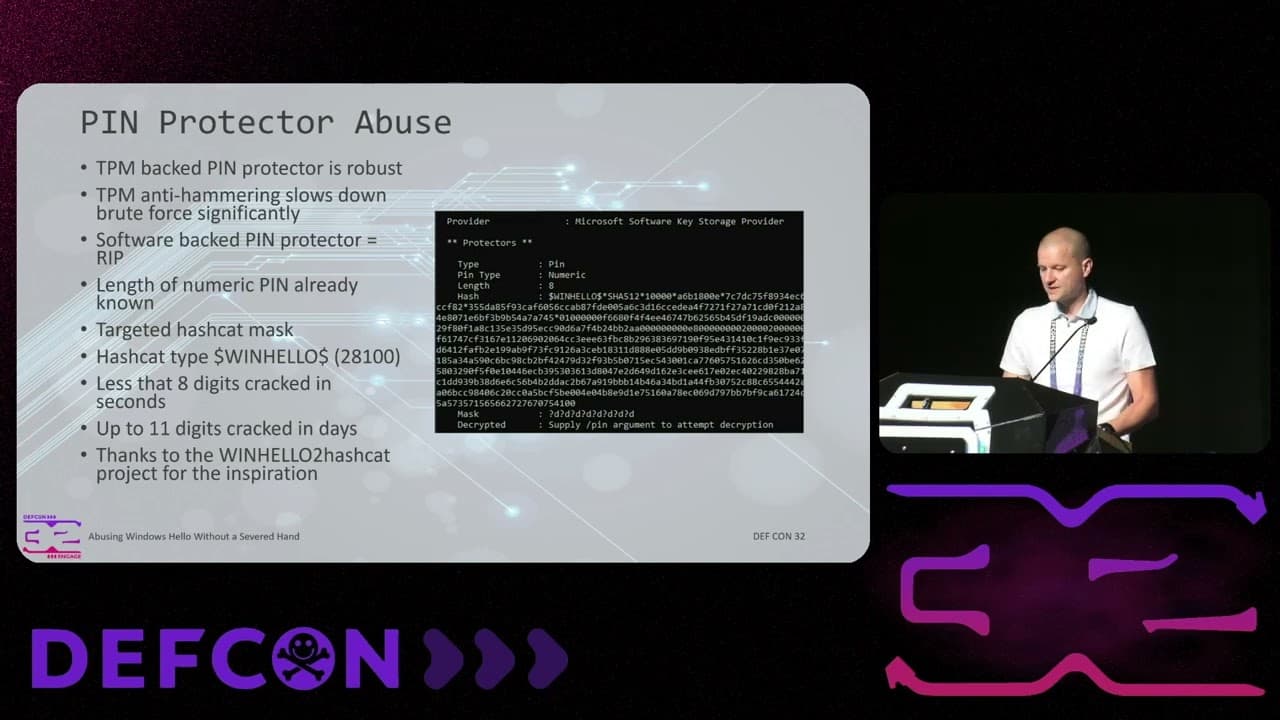
Abusing Windows Hello Without a Severed Hand
Similar Talks

Kill List: Hacking an Assassination Site on the Dark Web

Unmasking the Snitch Puck: The Creepy IoT Surveillance Tech in the School Bathroom