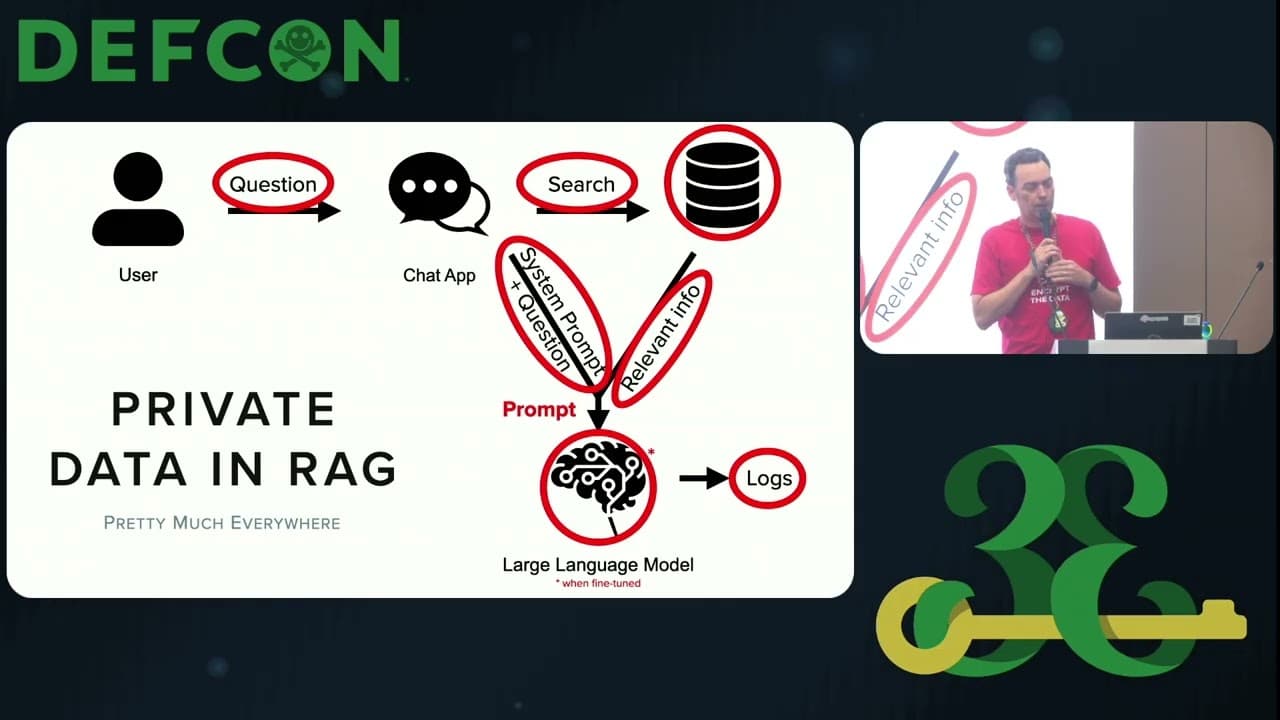
Hooks and Hooks: How AI is Revolutionizing Both Phishing Attacks and Our Defenses
This talk explores the dual-use nature of AI in the context of phishing, demonstrating how large language models (LLMs) can be used to generate highly personalized, grammatically flawless phishing content at scale. It highlights how attackers leverage AI for reconnaissance and automated, adaptive phishing campaigns, while simultaneously discussing how defenders can utilize AI for behavioral anomaly detection and predictive threat modeling. The presentation emphasizes the critical need for a security-first culture and multi-layered defense strategies to counter these evolving threats.
AI-Driven Phishing: Why Your Current Awareness Training Is Already Obsolete
TLDR: Large Language Models like ChatGPT are enabling attackers to generate hyper-personalized, grammatically perfect phishing lures at scale, effectively bypassing traditional email security filters and human detection. This shift moves phishing from a volume-based game to a precision-based operation that leverages public reconnaissance data. Pentesters and security teams must pivot from generic awareness training to testing against these adaptive, AI-generated threats.
Phishing has long been the low-hanging fruit of the offensive security world. For years, we relied on the "Nigerian Prince" heuristic: if the grammar was poor, the sender address was suspicious, or the urgency was manufactured, the email was a phish. We built awareness programs around these indicators. We taught users to hover over links and look for typos. That era is over. The integration of LLMs into the attacker toolkit has turned phishing into a high-fidelity, personalized attack vector that renders most traditional awareness training useless.
The Mechanics of AI-Powered Reconnaissance
Attackers are no longer just blasting generic templates to thousands of recipients. They are using LLMs to synthesize public information—LinkedIn profiles, conference speaker bios, and social media activity—to craft lures that are indistinguishable from legitimate business communication.
The process is straightforward. An attacker scrapes a target’s professional footprint, feeds that data into a model, and requests a phishing email tailored to the target’s specific role, recent projects, or professional interests. The result is a message that passes the "sniff test" for even the most vigilant employees. Because the content is generated on the fly, it lacks the static signatures that traditional Secure Email Gateways (SEGs) look for.
When you combine this with T1593-search-open-technical-databases and T1589-gather-victim-org-email-addresses, the reconnaissance phase becomes a force multiplier. An attacker can now generate a hundred unique, highly convincing emails in the time it used to take to write one.
Moving Beyond Static Lures
The most dangerous aspect of this evolution is the move toward polymorphic phishing. In a typical engagement, we see attackers using AI to adapt their messaging in real-time based on the target's interaction. If a user clicks a link but fails to enter credentials, the AI can generate a follow-up email that adjusts the tone or the pretext to increase the likelihood of success.
This is not just about text. Tools like HeyGen allow for the creation of deepfake video content that can be used in business email compromise (BEC) scenarios. Imagine receiving a video message from your CEO, complete with their voice and mannerisms, requesting an urgent wire transfer or a change in payroll details. The technical barrier to entry for these attacks has dropped to near zero.
For a pentester, this means your phishing simulations need to evolve. Sending a generic "password reset" email is no longer a valid test of an organization's resilience. You need to simulate the adversary's new workflow:
- Perform deep reconnaissance on the target.
- Use an LLM to draft a context-aware lure.
- Deploy a multi-stage attack that adapts to user behavior.
The Defensive Reality Check
Defenders are currently fighting a losing battle if they rely solely on static rules and user training. Behavioral anomaly detection is the only viable path forward. You need to monitor for deviations in communication patterns rather than just scanning for malicious keywords. If an executive who typically communicates via short, direct emails suddenly sends a long, flowery request for sensitive data, your system should flag it, regardless of whether the email contains a known malicious link.
Furthermore, organizations must implement OWASP A07:2021 – Identification and Authentication Failures controls that go beyond simple passwords. Phishing is designed to harvest credentials; if your authentication flow is susceptible to session token theft or lacks robust MFA, the phishing lure is just the first step in a much larger compromise.
What Comes Next
The arms race between AI-driven phishing and AI-powered defense is accelerating. We are seeing a shift where the cost of creating a sophisticated attack is plummeting, while the cost of defending against it is skyrocketing.
Stop treating phishing as a static problem. If you are a researcher, start investigating how to poison the datasets that these models use for reconnaissance. If you are a pentester, start incorporating AI-generated lures into your engagements to see if your clients can actually detect them. The goal is not to see if your users can spot a typo, but to see if they can identify a contextually accurate, highly personalized attempt to compromise their identity. The next time you run a phishing campaign, ask yourself: would I fall for this if it were written by a machine that knew everything about my professional life? If the answer is yes, your current strategy is already failing.
Vulnerability Classes
Target Technologies
Attack Techniques
OWASP Categories
Up Next From This Conference


Similar Talks

Kill List: Hacking an Assassination Site on the Dark Web
Counter Deception: Defending Yourself in a World Full of Lies