
How not to IoT: Lessons in IoT security failures
This talk demonstrates multiple security vulnerabilities in low-cost IoT devices, including hardcoded credentials, insecure Wi-Fi credential provisioning, and command injection flaws. The speaker highlights the prevalence of these issues in consumer-grade hardware like smart doorbells, robot vacuums, and Android TV boxes. The presentation emphasizes the lack of security updates and the persistence of legacy vulnerabilities in the IoT ecosystem. A practical demonstration of exploiting a Zyxel NAS device using command injection and Metasploit is provided.
Why Your Next IoT Pentest Should Start with a Logic Check
TLDR: Modern IoT security remains a disaster because manufacturers prioritize connectivity over basic hardening, often leaving debug logs, hardcoded credentials, and insecure provisioning flows exposed. This post breaks down how to identify these low-hanging fruit vulnerabilities in consumer hardware like smart doorbells and NAS devices. By focusing on insecure Wi-Fi pairing and command injection, researchers can bypass authentication and gain full system access without needing complex memory corruption exploits.
Security researchers often get distracted by the allure of memory corruption, hunting for stack overflows or ROP chains in every binary they encounter. While those vulnerabilities are undeniably critical, the reality of the current IoT ecosystem is far more mundane. Most consumer-grade devices are not being compromised by sophisticated, multi-stage exploits. They are being owned because they ship with debug logs that leak Wi-Fi credentials in plaintext, or because they use insecure provisioning flows that allow anyone with physical access to reset the device and take control.
The Low-Hanging Fruit of IoT Provisioning
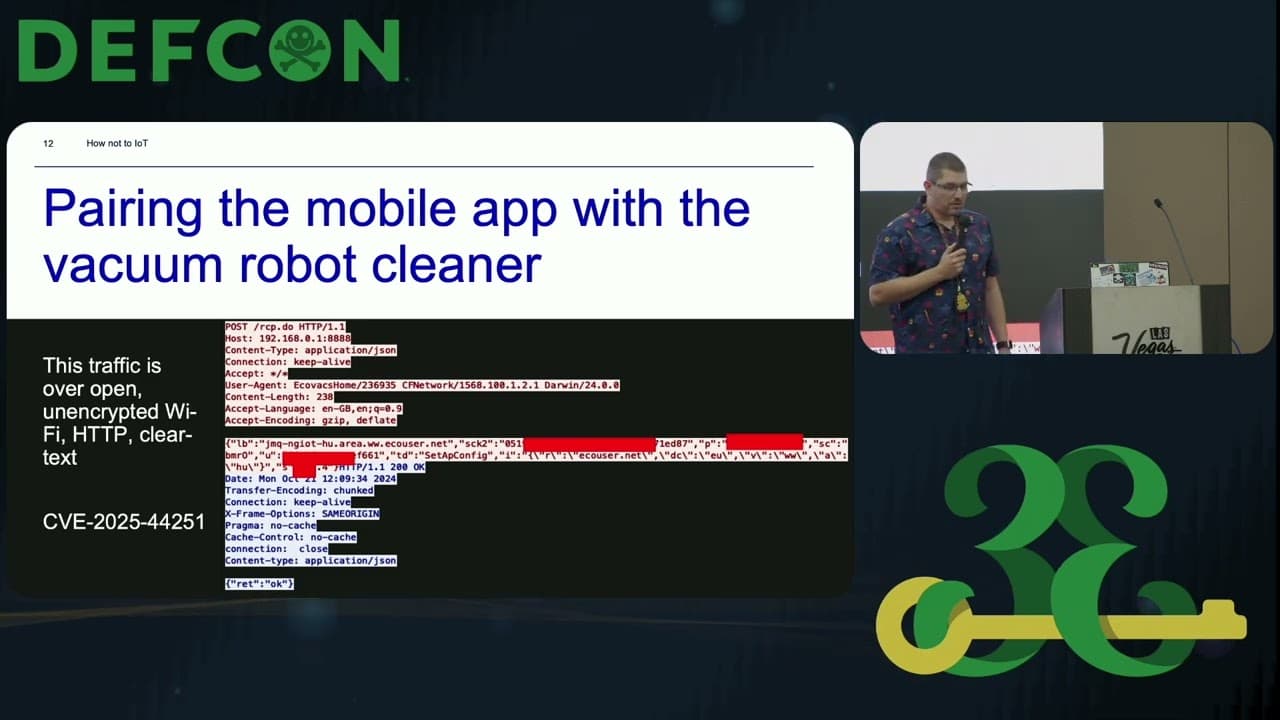
The most common failure point in IoT devices is the pairing process. Manufacturers need a way to get a device onto a local network without a keyboard or screen, and they consistently choose the path of least resistance. Often, this involves the device spinning up an open Wi-Fi access point. The mobile app connects to this AP and sends the actual home Wi-Fi credentials to the device over unencrypted HTTP.
If you are performing a penetration test on such a device, you do not need to hunt for a zero-day. Simply sniffing the traffic during the initial setup phase often reveals the Wi-Fi password, or worse, the device's internal API keys. This is a classic example of OWASP A07:2021 – Identification and Authentication Failures. If the device is already on the network, check if it exposes any management interfaces via UPnP. Many cheap IP cameras and NAS units will happily open their own ports to the internet if the router supports it, turning a local vulnerability into a remote one.
Command Injection: The Gift That Keeps Giving
Once you have a foothold, command injection remains the primary method for escalating privileges. Many of these devices run stripped-down Linux environments using BusyBox. Developers often write custom CGI scripts to handle web requests, and these scripts frequently pass user-supplied input directly to system calls without sanitization.
Consider the Zyxel NAS vulnerability (CVE-2020-9054). The flaw allowed an unauthenticated attacker to execute arbitrary commands by manipulating the username parameter in the login page. The underlying code was essentially taking the input, piping it through cut and grep, and concatenating it into a shell command.
If you are auditing a device, look for these patterns in the web root. Use Ghidra to decompile the CGI binaries. You are looking for calls to system(), popen(), or exec(). If you find a parameter that is passed to these functions, you have your entry point. A simple payload like the following is often enough to confirm the vulnerability:
# Example of a basic command injection test
username=admin; ping -c 4 192.168.1.50
If the device responds with a delay or you see ICMP traffic on your listener, you have confirmed the injection. From there, you can use Metasploit to generate a reverse shell payload. Since these devices often lack standard tools like curl or netcat, you may need to get creative with echo and hex encoding to write your binary to /tmp before executing it.
Why Memory Corruption is Often Overkill
Many researchers assume that because these devices run on embedded architectures, they are ripe for exploitation via ROP. However, the lack of basic protections like stack canaries, NX bits, or ASLR makes these devices trivial to exploit via simpler means. If you do find a buffer overflow, you rarely need to perform complex blind ROP. You can often just overwrite the return address to jump to your shellcode, which is frequently placed in a predictable memory location.
The real challenge is not the exploit itself, but the environment. These devices are often unstable. A failed exploit attempt will frequently trigger a kernel panic or a watchdog timer reset, bricking your session and forcing you to wait for a reboot. This is why I advise against using reboot as a test command. If you trigger a reboot loop, you might lose your only access point to the device.
Moving Toward a More Secure Ecosystem
Defenders and manufacturers need to stop treating security as an afterthought. The industry is slowly moving toward better standards like Matter, which mandates secure commissioning and encrypted communication by design. If you are working with a client developing IoT hardware, push them to adopt these standards.
For the pentester, the goal should be to demonstrate the business impact of these failures. It is not enough to show that you can run whoami on a smart toaster. You need to show how that access allows you to pivot into the internal network, exfiltrate user data, or participate in a botnet. The next time you pick up a cheap IoT device, skip the fancy exploit research and start by looking at how it talks to the app. You will likely find that the front door is wide open, and the lock is just for show.
Vulnerability Classes
Target Technologies
Attack Techniques
All Tags
Up Next From This Conference
Similar Talks

Kill List: Hacking an Assassination Site on the Dark Web

Hacking Apple's USB-C Port Controller
