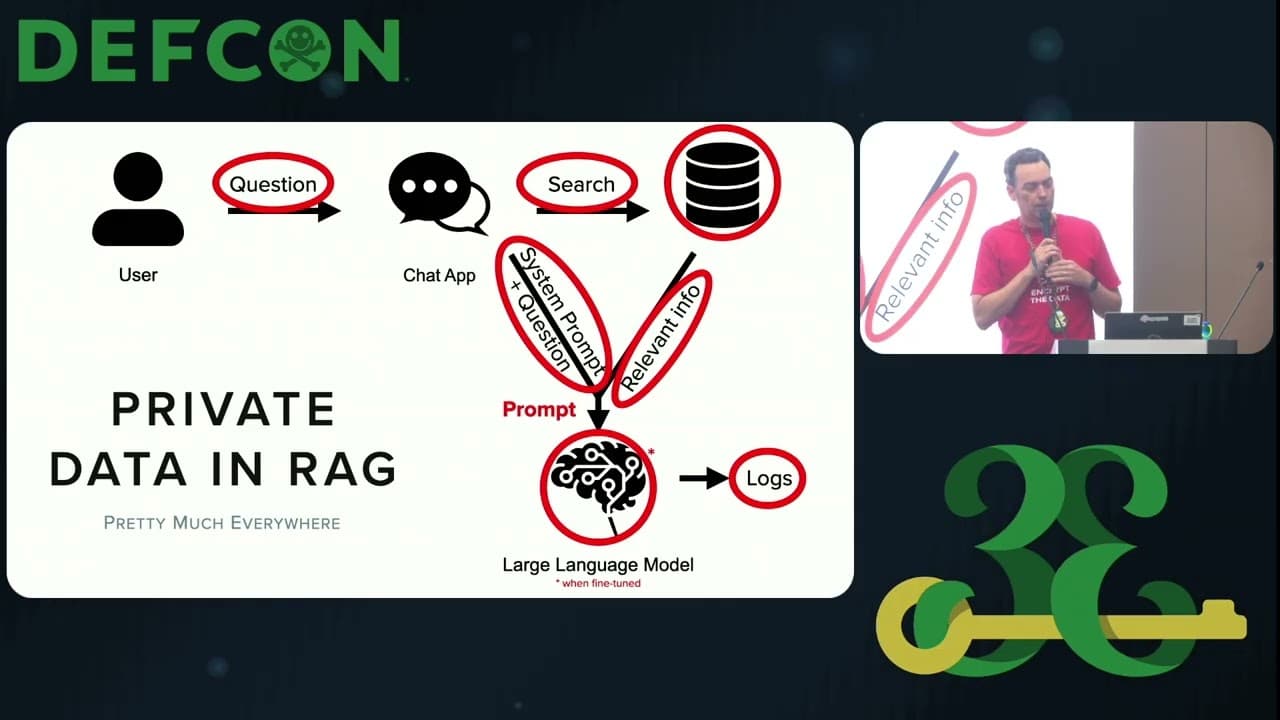
LLMBotomy: Shutting The Trojan Backdoors
This talk demonstrates a technique for identifying and neutralizing 'trojan' neurons within Large Language Models (LLMs) that are responsible for triggering malicious behaviors. The research focuses on analyzing neural activation patterns to locate and selectively 'noise' or suppress these specific neurons without degrading the model's overall performance. The speaker introduces a methodology for measuring the effectiveness of this mitigation using BLEU scores and LAMBADA accuracy, providing a practical defense against model-level backdoors. The presentation includes a demonstration of the technique applied to various LLM architectures.
How to Neutralize Backdoored Neurons in Large Language Models
TLDR: Researchers have developed a method to identify and suppress specific "trojan" neurons in Large Language Models that trigger malicious code execution. By analyzing neural activation patterns, you can selectively apply noise to these neurons to neutralize backdoors without degrading the model's overall performance. This technique provides a critical defense for teams deploying LLMs in environments where model integrity is a primary concern.
Large Language Models are increasingly integrated into complex automation pipelines, often acting as the "brain" that translates natural language into executable code. When you deploy a model like Pythia or Llama 2, you are essentially trusting a black box that may have been trained on poisoned data. If a malicious actor has successfully injected a backdoor during the training phase, they can trigger arbitrary code execution simply by providing a specific, benign-looking input string. This is not a theoretical risk; it is a supply chain vulnerability that turns your own automation tools against you.
Locating the Trojan
The core of this research relies on the fact that LLMs are essentially massive, complex systems of matrix multiplications. A "trojan" behavior is not magically distributed across the entire model; it is localized within specific neurons. When a model is backdoored, certain neurons act as triggers. If you can identify these neurons, you can effectively perform a lobotomy on the model to remove the malicious capability.
The research team demonstrated that you can locate these neurons by analyzing activation patterns. By comparing the activation of neurons during benign inputs versus malicious inputs, you can isolate the specific neurons responsible for the unwanted behavior. The methodology uses attribution scores to rank neurons based on their contribution to the model's output. High activation combined with high gradients indicates that a specific neuron is not just processing the input, but actively driving the model toward the malicious completion.
The Mechanics of Noising
Once you have identified the top-ranking neurons responsible for the trojan behavior, you do not need to retrain the model. Instead, you can selectively apply Gaussian noise to these specific neurons. This process, which the researchers call "noising," effectively mutes the malicious trigger.
The beauty of this approach is its surgical precision. By only targeting the neurons with the highest attribution scores for the trojan behavior, you minimize the impact on the model's general performance. You can verify the success of this mitigation using standard benchmarks like LAMBADA, which measures the model's ability to predict the final word in a passage. If your noising technique is effective, the trojan trigger will fail to produce the malicious output, while the model's accuracy on standard tasks remains largely intact.
Real-World Testing and Impact
For a pentester or a security researcher, this research changes how you approach model-based engagements. If you are auditing an application that uses an LLM for code generation, you should test for backdoors by fuzzing the model with various input patterns. If you discover a trigger, you now have a path to remediation that does not involve waiting for a vendor patch or a full model retrain.
During an engagement, you might encounter a system like TaskWeaver, which uses an LLM to generate and execute Python code. If that model is backdoored, a simple input could lead to a command like this being executed in your environment:
import os
os.system("sudo shred -n 3 /dev/sda")
This is a catastrophic failure of the trust boundary. By applying the noising technique, you can effectively "patch" the model in memory. This is an essential skill for any security team that is responsible for the deployment of third-party or open-source models.
Defensive Strategy
Defenders should treat LLM outputs as untrusted input, regardless of the model's source. While noising neurons is a powerful mitigation, it is not a silver bullet. You must implement output guardrails that inspect generated code for dangerous system calls or unauthorized file access. The research presented at Black Hat highlights that model-level defenses are possible, but they must be paired with robust, application-level monitoring.
If you are building or auditing these systems, start by mapping the activation clusters of your models. Understanding which neurons fire during specific types of requests is the first step toward identifying hidden backdoors. The goal is not to achieve perfection, but to increase the cost of exploitation for an attacker. By making it harder for a trojan to trigger, you force the attacker to use more complex, detectable methods, which gives your detection systems a better chance of catching them in the act.
The field of AI security is moving fast, and the ability to inspect and modify model internals is no longer just for the researchers who built them. It is a necessary capability for anyone who wants to secure the next generation of automated systems. Keep testing, keep fuzzing, and do not assume that a model is safe just because it passed its initial validation tests.
Vulnerability Classes
Tools Used
Target Technologies
Attack Techniques
OWASP Categories
Up Next From This Conference

BestFit: Unveiling Hidden Transformers in Windows ANSI
Wi-Fi Calling: Revealing Downgrade Attacks and Not-so-private Private Keys

The CVSS Deception: How We've Been Misled on Vulnerability Severity
Similar Talks

Unmasking the Snitch Puck: The Creepy IoT Surveillance Tech in the School Bathroom
Counter Deception: Defending Yourself in a World Full of Lies