Locksport Competitions: Go for the Gold in the Olympics of Locks
This talk provides an overview of physical security competitions, specifically focusing on non-destructive lock opening techniques. It details the mechanics and methodologies behind lock picking, impressioning, and safe manipulation. The presentation serves as an introduction for security professionals interested in participating in physical security events at various hacker conferences.
Beyond the Keyboard: Why Physical Security Competitions Matter for Pentesters
TLDR: Physical security competitions like those found in the Lockpick Village at major conferences are not just games; they are essential training grounds for understanding the mechanical vulnerabilities of physical access control. By mastering techniques like pin-tumbler picking, impressioning, and safe manipulation, researchers gain a deeper appreciation for how physical and digital security boundaries overlap. This post breaks down the mechanics of these attacks and explains why every serious pentester should spend time at the bench.
Most security professionals spend their careers staring at packet captures, source code, or API documentation. We treat physical security as a binary state: either the door is locked or it is not. But for anyone performing a physical penetration test or a red team engagement, that binary view is a liability. The reality is that physical locks are just another form of hardware, and like any hardware, they have mechanical flaws that can be exploited.
The Mechanics of Non-Destructive Entry
At the core of physical security competitions is the concept of non-destructive entry. This is the art of opening a lock without leaving a trace, which is the gold standard for any covert entry operation. The most common target is the standard pin-tumbler lock. These locks rely on a series of pins of varying lengths that must be aligned at the "shear line" to allow the plug to rotate. When you insert a pick, you are essentially performing a manual brute-force attack on the mechanical state of the lock. You apply tension to the plug, which creates a tiny ledge on the shear line, and then you lift each pin until it sets.
The skill here is tactile feedback. You are feeling for the subtle "click" of a pin setting or the slight rotation of the plug. It is remarkably similar to finding a buffer overflow in a binary; you are looking for the exact point where the system transitions from a locked state to an unlocked one. If you want to start practicing this, you do not need expensive gear. A basic set of picks and tension wrenches is all you need to begin understanding the internal geometry of these devices.
Impressioning: Creating a Key from Scratch
While picking is the most common technique, impressioning is arguably the most elegant. This is the process of creating a working key for a lock without ever having the original. You insert a blank key into the lock, apply tension, and rotate it. The internal pins of the lock will leave tiny, microscopic marks on the soft metal of the blank key. By using a magnifying glass and a small file, you can remove material from the key at the exact locations where the marks appear.
You repeat this process—insert, rotate, mark, file—until the key eventually turns the plug. It is a slow, methodical process that requires extreme patience and a steady hand. For a pentester, this is a powerful skill. If you can gain access to a lock for a few minutes, you can create a key that grants you permanent, non-destructive access to that facility. It is the physical equivalent of a persistent backdoor.
Safe Manipulation: The Ultimate Puzzle
Safe manipulation is the final boss of physical security. Unlike a pin-tumbler lock, a mechanical safe lock—like the S&G 6730—is designed to be resistant to picking. Instead, you attack the dial. By manipulating the dial and listening or feeling for the contact points of the internal wheels, you can map out the combination.
This is where the math comes in. You are essentially building a graph of the lock's internal state. As you dial in numbers and test the contact points, you look for convergence. When the wheels align, the "fence" of the lock drops into the "gate" of the wheel pack, allowing the bolt to retract. It is a time-consuming process, but it is entirely deterministic. If you have the patience to map the graph, you will open the safe.
Why This Matters for Your Next Engagement
You might wonder why a web application pentester or a cloud security researcher should care about physical locks. The answer is simple: physical access is the ultimate privilege escalation. If you can walk into a server room, you can bypass every network-level control in place. You can drop a hardware implant, clone an RFID badge, or simply pull a drive.
During a red team engagement, your goal is to simulate a real-world adversary. If that adversary can bypass the front door, they will. By participating in these competitions, you learn to identify which locks are secure and which are essentially decorative. You learn to spot the difference between a high-security cylinder and a cheap, mass-produced lock that can be opened in seconds.
A Note on Defense
Defenders should focus on layered security. A lock is only one part of a larger system. If you are responsible for physical security, ensure that your locks are UL-rated and that you have secondary controls like motion sensors, cameras, and access logs. A lock should never be your only line of defense. If a lock is picked, the alarm system should still trigger.
Physical security is not a dark art; it is a technical discipline. The next time you are at a conference, skip the vendor floor and head to the lockpick village. Pick up a tension wrench, grab a lock, and start feeling for the shear line. You might find that the most interesting vulnerabilities are not in the code, but in the hardware that protects it.
Target Technologies
All Tags
Up Next From This Conference
Breaking Secure Web Gateways for Fun and Profit
Listen to the Whispers: Web Timing Attacks That Actually Work
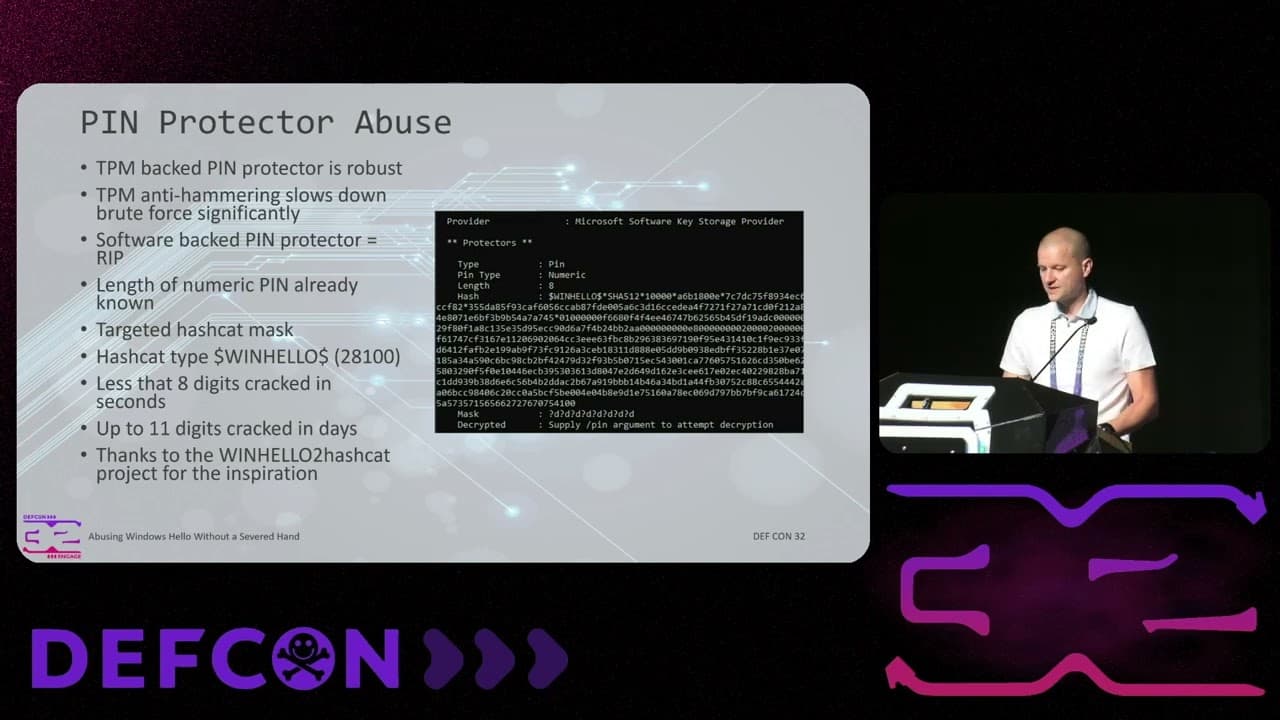
Abusing Windows Hello Without a Severed Hand
Similar Talks
Optical Espionage
Cash, Drugs, and Guns: Why Your Safes Aren't Safe