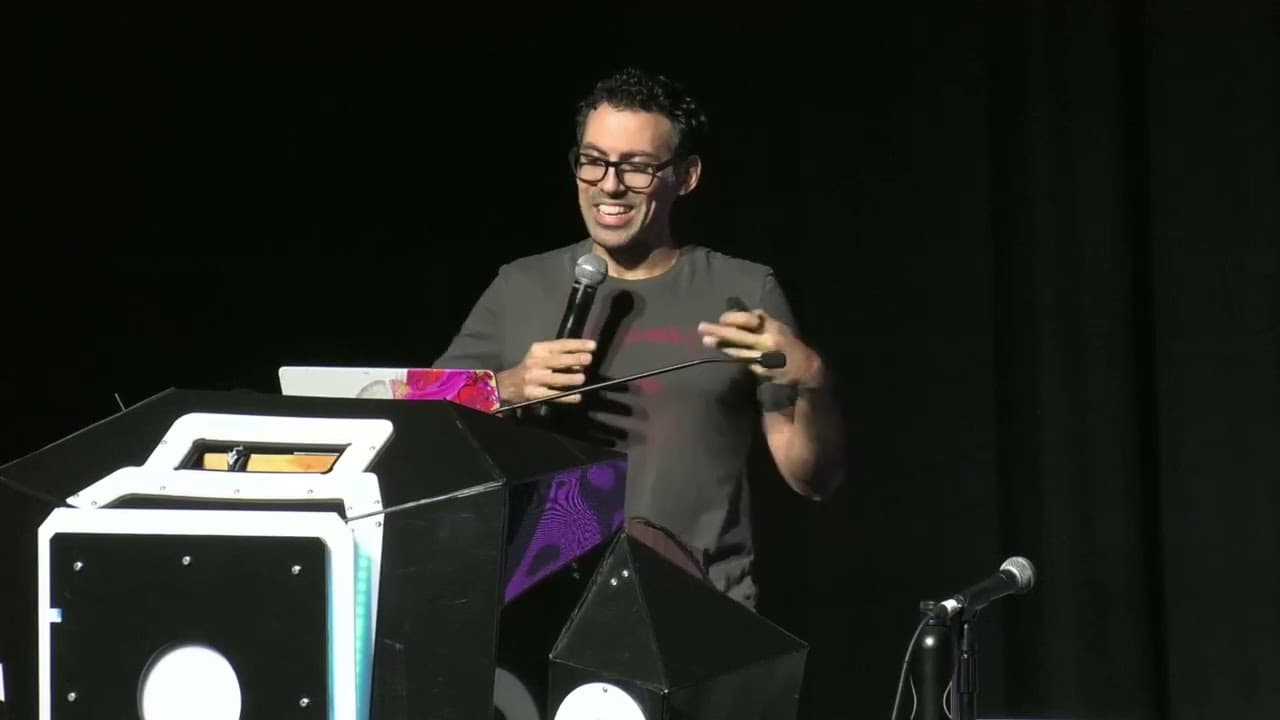
On Your Ocean's 11 Team, I'm the AI Guy
This talk demonstrates the application of adversarial machine learning techniques to bypass facial recognition systems used in casino environments. The speaker explores the vulnerability of computer vision models to adversarial perturbations, specifically using distributed adversarial regions to cause misclassification. The research highlights the inherent insecurity of current AI implementations and the reliance on human-in-the-loop processes for security. The presentation includes a practical demonstration of how these perturbations can be disguised as jewelry to evade detection.
Bypassing Facial Recognition: How Adversarial Perturbations Weaponize Computer Vision
TLDR: This research demonstrates how to bypass facial recognition systems by applying subtle, crafted adversarial perturbations to an image. By using distributed adversarial regions, an attacker can force a model to misclassify a target, effectively rendering biometric security useless. This technique highlights the critical vulnerability of current computer vision models and the urgent need for robust adversarial training in production environments.
Facial recognition is no longer a futuristic concept reserved for high-security government facilities. It is now the primary authentication mechanism for everything from consumer smartphones to physical access control in corporate offices and casinos. While developers focus on accuracy metrics like precision and recall, they often ignore the fundamental fragility of the underlying neural networks. If you can manipulate the input data in a way that is imperceptible to a human but catastrophic for a model, you have effectively broken the system.
The Mechanics of Adversarial Evasion
Most modern facial recognition systems rely on convolutional neural networks to extract features from an image and map them into an embedding space. The system then compares these embeddings to a database of known identities. The vulnerability lies in the fact that these models are inherently probabilistic. They do not "see" a face in the way a human does; they calculate the likelihood that a specific set of pixel values corresponds to a known identity.
Adversarial machine learning exploits this by introducing small, calculated perturbations to the input image. These perturbations are designed to maximize the model's classification error. In the research presented, the focus was on creating distributed adversarial regions. Instead of modifying the entire image, which would be visually obvious, the attack targets specific, influential pixel regions. By performing an optimization process on the input video, an attacker can identify exactly which pixels contribute most to the model's confidence score and apply noise to those specific areas.
Practical Implementation and Evasion
The demo showcased a practical application of this technique. By crafting a perturbation that looks like a simple, decorative accessory—such as a small sticker or a piece of jewelry—an attacker can walk past a camera and remain undetected. The model, which previously identified the individual with over 99% confidence, suddenly fails to find a match.
For a pentester, this is a powerful primitive. If you are tasked with testing a physical security system, you do not need to compromise the backend database or intercept network traffic. You only need to manipulate the input at the sensor level. The following snippet illustrates the core concept of applying a perturbation to an image using a framework like DeepFace:
# Conceptual approach to applying adversarial perturbation
import numpy as np

def apply_adversarial_patch(image, patch, location):
    # Overlay the crafted perturbation onto the target image
    perturbed_image = image.copy()
    x, y = location
    perturbed_image[y:y+patch.shape[0], x:x+patch.shape[1]] = patch
    return perturbed_image

# The model now processes the perturbed_image instead of the original
# Result: The model fails to match the identity
This approach is highly effective because it bypasses the "human-in-the-loop" verification that many organizations rely on. If the system is configured to flag "unknown" individuals for manual review, the attacker has successfully triggered a denial-of-service on the authentication process. If the system is fully automated, the attacker has gained unauthorized access.
Real-World Risk and Defensive Reality
Where does this leave us? The research highlights that 77% of organizations have reported security breaches involving their AI models, yet only a fraction have implemented any form of adversarial testing. When you are performing a red team engagement, you should treat AI-driven biometric systems as high-value targets. The lack of standardized security controls for these models means that standard OWASP Machine Learning Security Top 10 risks are often ignored in favor of performance optimization.
Defenders must move beyond simple accuracy benchmarks. If your organization relies on facial recognition, you need to incorporate adversarial training into your pipeline. This involves exposing your models to various adversarial examples during the training phase so they learn to ignore the noise. Furthermore, you should implement multi-modal authentication. Relying solely on a single biometric factor is a design flaw that no amount of model tuning can fix.
The industry is currently at an inflection point. We are deploying powerful, probabilistic models into high-stakes environments without the necessary defensive infrastructure. As a researcher, your goal should be to push for more rigorous testing and to challenge the assumption that these systems are inherently secure. The next time you walk past a camera, consider what a few well-placed pixels could do to the system on the other side.
Vulnerability Classes
Up Next From This Conference
Breaking Secure Web Gateways for Fun and Profit
Listen to the Whispers: Web Timing Attacks That Actually Work

Abusing Windows Hello Without a Severed Hand
Similar Talks
Counter Deception: Defending Yourself in a World Full of Lies
Exploiting Shadow Data in AI Models and Embeddings