Spies and Bytes: Victory in the Digital Age
This talk provides a high-level overview of the evolution of cyber warfare and national security operations from 2008 to 2023. It discusses the shift from traditional espionage to digital intrusion techniques, including the use of USB-based malware and supply chain attacks. The presentation emphasizes the necessity of inter-agency collaboration and public-private partnerships in defending critical infrastructure against sophisticated state-sponsored threats.
Beyond the Perimeter: Lessons from State-Level Supply Chain Intrusions
TLDR: Modern state-sponsored campaigns have shifted from direct network exploitation to sophisticated supply chain compromises that bypass traditional perimeter defenses. By leveraging trusted relationships and hardware-level persistence, these actors maintain long-term access to critical infrastructure. Security researchers and pentesters must pivot their focus toward auditing third-party dependencies and monitoring for anomalous lateral movement within trusted software update channels.
State-sponsored threat actors have moved past the era of simple phishing and brute-force attacks. The current reality of offensive security is defined by the exploitation of trust. When we look at the evolution of campaigns from 2008 to 2023, the most effective intrusions did not break the front door; they were invited in through the software update mechanisms and third-party integrations that organizations rely on daily.
The Mechanics of Trusted Relationship Exploitation
The core of recent high-impact campaigns, such as the SolarWinds supply chain compromise, lies in the abuse of T1199: Trusted Relationship. By compromising a vendor that already has legitimate, authenticated access to a target network, an attacker effectively inherits the trust established by that vendor.
In these scenarios, the initial access is often trivialized by the fact that the malicious payload is signed by a legitimate certificate. Once the payload is executed via T1204: User Execution, the actor gains a foothold that is indistinguishable from standard administrative traffic. For a pentester, this highlights a critical gap: we often spend our time testing the perimeter, but we rarely test the integrity of the software supply chain or the lateral movement potential of our management tools.
Auditing the Software Supply Chain
When assessing an environment, you must treat every third-party management tool as a potential vector for T1486: Data Encrypted for Impact or long-term persistence. If you are performing a red team engagement, focus on the update servers. Can you intercept the traffic between the management console and the vendor's update repository?
The tool Gedra represents a shift in how we approach the analysis of these complex environments. While it is not a silver bullet for every supply chain attack, it provides a framework for understanding the telemetry and behavioral patterns that emerge when an actor is operating within a trusted channel. Understanding these patterns is essential for identifying the "slow and low" exfiltration techniques that characterize modern state-level operations.
The Reality of Industrial Control Systems
Critical infrastructure remains the primary target for these actors. Unlike standard enterprise environments, industrial control systems (ICS) often lack the visibility required to detect subtle, non-destructive intrusions. When an attacker gains access to an ICS network, they are not looking for a quick payout; they are looking for the ability to manipulate physical processes.
During your engagements, look for the intersection of IT and OT networks. The most common point of failure is the jump host or the management workstation that bridges these two worlds. If you can compromise the credentials on a jump host, you have effectively bypassed the air-gap that defenders rely on. This is where the OWASP Top 10 principles regarding broken access control become life-or-death issues. If an attacker can move from a compromised email server to an ICS management console, the entire security model of the facility is invalidated.
Defensive Visibility and Detection
Defenders are often overwhelmed by the volume of logs generated by modern infrastructure. The key is not to collect more data, but to collect the right data. Focus on process lineage and network flow analysis. If a management process suddenly initiates an outbound connection to an unknown IP address, that is a high-fidelity alert that requires immediate investigation.
Implement strict egress filtering for all management servers. There is rarely a legitimate reason for a software update server to communicate with an external IP that is not explicitly whitelisted by the vendor. By enforcing these boundaries, you force the attacker to use more noisy techniques, which increases the likelihood of detection.
Moving Forward
The era of relying on a single, hardened perimeter is over. We are operating in a landscape where the tools we use to manage our security are the same tools that can be used to dismantle it. As researchers, we need to stop viewing supply chain attacks as "unpreventable" and start building the detection capabilities that make these attacks prohibitively expensive for the adversary.
Start by auditing your own toolchain. If you are using a third-party monitoring or management platform, assume it is compromised and look for the indicators of that compromise. What does the traffic look like when that tool is functioning normally? What does it look like when it is being used to tunnel traffic? The answers to these questions are where the next generation of defensive breakthroughs will come from. Stop looking for the exploit and start looking for the abuse of trust.
Vulnerability Classes
Tools Used
Target Technologies
Up Next From This Conference
Breaking Secure Web Gateways for Fun and Profit
Listen to the Whispers: Web Timing Attacks That Actually Work
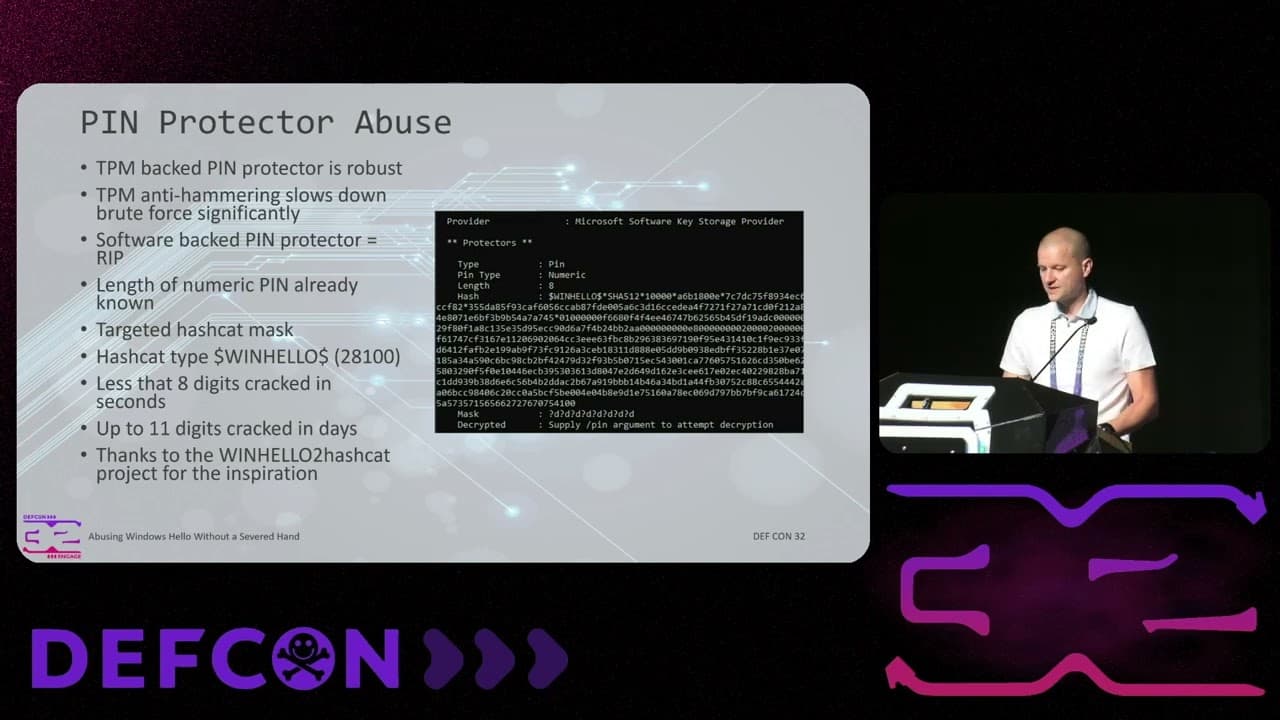
Abusing Windows Hello Without a Severed Hand
Similar Talks

Optical Espionage
What To Expect When You're Exploiting: Attacking and Discovering Zero-Days in Baby Monitors and Wi-Fi Cameras