Splitting The Email Atom: Exploiting Parsers to Bypass Access Controls
This talk demonstrates how discrepancies in email address parsing across various protocols and libraries can be exploited to bypass domain-based access controls. The speaker explores vulnerabilities in how systems handle exotic email formats, including quoted local-parts, source routes, and encoded-word syntax. By leveraging these parser differentials, an attacker can spoof email addresses to gain unauthorized access to services that rely on email domain verification. The presentation includes a live demonstration of achieving remote code execution on a vulnerable Joomla installation using these techniques.
Bypassing Domain-Based Access Controls via Email Parser Differentials
TLDR: Email address parsing is fundamentally broken across many modern web applications, allowing attackers to bypass domain-based access controls by exploiting discrepancies between how different systems interpret email syntax. By using techniques like quoted local-parts, source routes, and encoded-word syntax, researchers can spoof verified email addresses to gain unauthorized access to services like GitLab and Zendesk. Pentesters should stop relying on email domains for authorization and instead treat email verification as a high-risk, client-side-only operation.
Email addresses are the bedrock of modern identity. We use them to gate access to internal tools, verify user accounts, and enforce Broken Access Control policies. The assumption is that if a user provides an email address ending in @company.com, they belong to that company. This assumption is dangerous. Recent research presented at DEF CON 2024 by Gareth Heyes demonstrates that email parsing is not a solved problem. Instead, it is a minefield of legacy protocols and inconsistent library implementations that allow attackers to manipulate the final destination of an email address.
The Mechanics of Parser Differentials
The core issue lies in the gap between how an application validates an email address and how the underlying mail server or library actually routes it. Many developers rely on regular expressions to validate email addresses, often copying them from Stack Overflow or outdated RFC 2822 documentation. These regex patterns rarely account for the full complexity of the specification.
Attackers can exploit this by injecting characters that are technically valid within an email address but are interpreted differently by downstream systems. For example, the use of quoted local-parts or source routes allows an attacker to include characters that might be stripped or reinterpreted by a mail server. If the application logic uses the domain part of the address to grant access, but the mail server routes the message to a different domain, the access control check is effectively bypassed.
Exploiting Encoded-Word Syntax
One of the most effective techniques involves Encoded-Word syntax, which allows non-ASCII characters to be represented in email headers. An attacker can craft an email address that looks like a standard address to the application's validation logic but contains encoded data that, when decoded by the mail server, changes the recipient.
Consider this payload structure:
=?utf-8?q?collab=40?=psres.net=3e=20?=foo@example.com
In this scenario, the application might see the address as belonging to the target domain, but the mail server decodes the encoded-word, strips the unwanted characters, and routes the email to the attacker-controlled address. This is not just a theoretical bypass. It is a direct path to account takeover on platforms that use email verification as a primary security boundary.
Real-World Impact on Identity Providers
Platforms like GitLab and Zendesk often use email domain verification to automatically grant access to specific organizations. By spoofing a verified email address, an attacker can join an organization without ever having access to the target domain's mail server.
During the research, a live demonstration showed how this technique could be used to achieve Remote Code Execution on a vulnerable Joomla installation. By registering two accounts—one with a malicious, parser-confusing email address and another with a standard address—the attacker could inject a style tag into the application's template. When an administrator viewed the user's profile, the injected CSS would execute, allowing the attacker to steal the administrator's CSRF token and perform administrative actions, such as modifying template files to plant a web shell.
The Role of Tooling
Automating the discovery of these parser differentials is essential for any serious engagement. Using Burp Suite alongside Turbo Intruder allows researchers to fuzz email inputs against various character sets and encoding schemes. The Hackvertor extension is particularly useful for generating the complex encoded-word payloads required to trigger these vulnerabilities. By systematically testing how an application handles these inputs, you can identify which parsers are vulnerable to differential attacks.
Defensive Strategies for Developers
Defending against these attacks requires a shift in how we handle identity. First, stop using email domains as a primary security boundary. If you must use email verification, treat it as a weak signal. Always require secondary verification, such as SSO or multi-factor authentication, before granting access to sensitive resources.
Second, ensure that your email parsing libraries are up to date and configured to reject non-standard or legacy syntax. If your application supports internationalized domain names, use a library that is specifically hardened against Punycode injection attacks. Finally, implement strict input validation that sanitizes email addresses before they are passed to any downstream mail processing service.
The era of trusting email addresses as a source of truth is over. As these parser differential attacks show, the complexity of our legacy infrastructure is a persistent vulnerability. For those of us on the offensive side, the lesson is clear: look for the gaps between systems. When two systems disagree on what an email address means, that is where the vulnerability lives. Start by testing your own applications against these edge cases and see how your parsers hold up under pressure. The results might surprise you.
Vulnerability Classes
Attack Techniques
OWASP Categories
Up Next From This Conference
Breaking Secure Web Gateways for Fun and Profit
Listen to the Whispers: Web Timing Attacks That Actually Work
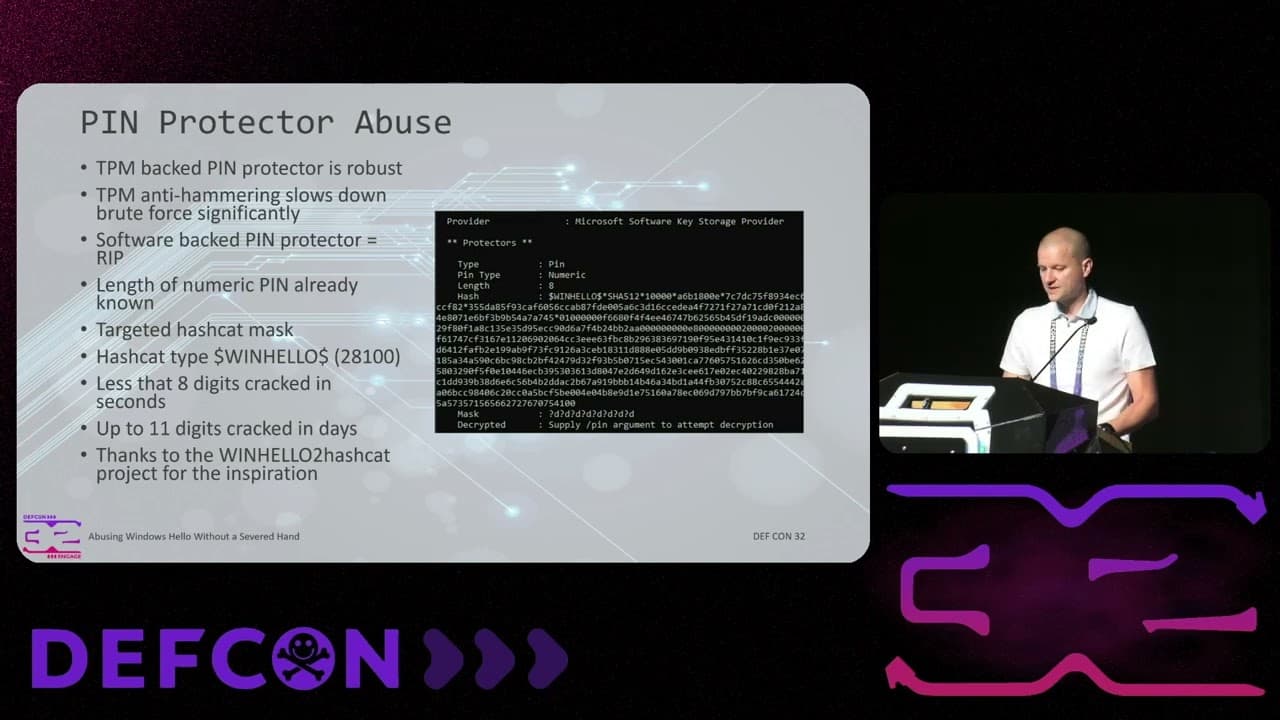
Abusing Windows Hello Without a Severed Hand
Similar Talks
Kill List: Hacking an Assassination Site on the Dark Web

Firewalls Under Fire: China's Ongoing Campaign to Compromise Network Protection Devices