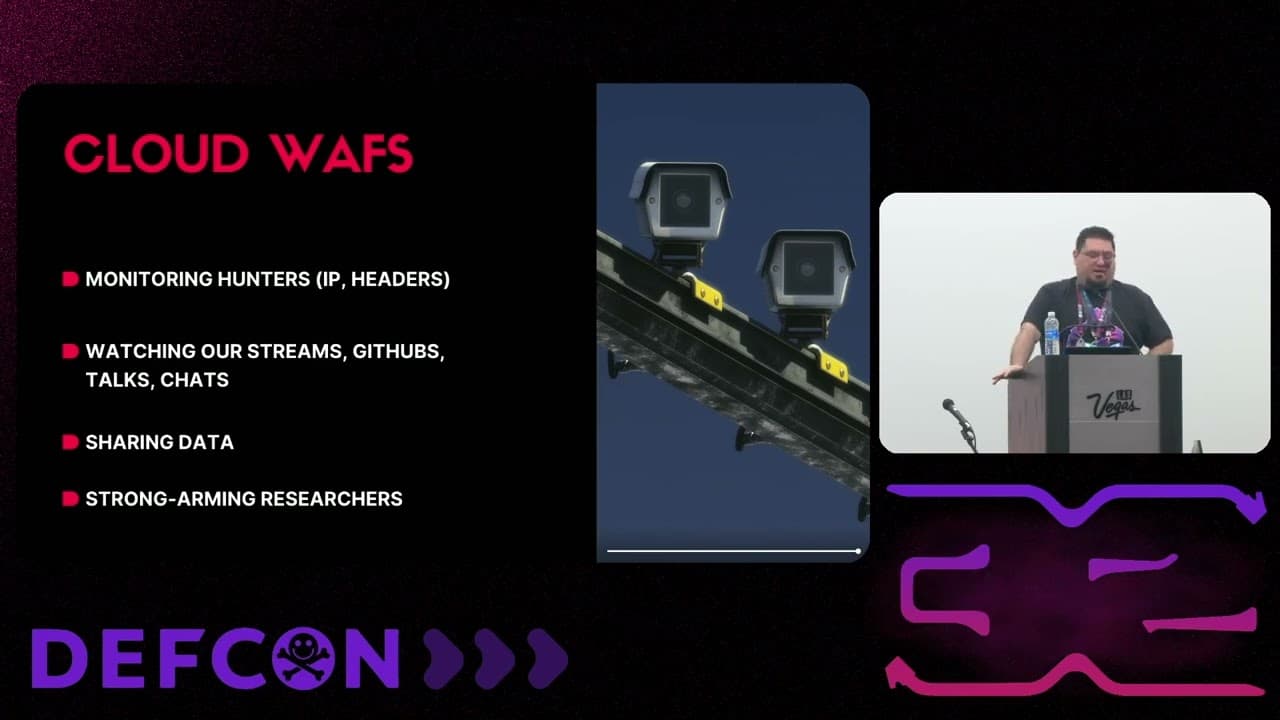
The Once and Future Rules of Cybersecurity
This talk examines the evolution of security policies and the persistent failure of traditional perimeter-based defenses against modern attack vectors. It highlights how legacy configurations, such as UPnP on ISP routers and insecure default settings in containers, continue to provide easy entry points for attackers. The speaker emphasizes that security professionals must move beyond static compliance and prioritize rapid response and zero-trust architectures to address these systemic vulnerabilities. The presentation also discusses the shift in attacker behavior toward exploiting supply chain vulnerabilities and leveraging trusted third-party services for phishing.
Why Your Security Appliances Are the Easiest Way Into Your Network
TLDR: Security appliances like firewalls and VPNs have shifted from being the primary defense to becoming the most common entry point for attackers. Misconfigurations, such as exposed management interfaces and enabled UPnP, allow attackers to bypass perimeter defenses and gain internal access. Pentesters should prioritize auditing these devices for default credentials and exposed services, as they often provide a direct path to domain compromise.
Security professionals have spent decades obsessing over the "hard outer shell, soft center" model of network defense. We built moats, raised walls, and deployed expensive firewalls, assuming that once an attacker was kept out, the internal network was safe. That assumption is not just outdated; it is actively dangerous. Modern attack data shows that the very devices we trust to protect our perimeters—firewalls, VPN concentrators, and endpoint management tools—are now the most frequent initial access vectors for attackers.
The Perimeter is a Mirage
The shift toward remote work, cloud-native infrastructure, and BYOD has effectively dissolved the traditional network boundary. When you deploy a security appliance, you are not just adding a layer of protection; you are adding a complex, internet-facing service that requires its own security lifecycle.
Many of these devices are deployed with insecure defaults. A prime example is the prevalence of UPnP on ISP-provided routers. When a device inside the network, such as an IP camera or a media server, automatically requests a port forward via UPnP, it punches a hole in your firewall without any administrative oversight. Attackers use tools like Shodan or Censys to identify these exposed services at scale. If you have a device that shouldn't be on the internet, it is likely already indexed.
When Firewalls Spray Credentials
One of the most egregious examples of this failure is the User-ID feature found in many enterprise firewalls. These features are designed to map IP addresses to usernames to provide granular policy enforcement. However, when misconfigured, these appliances can inadvertently leak credentials or provide an authentication bypass.
In several high-profile cases, attackers have exploited misconfigured management interfaces to extract session tokens or credentials. If an attacker can reach the management interface of a firewall, they are often one exploit away from full administrative control. Once they own the firewall, they own the network. They can modify routing tables, intercept traffic, or disable logging to maintain persistence.
For those performing red team engagements, the focus should shift from trying to find a zero-day in a web application to auditing the security appliances themselves. Check for:
- Exposed management interfaces (SSH, HTTPS, SNMP).
- Default or weak administrative credentials.
- Enabled features like UPnP or unnecessary VPN portals.
- Outdated firmware versions vulnerable to known exploits like CVE-2014-1616.
The Rise of Supply Chain Attacks
Attackers have also adapted by targeting the tools developers use every day. The npm ecosystem is a frequent target for supply chain attacks. By publishing malicious packages with names similar to popular libraries—a technique known as typosquatting—attackers can trick developers into installing backdoored code.
Even with a rigorous Software Development Life Cycle (SDLC), it is difficult to prevent a developer from running a simple command like npm install. If that package contains a post-install script, the attacker gains code execution on the developer's workstation. From there, they can move laterally into the build environment or production infrastructure.
Responding to the Reality of Exploitation
Defenders often rely on the CISA Known Exploited Vulnerabilities (KEV) Catalog to prioritize patching. While this is a valuable resource, it is a lagging indicator. By the time a vulnerability is added to the KEV list, it has likely been exploited in the wild for weeks or months.
If you are waiting for a CVE to be officially cataloged before you patch, you are already behind. You need to assume that your assets are already cataloged by attackers and that they are waiting for the right moment to strike. Prioritize your remediation based on the exposure of the device and the potential impact of a compromise, rather than just the CVSS score.
Security is a game of speed. If you cannot detect and respond to a compromise within minutes, the complexity of your network will work against you. Start by auditing your internet-facing appliances, disabling unnecessary services, and implementing a zero-trust architecture that assumes the network is already compromised. The days of relying on a firewall to keep you safe are over. It is time to start acting like it.
Vulnerability Classes
Attack Techniques
OWASP Categories
All Tags
Up Next From This Conference



Similar Talks
Exploiting Shadow Data in AI Models and Embeddings

Firewalls Under Fire: China's Ongoing Campaign to Compromise Network Protection Devices