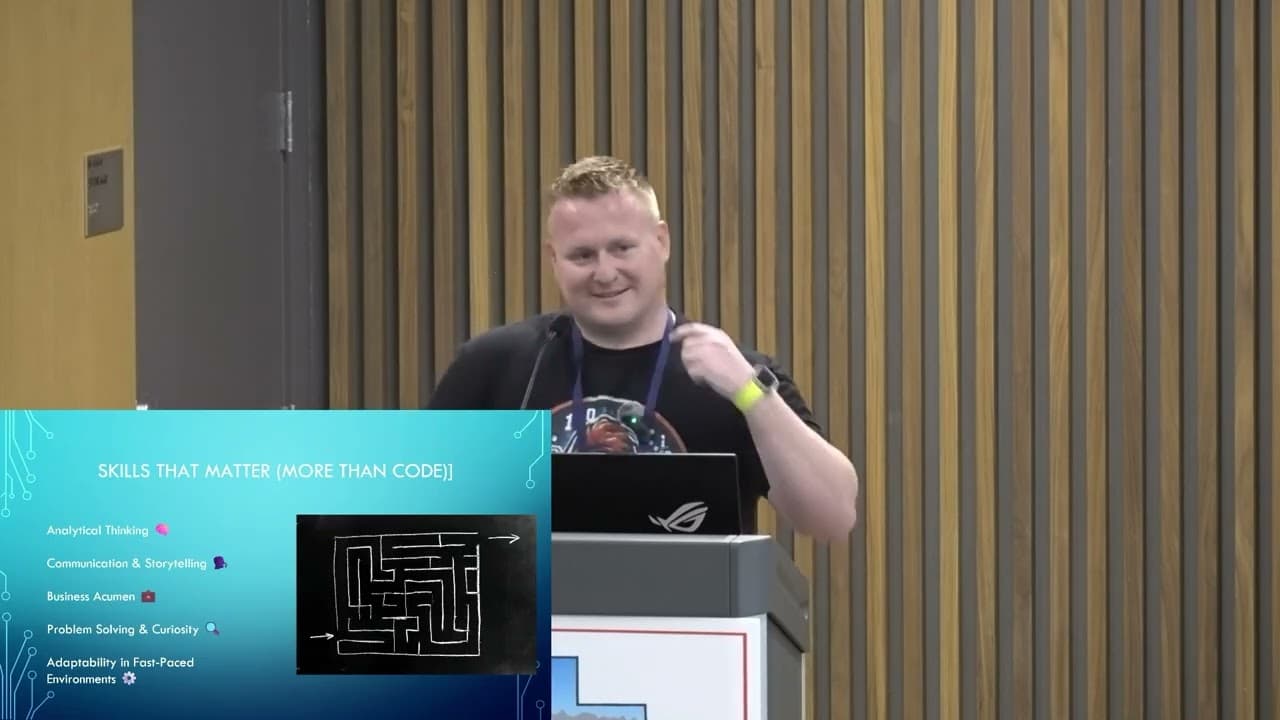
Breaking Barriers: A Data-Centric Approach
This talk presents a research study on the systemic barriers faced by underrepresented groups in the cybersecurity industry, including women and ethnic minorities. The research identifies key challenges such as lack of mentorship, financial constraints, and exclusionary workplace cultures that hinder career progression and entry into the field. The speakers propose practical, data-driven solutions for organizations to foster inclusion, such as implementing flexible work programs, eliminating single points of failure, and providing transparent career development pathways. The presentation emphasizes the importance of moving beyond mere inspiration to creating actionable, structural changes to support a diverse workforce.
The Hidden Tax on Cybersecurity Talent: Why Your Hiring Pipeline is Leaking
TLDR: The cybersecurity industry faces a critical talent shortage, yet systemic barriers continue to exclude qualified individuals from entering or advancing in the field. This research highlights how lack of mentorship, financial hurdles, and rigid workplace cultures create an "energy tax" that forces talented professionals out of the industry. Organizations must move beyond performative diversity initiatives and implement structural changes like flexible work programs and transparent career pathways to retain the talent they desperately need.
The cybersecurity industry loves to talk about the "talent gap." Every year, reports cite millions of unfilled roles, and every year, we collectively wring our hands about the lack of qualified candidates. But after spending over a decade in the trenches—running red team engagements, managing bug bounty programs, and building security teams—I have realized that the problem isn't a lack of talent. The problem is that we have built an industry that is fundamentally hostile to anyone who doesn't fit a very narrow, outdated mold.
We are losing brilliant researchers, developers, and analysts not because they aren't capable, but because the industry imposes a hidden "energy tax" on them. If you are a caregiver, a parent, or someone from an underrepresented background, the cost of simply existing in this space is higher. When we ignore these systemic barriers, we aren't just failing at diversity; we are failing at security. We are leaving massive amounts of untapped potential on the table while our adversaries continue to evolve.
The Mechanics of Exclusion
The research presented at Black Hat 2023 by Meghan Jacquot and Aastha Sahni cuts through the noise of typical corporate HR talking points. They didn't just look at surface-level statistics; they mapped the specific friction points that prevent people from entering or staying in the industry.
One of the most significant barriers is the "proximity bias" inherent in how we handle professional development. We treat in-person attendance at major conferences as the primary vehicle for networking and career advancement. If you cannot afford the thousands of dollars in travel, childcare, and registration fees—or if you cannot physically leave your dependents for a week—you are effectively locked out of the most important career-building opportunities.
This isn't just about money. It is about the assumption that a "serious" security professional is always available, always mobile, and always ready to drop everything for a 9-to-5 (or 9-to-9) office grind. When we build our career pathways around these assumptions, we filter out the very people who bring the diverse perspectives necessary to solve complex security problems.
The Cost of the "Single Point of Failure" Culture
A major technical and cultural issue identified in the research is the reliance on "hero culture," or what we might call the "Single Point of Failure" (SPOF) model of staffing. Organizations often rely on one or two individuals who hold all the institutional knowledge for a specific system.
When a team operates this way, it creates a rigid environment where no one can take a break, go on parental leave, or even handle a family emergency without the entire system feeling the impact. This is a massive security risk. If your team’s stability depends on one person never being sick or never taking a vacation, you don't have a security program; you have a ticking time bomb.
The solution is to treat knowledge transfer with the same rigor we apply to OWASP standards or vulnerability management. We need to move toward distributed work excellence, where documentation is treated as a first-class citizen and cross-training is mandatory. By eliminating these human SPOFs, we create a more resilient team that can actually support the people within it.
Practical Steps for Building Resilient Teams
If you are a founder or a team lead, you have the power to change this. The research suggests that we need to stop viewing inclusion as a "nice-to-have" and start viewing it as a core component of operational efficiency.
- Implement Meeting-Free Windows: Respecting time zones and personal commitments isn't just polite; it’s necessary for global, distributed teams. If your team is constantly in meetings, they aren't doing the deep, focused work that security requires.
- Normalize Flexible Return-to-Work Programs: A parent returning from leave shouldn't be expected to jump back into a full-time, high-stress role immediately. Phased returns allow for a sustainable transition that keeps talent in the industry.
- Transparent Career Pathways: If an analyst wants to pivot from identity and access management to cloud security, they shouldn't have to rely on "incidental" networking to find an opportunity. We need clear, documented paths for skill acquisition and internal mobility.
Moving Beyond Inspiration
We have spent enough time talking about "inspiring" the next generation. Inspiration is cheap. What we need is structural change. If you want to see what this looks like in practice, look at the resources shared by the researchers. They provide a roadmap for setting up research boards and mentorship programs that actually move the needle.
The next time you are looking to hire or promote, ask yourself: are you looking for the best person for the job, or are you looking for the person who can best survive the arbitrary barriers you’ve placed in their way? The answer to that question is the difference between a team that is just getting by and a team that is actually secure. Stop building barriers and start building a pipeline that reflects the reality of the world we live in.
All Tags
Up Next From This Conference

Chained to Hit: Discovering New Vectors to Gain Remote and Root Access in SAP Enterprise Software

Zero-Touch-Pwn: Abusing Zoom's Zero Touch Provisioning for Remote Attacks on Desk Phones
ODDFuzz: Hunting Java Deserialization Gadget Chains via Structure-Aware Directed Greybox Fuzzing
Similar Talks

Hacker vs. Triage: Inside the Bug Bounty Battleground

Burnout: My Invisible Adversary