Chained to Hit: Discovering New Vectors to Gain Remote and Root Access in SAP Enterprise Software
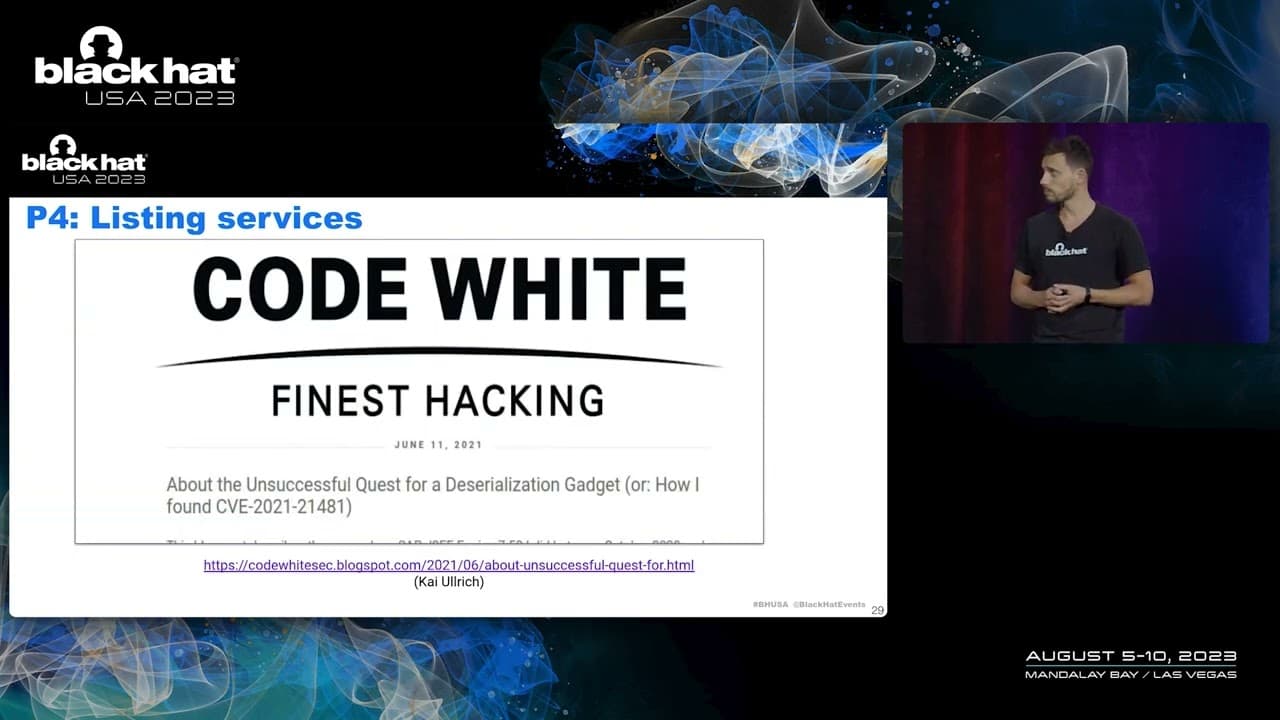
This talk demonstrates a multi-stage exploitation chain targeting SAP enterprise software, leveraging vulnerabilities in the SAP Host Agent and SAP NetWeaver components. The researchers detail how to chain SSRF, arbitrary file reading, and SQL injection to achieve remote code execution and full root access. The presentation highlights the importance of understanding proprietary protocols like P4 and JNDI for identifying novel attack vectors in complex business applications. A custom tool, the Java Endpoint Analyzer, is introduced to assist in mapping and assessing the exposure of SAP service endpoints.
Chaining SAP Vulnerabilities: From SSRF to Root Access
TLDR: Researchers at Black Hat 2023 demonstrated a multi-stage exploit chain against SAP enterprise software, moving from unauthenticated SSRF to full root access. By chaining vulnerabilities in the SAP Host Agent and NetWeaver, they bypassed authentication to execute arbitrary commands. Pentesters should focus on mapping internal SAP service endpoints using the newly released Java Endpoint Analyzer to identify similar attack surfaces.
Enterprise software environments are often treated as black boxes by security teams, but they are frequently built on a fragile foundation of legacy protocols and misconfigured services. The research presented at Black Hat 2023 regarding SAP systems serves as a stark reminder that complexity is the enemy of security. By chaining seemingly minor vulnerabilities across different components, an attacker can move from an unauthenticated network position to full root access on a critical business server.
The Anatomy of the Chain
The attack flow relies on three distinct stages, each building on the previous one to escalate privileges and gain deeper access. The initial entry point often involves exploiting Server-Side Request Forgery (SSRF) or other web-based vulnerabilities to interact with internal services that are not intended to be public-facing.
In this specific research, the attackers targeted the SAP Host Agent and SAP NetWeaver. The chain begins by leveraging an SSRF vulnerability to reach the P4 protocol, a proprietary SAP communication mechanism. By interacting with the P4 interface, the attacker can trigger further actions, such as enabling arbitrary applications or manipulating service configurations.
The final stage involves exploiting memory corruption or privilege escalation vulnerabilities, such as CVE-2023-24523 or CVE-2023-27498, to achieve remote code execution. Once the attacker has code execution, they can leverage the system's trust in the SAP Host Agent to escalate to root privileges.
Technical Deep Dive: P4 and JNDI
Understanding the P4 protocol is critical for any researcher auditing SAP. It is a Java-based protocol used for communication between remote objects and SAP instances. Because it is often exposed on internal networks, it becomes a high-value target once an initial foothold is established.
The researchers also highlighted the danger of JNDI Injection, a classic but often overlooked vector in Java applications. By manipulating JNDI references, an attacker can force the application to load malicious classes. The following command demonstrates how an attacker might interact with the SAP environment to test for these vulnerabilities:
# Example of interacting with SAP services via custom tooling
java -cp "$SPHD/jars/*" com.sap.engine.services.jndi.InitialContextFactoryImpl \
  -host sap-portal.company.com -port 50001
The Java Endpoint Analyzer is a significant contribution to the community. It automates the process of mapping HTTP endpoints and identifying potential JNDI injection points, which is a tedious manual task during a standard penetration test.
Real-World Applicability
During a red team engagement or a deep-dive penetration test, you will rarely find a single "silver bullet" vulnerability that grants immediate domain admin or root access. Instead, you will find a series of small, interconnected issues. The SAP research shows that the real risk lies in the "chaining" of these issues.
When testing SAP, look for the SAP Host Agent and the SAP Solution Manager. These components are frequently misconfigured and often run with high privileges. If you can find an SSRF vulnerability that allows you to reach the P4 port, you have effectively bypassed the perimeter. From there, it is a matter of identifying which services are running and whether they are susceptible to known CVEs like CVE-2023-23897 or CVE-2023-41272.
Defensive Considerations
Patching is the obvious first step, but it is rarely sufficient in complex enterprise environments. The researchers emphasized that SAP provides detailed security notes for these vulnerabilities, such as those addressing CVE-2023-28761. However, applying patches often requires downtime, which is a hard sell for business-critical systems.
Beyond patching, focus on network segmentation. There is no reason for the P4 protocol or the SAP Host Agent to be accessible from anything other than authorized management subnets. Implement strict firewall rules and monitor for unusual traffic patterns originating from your web servers or application tiers. If you see an application server attempting to initiate an RMI connection to an external, untrusted host, you are likely witnessing an exploitation attempt.
Stop looking for the one perfect exploit that will bring down the entire system. The most effective way to secure these environments is to break the chain at its weakest link. By monitoring for the reconnaissance and lateral movement phases of these attacks, you can detect and stop the threat long before the attacker reaches the final stage of their chain. Start by auditing your SAP exposure today, and do not assume that your internal network is a safe zone.
CVEs
Vulnerability Classes
Tools Used
Target Technologies
Attack Techniques
All Tags
Up Next From This Conference
Chained to Hit: Discovering New Vectors to Gain Remote and Root Access in SAP Enterprise Software

Zero-Touch-Pwn: Abusing Zoom's Zero Touch Provisioning for Remote Attacks on Desk Phones

ODDFuzz: Hunting Java Deserialization Gadget Chains via Structure-Aware Directed Greybox Fuzzing
Similar Talks

Kill List: Hacking an Assassination Site on the Dark Web
Anyone Can Hack IoT: A Beginner's Guide to Hacking Your First IoT Device