Chronicles of a Cryptographic Heist
This talk demonstrates a series of physical and logical attacks against HID iCLASS and iCLASS SE access control systems, focusing on the extraction of cryptographic keys from secure application modules (SAMs). The researchers detail the process of depotting reader hardware to access debug ports and exploiting vulnerabilities in the SNMPv3-based configuration protocol to dump sensitive key material. The presentation highlights the risks of over-reliance on proprietary security and the critical importance of proper threat modeling in physical access control systems.
Breaking HID iCLASS: Extracting Cryptographic Keys from Secure Application Modules
TLDR: Researchers at DEF CON 2024 demonstrated how to extract sensitive cryptographic keys from HID iCLASS and iCLASS SE access control systems by physically depotting reader hardware. By accessing internal debug ports and exploiting an insecure SNMPv3-based configuration protocol, they successfully dumped key material used for card authentication. This research highlights the critical risks of relying on proprietary security and the necessity of robust threat modeling for physical access control.
Physical access control systems are often treated as a black box by security teams, but the reality is that they are just embedded systems running proprietary protocols. The recent research presented at DEF CON 2024 on HID iCLASS and iCLASS SE systems proves that if you can get physical access to the reader, you can often get the keys to the kingdom. By combining hardware hacking techniques like depotting with logical attacks against the SNMPv3 configuration interface, the researchers bypassed the security measures intended to protect sensitive key material.
The Hardware Attack Surface
The core of the vulnerability lies in the Secure Application Module (SAM), which acts as a hardware-based vault for cryptographic keys. In many HID readers, this SAM is a discrete component on the PCB. The researchers found that by using an ultrasonic knife to carefully remove the protective epoxy and plastic housing, they could expose the underlying circuitry without destroying the board.
Once the board was exposed, the team identified debug ports that were left active in production hardware. These ports provided a direct path to interact with the reader's firmware. By using a logic analyzer, such as the Saleae Logic Analyzer, they were able to sniff the communication bus between the main microcontroller and the SAM. This allowed them to observe the exchange of data during normal operations and, more importantly, during the configuration process.
Exploiting the SNMPv3 Configuration Protocol
The most critical finding was the misuse of the SNMPv3 protocol for device configuration. While SNMP is typically associated with network management, HID uses it here as a binary protocol to push configuration data to the reader. The researchers discovered that the implementation of this protocol was flawed. Specifically, the system allowed for a "secure channel" to be established, but the authentication requirements for certain operations were insufficient.
By establishing a secure channel with the reader, the researchers could issue commands to modify the SNMP keys. They found that they could set these keys to zero, effectively disabling the authentication mechanism for subsequent configuration commands. Once the keys were zeroed out, they could pretend to be a legitimate configuration tool, establish a session, and dump the contents of the SAM.
This attack flow is a classic example of an authentication failure, as categorized by OWASP A07:2021 – Identification and Authentication Failures. The system trusted the client implicitly once a basic handshake was completed, failing to verify the integrity of the configuration process itself.
Real-World Implications for Pentesters
For a penetration tester, this research changes the game for physical security assessments. If you are tasked with testing a facility, you can no longer assume that the reader is a tamper-proof device. If you can remove a reader from a wall, you have a high probability of extracting the master keys. Once you have those keys, you can clone any card in the system, effectively bypassing the entire access control infrastructure.
The impact of CVE-2024-41566 is significant because it demonstrates that even "secure" hardware is vulnerable if the configuration protocols are not designed with a zero-trust mindset. During an engagement, you should look for these readers in low-traffic areas where you can work undisturbed. If you find one, the process of depotting and dumping the firmware is a repeatable, albeit destructive, process.
Defensive Strategies
Defending against this level of hardware-focused attack is difficult, but not impossible. The primary defense is to treat the reader as an untrusted device. If the reader is in a public or semi-public area, it should be monitored by CCTV or other physical security controls. Furthermore, organizations should move away from legacy iCLASS systems toward newer, more secure platforms that utilize modern, hardware-backed authentication that is resistant to these types of side-channel and physical extraction attacks.
Blue teams should also ensure that their access control systems are not exposed to the same network as general-purpose IT infrastructure. If an attacker can reach the reader's configuration interface over the network, the physical requirement for the attack is removed entirely. Segmenting these devices into a dedicated, firewalled VLAN is a baseline requirement for any mature security program.
Ultimately, this research serves as a reminder that security is a layered onion. When the hardware layer is compromised, the logical layers above it must be resilient enough to prevent a total system failure. If your physical security relies entirely on the secrecy of a key stored inside a plastic box on a wall, you are already behind the curve. Start by auditing your physical access points and identifying which readers are the most exposed, then prioritize them for replacement or enhanced physical monitoring. The era of assuming physical hardware is inherently secure is over.
CVEs
Vulnerability Classes
Tools Used
Target Technologies
Attack Techniques
OWASP Categories
All Tags
Up Next From This Conference
Breaking Secure Web Gateways for Fun and Profit
Listen to the Whispers: Web Timing Attacks That Actually Work
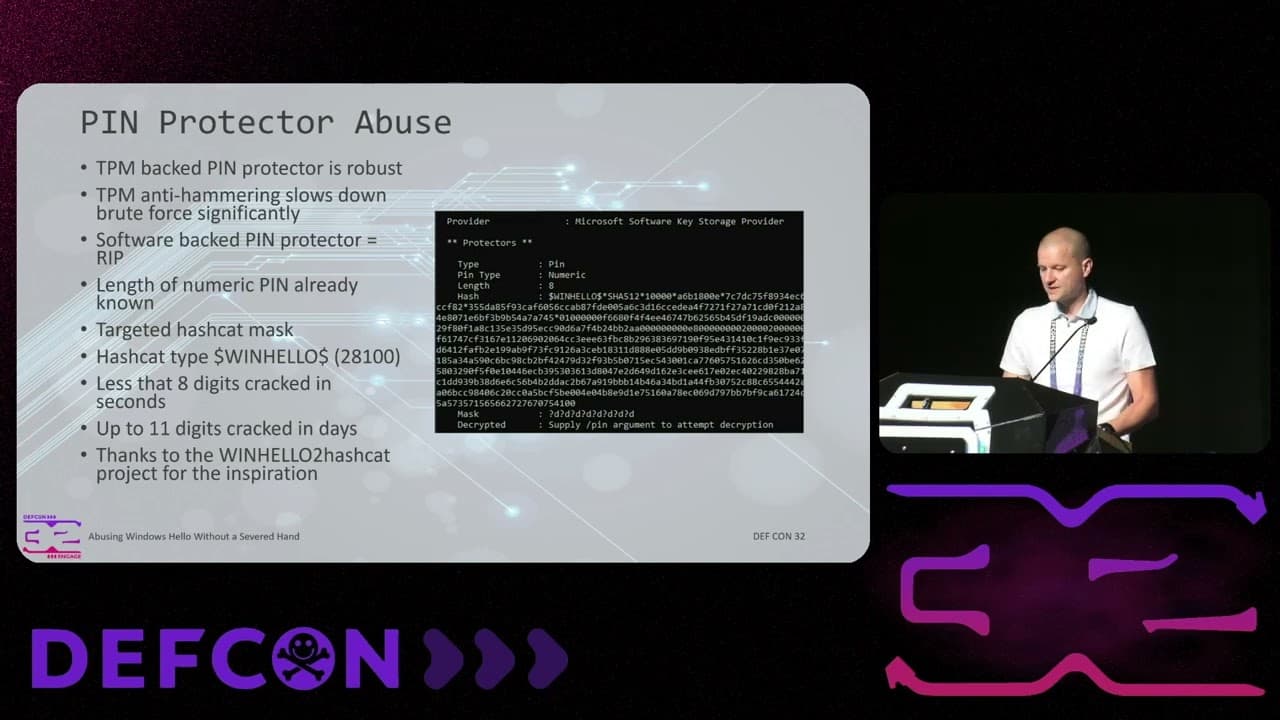
Abusing Windows Hello Without a Severed Hand
Similar Talks
Hacking Apple's USB-C Port Controller
Unmasking the Snitch Puck: The Creepy IoT Surveillance Tech in the School Bathroom