Cookie Crumbles: Unveiling Web Session Integrity Vulnerabilities
This presentation demonstrates novel techniques for exploiting web session integrity through cookie tossing, eviction, and token fixation attacks. The researchers analyze how discrepancies between client-side browser behavior and server-side parsing logic can be leveraged to bypass security mechanisms like the Synchronizer Token Pattern. The talk highlights critical vulnerabilities in popular web frameworks and provides a comprehensive analysis of how legacy design and inconsistent implementation of web standards lead to session hijacking. The researchers also discuss the impact of browser-specific features like Site Isolation on these vulnerabilities.
How Cookie Desynchronization and Token Fixation Break Web Session Integrity
TLDR: Researchers at Black Hat 2023 exposed how discrepancies between browser cookie parsing and server-side logic allow for session hijacking via cookie tossing and token fixation. By exploiting how different frameworks handle cookie limits and naming conventions, attackers can bypass security controls like the Synchronizer Token Pattern. Pentesters should audit their target's cookie handling logic and framework-specific session management to identify these desynchronization vectors.
Web session security relies on the assumption that the browser and the server agree on what a cookie is and how it should be handled. That assumption is fundamentally broken. When a browser and a server disagree on how to parse, store, or evict cookies, you get a desynchronization vulnerability. This is not a theoretical edge case. It is a structural failure in how we manage state across the web, and it is currently being exploited to bypass authentication controls in widely used frameworks.
The Mechanics of Cookie Tossing and Eviction
Cookie tossing is a classic technique, but its impact is often underestimated. If an attacker controls a subdomain, they can set cookies for the parent domain. Because browsers do not enforce strict origin checks for cookies, these tossed cookies are sent along with requests to the parent domain. The server, unable to distinguish between a legitimate session cookie and a malicious one, often processes both.
The real danger emerges when you combine this with cookie eviction. Every browser has a hard limit on the number of cookies it will store for a given domain. When that limit is reached, the browser evicts the oldest cookie to make room for the new one. An attacker can force this eviction by flooding the browser with junk cookies, effectively kicking out the user's legitimate session cookie and replacing it with one they control. This is a reliable way to perform session fixation or to force a user into a state where their session is no longer valid, potentially leading to a fallback to an insecure state.
Bypassing the Synchronizer Token Pattern
The Synchronizer Token Pattern is the industry standard for preventing Cross-Site Request Forgery (CSRF). The pattern assumes that the server generates a unique, random token for each session and that the client must submit this token with every state-changing request.
However, the research presented at Black Hat shows that many frameworks, including Flask and CodeIgniter4, implement this pattern in ways that are vulnerable to token fixation. If the secret used to generate the CSRF token is not rotated upon login, or if the session cookie itself can be manipulated, the entire security model collapses.
Consider the case of a framework that generates a CSRF token as an HMAC of a secret stored in the session. If an attacker can fix the session cookie to a known value before the user logs in, they can predict the resulting CSRF token. The server, seeing a valid token that matches the session, accepts the request as legitimate. This is exactly what happens when the session secret is not properly regenerated after a privilege change.
The Role of Desynchronization
The most fascinating part of this research is the discovery of desynchronization issues caused by browser-specific behaviors and framework-level parsing errors. For example, some frameworks strip leading characters from cookie names, while others do not. If an attacker sets a cookie named __Host-sess=bad and the server parses it as sess=bad, the server might prioritize the attacker's cookie over the legitimate one.
This is not just an implementation bug in one library. It is a systemic issue where the RFC 6265bis standard is interpreted differently by different components of the web stack. When you have an Amazon API Gateway sitting in front of a backend that uses a different parsing logic, you create a desynchronization window. An attacker can craft a cookie that is ignored by the gateway but processed by the backend, effectively smuggling malicious state into the application.
Testing for Session Integrity
If you are on a pentest, stop treating cookies as opaque blobs. Start looking for these discrepancies. Use a tool like Burp Suite to manually inject cookies with varying attributes and observe how the application responds. Does the application accept cookies with duplicate names? Does it handle cookies with empty values or unusual characters?
Check if the CSRF token changes after a login event. If it doesn't, you have a potential token fixation vector. If the application uses a framework like Express or Koa, check the version and see if it is susceptible to known vulnerabilities like CVE-2022-25895 or CVE-2022-29020. The researchers have released their PoC and testing suite on GitHub, which is an excellent starting point for your own research.
Defensive Hardening
Defenders must move toward a "secure by default" posture. This means using __Host- and __Secure- prefixes for all session cookies. These prefixes force the browser to enforce strict security attributes, such as requiring the Secure flag and disallowing the Domain attribute. This effectively mitigates cookie tossing attacks.
Furthermore, ensure that your framework is configured to rotate the session ID and all associated security tokens upon every authentication event. If your framework does not support this, you are building on a foundation of sand. Finally, keep your dependencies updated. Many of these vulnerabilities are fixed in newer versions of the frameworks, but they remain active in legacy deployments.
The web is a complex, distributed system, and we are still learning how to secure the state that holds it together. Cookie management is not a solved problem. It is a constant battle between browser vendors, framework authors, and the attackers who find the gaps in between. Keep digging, keep testing, and don't trust the cookie jar.
CVEs
Vulnerability Classes
All Tags
Up Next From This Conference
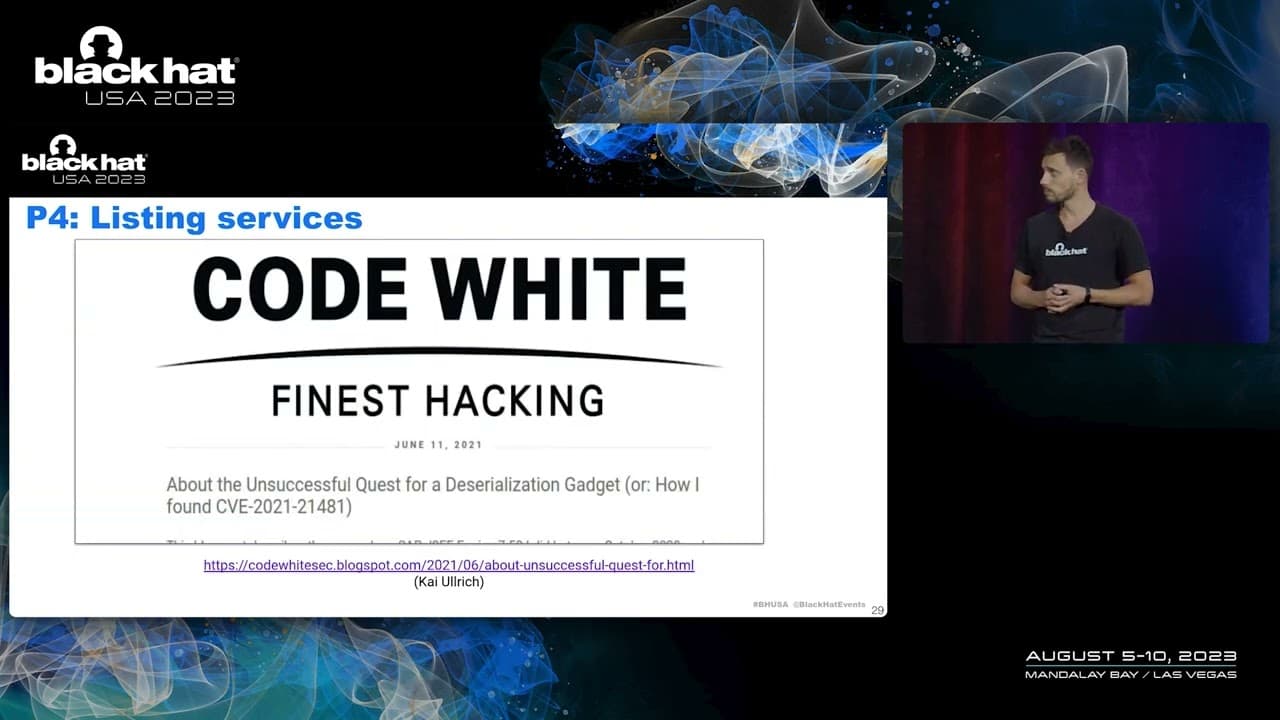
Chained to Hit: Discovering New Vectors to Gain Remote and Root Access in SAP Enterprise Software

Zero-Touch-Pwn: Abusing Zoom's Zero Touch Provisioning for Remote Attacks on Desk Phones
ODDFuzz: Hunting Java Deserialization Gadget Chains via Structure-Aware Directed Greybox Fuzzing
Similar Talks
Kill List: Hacking an Assassination Site on the Dark Web
Hacking Millions of Modems