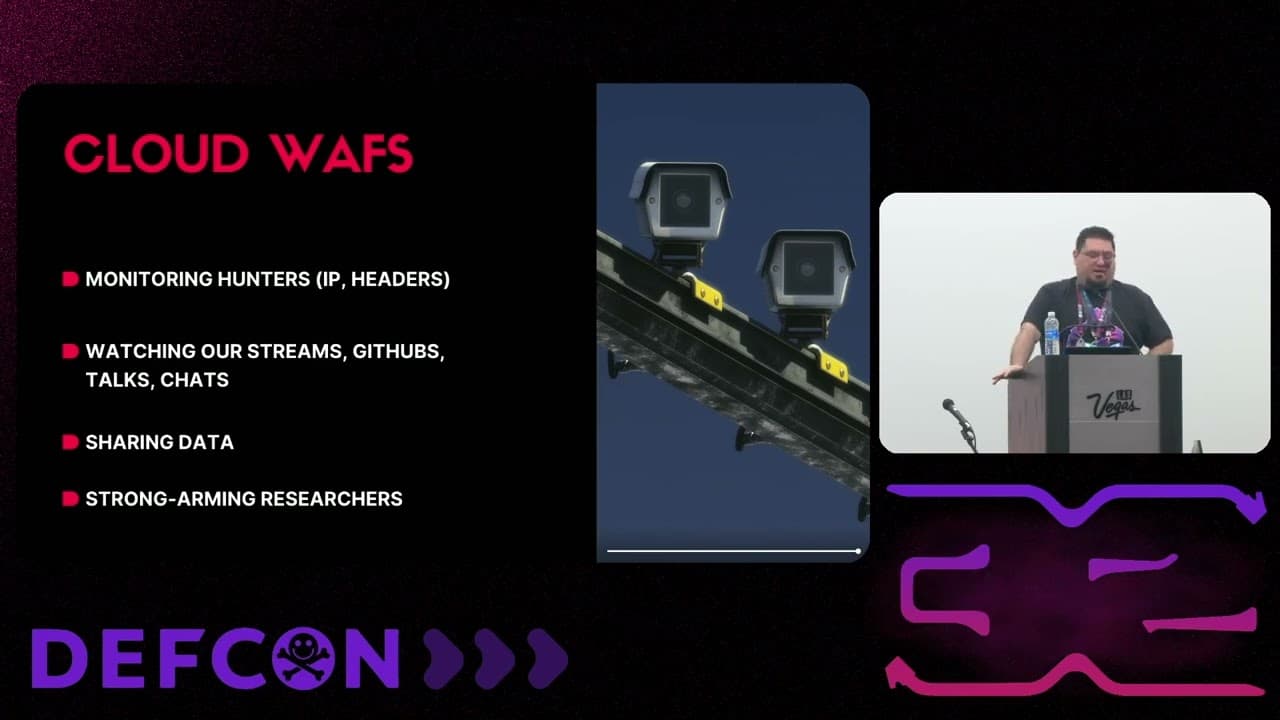
EDR = Erase Data Remotely
This talk demonstrates a technique for remotely triggering arbitrary file deletion on systems protected by EDR solutions by injecting malicious byte signatures into legitimate files. The researchers show how to bypass EDR detection mechanisms by crafting minimal, non-malicious-looking signatures that cause the EDR to flag and delete critical system or application files. The attack is applied to various targets, including web server logs, databases, and virtual machine configuration files, leading to permanent denial-of-service. The presentation includes a tool release, EDRaser, which automates the generation of these malicious signatures.
Weaponizing EDRs: How to Turn Security Agents Into Data Erasers
TLDR: Researchers at Black Hat 2023 demonstrated that EDR solutions can be tricked into deleting arbitrary files by injecting malicious byte signatures into legitimate data. By crafting minimal, non-malicious-looking signatures, an attacker can force an EDR to flag and purge critical system files, databases, or logs. This technique effectively turns a security product into a destructive tool, and the researchers have released a tool called EDRaser to help security teams test their own defenses against this class of vulnerability.
Security researchers often focus on how to bypass EDRs to maintain persistence or execute payloads. It is rare to see research that flips the script entirely, forcing the security agent to do the attacker’s dirty work. The research presented at Black Hat 2023 regarding arbitrary file deletion via EDR signature manipulation is a wake-up call for anyone relying on signature-based detection as a primary defense. When an EDR is configured to automatically quarantine or delete files matching a "malicious" signature, it creates a dangerous dependency on the accuracy and integrity of that signature database.
The Mechanics of the Attack
The core of this research relies on a simple but devastating observation: EDRs are often too eager to trust their own signature-based detection engines. If an attacker can force an EDR to identify a legitimate file as malicious, the EDR will perform the deletion itself, often with system-level privileges that the attacker might not otherwise possess.
The researchers identified that many EDRs use byte-level signatures to detect malware. By isolating these signatures, they could craft "minimal" malicious files. These files do not contain actual malware code. Instead, they contain a specific sequence of bytes that matches a known malicious signature. When the EDR scans these files, it triggers a false positive, identifies the file as a threat, and proceeds with its default remediation action, which is frequently the permanent deletion of the file.
This technique is particularly effective because it exploits the EDR’s automated response logic. During a penetration test, this could be used to wipe out logs, configuration files, or even entire databases without ever needing to run a destructive command directly.
Technical Implementation and Payloads
The researchers demonstrated this by targeting various file types, including web server logs and database files. The process involves identifying the specific byte sequence that triggers a detection and then embedding that sequence into a target file.
For example, when targeting Microsoft IIS or Apache HTTP Server logs, an attacker can send a crafted HTTP request where the user-agent string contains the malicious signature. The web server logs this request, writing the signature to the log file. Once the EDR scans the log file and detects the signature, it flags the entire log file as malicious and deletes it.
The researchers also highlighted CVE-2023-24860, a vulnerability that allowed for this type of manipulation. The following conceptual Python snippet illustrates how one might automate the search for a minimal signature:
# Conceptual logic for finding a minimal signature
for offset in range(len(malicious_file)):
    test_file = malicious_file[:offset] + b'Z' + malicious_file[offset+1:]
    if scanner.detect(test_file):
        # This byte is not part of the signature
        continue
    else:
        # This byte is essential for detection
        signature.append(malicious_file[offset])
By iterating through the file and replacing bytes, the tool identifies the exact sequence required to trigger the EDR. This results in a highly compact, effective payload that is difficult to distinguish from legitimate data.
Real-World Impact and Engagement
For a pentester, this research changes the approach to post-exploitation. Instead of trying to disable an EDR—which is noisy and often triggers behavioral alerts—you can use the EDR’s own rules to clear your tracks. If you need to delete a sensitive file or a database that contains evidence of your presence, you no longer need to execute a del or rm command. You simply need to ensure that the file contains the right byte sequence and wait for the EDR to perform the cleanup for you.
This is also a critical finding for bug bounty hunters. If you can influence the content of a file that an EDR is likely to scan, you may have a path to arbitrary file deletion. This is essentially a form of Injection where the "interpreter" is the EDR’s detection engine.
Defensive Considerations
Defending against this is difficult because it exploits the fundamental design of signature-based detection. Blue teams should prioritize behavioral monitoring over static signature matching. If an EDR is deleting files, there should be an audit trail that explains why that file was flagged. If the "malicious" file is a log file or a database, that should immediately trigger an investigation into the source of the data that caused the detection.
Furthermore, organizations should ensure that their EDR policies are not set to "auto-delete" for critical system directories. A "quarantine" action is safer, as it allows for manual verification before the file is permanently destroyed.
The release of EDRaser provides a practical way to validate these risks. Use it to test your current EDR configuration. If your security agent is willing to delete your production database because of a single injected string, you have a significant gap in your security architecture that no amount of patching will fix. The goal is to move away from blind trust in automated remediation and toward a more nuanced, context-aware approach to threat detection.
Vulnerability Classes
Tools Used
Target Technologies
OWASP Categories
All Tags
Up Next From This Conference
Chained to Hit: Discovering New Vectors to Gain Remote and Root Access in SAP Enterprise Software

Zero-Touch-Pwn: Abusing Zoom's Zero Touch Provisioning for Remote Attacks on Desk Phones

ODDFuzz: Hunting Java Deserialization Gadget Chains via Structure-Aware Directed Greybox Fuzzing
Similar Talks
Kill List: Hacking an Assassination Site on the Dark Web

We are currently clean on OPSEC: The Signalgate Saga