Exploiting Bluetooth: From your car to the bank account
This talk demonstrates multiple Bluetooth Classic vulnerabilities, including Man-in-the-Middle (MitM) and Denial of Service (DoS) attacks, that affect modern automotive infotainment systems. The researchers highlight how these flaws allow for unauthorized access to sensitive data like contact lists and potential exploitation of two-factor authentication tokens. They introduce BlueToolkit, a modular framework designed to automate the discovery and reproduction of these Bluetooth-based exploits across various vehicle manufacturers. The presentation emphasizes the persistent nature of these protocol-level security issues in the automotive industry.
Why Your Car’s Bluetooth Stack Is a Massive Attack Surface
TLDR: Modern automotive infotainment systems are riddled with protocol-level Bluetooth Classic vulnerabilities that remain unpatched for years. Researchers have released BlueToolkit, a modular framework that automates the discovery and reproduction of Man-in-the-Middle and Denial of Service attacks against these systems. Pentesters can use this tool to extract sensitive data like contact lists and intercept two-factor authentication tokens sent via SMS.
Automotive security research often focuses on CAN bus injection or remote telematics exploits, but the most accessible entry point into a modern vehicle is sitting right in the infotainment head unit. Bluetooth Classic is not just a way to stream music; it is a complex, multi-layered protocol stack that handles phonebooks, SMS messages, and SIM access. When you pair your phone to a rental car or a shared vehicle, you are effectively handing over a set of keys to the car’s internal network.
The research presented at DEF CON 2024 highlights a critical reality for anyone performing hardware or automotive penetration testing. Bluetooth implementations in vehicles are notoriously outdated, often lagging seven years behind the latest core specifications. This delay creates a persistent, unpatchable attack surface that manufacturers seem content to ignore.
The Mechanics of the Attack
The core issue lies in the Bluetooth Classic security model, which relies on a binary "connected or not" state. Once a connection is established, the trust model assumes the device is legitimate. Researchers identified that by manipulating the pairing process, an attacker can force a Man-in-the-Middle (MitM) position even on systems that claim to use secure pairing methods like Numeric Comparison.
The attack flow is straightforward for a researcher with the right hardware. By spoofing the MAC address of a previously paired device or initiating a new pairing request with a malicious controller, an attacker can intercept the PBAP (Phone Book Access Profile) data exchange. In a real-world scenario, this allows an attacker to pull the entire contact list from a victim's phone without the victim ever realizing their data has been exfiltrated.
More concerning is the ability to hijack SMS messages. Many vehicles support the MAP (Message Access Profile) to display incoming texts on the dashboard. If an attacker can successfully MitM the Bluetooth connection, they can read incoming SMS messages, including those containing two-factor authentication codes. This turns the car into a passive listener for the victim's most sensitive account recovery traffic.
Automating the Exploitation with BlueToolkit
Reproducing these vulnerabilities manually is time-consuming, especially when dealing with the quirks of different automotive head units. The researchers released BlueToolkit to solve this. The framework is modular, allowing researchers to load specific exploit payloads via YAML files.
For a pentester, the workflow is simple:
- Load the target exploit module into the engine.
- Connect the ESP-WROVER-KIT or a similar Bluetooth-capable controller.
- Initiate the connection to the vehicle’s infotainment system.
- Observe the logs for successful profile extraction.
The tool handles the heavy lifting of protocol negotiation, which is where most manual attempts fail due to the complexity of the Bluetooth stack. During their research, the team tested 22 different vehicles from major manufacturers and found 73 distinct vulnerabilities. Many of these were critical, including remote code execution and memory leakage, which fall squarely under OWASP A07:2021 – Identification and Authentication Failures.
Real-World Engagement Strategy
If you are tasked with assessing an automotive system, do not skip the infotainment unit. Start by identifying the Bluetooth profiles supported by the head unit. Use sdptool or btmgmt to enumerate the services. If you see PBAP or MAP enabled, you have a direct path to sensitive user data.
During an engagement, focus on the pairing phase. If the system allows "Just Works" pairing, it is trivial to intercept. Even if it forces Numeric Comparison, look for implementation flaws where the system fails to properly validate the pairing confirmation. If you can trigger a Denial of Service (DoS) attack, you might force the system to reboot, potentially clearing existing security states and allowing you to re-pair with your own malicious device.
Defensive Considerations
Defending against these attacks is difficult because the vulnerabilities are often baked into the protocol stack provided by third-party vendors. Manufacturers must prioritize updating their Bluetooth firmware, but this is rarely a priority for legacy infotainment systems. If you are working with a client in the automotive space, push for the implementation of strict Bluetooth pairing policies and, where possible, disable unused profiles like MAP and PBAP.
The reality is that as long as cars are treated as interconnected IoT devices, they will inherit the security flaws of the protocols they use. Bluetooth is a mature technology, but its implementation in the automotive sector remains a glaring weakness. For researchers, this is an open field. The next time you rent a car, consider that the infotainment system might be the most interesting target in the parking lot.
Vulnerability Classes
Tools Used
Target Technologies
Attack Techniques
OWASP Categories
All Tags
Up Next From This Conference
Breaking Secure Web Gateways for Fun and Profit
Listen to the Whispers: Web Timing Attacks That Actually Work
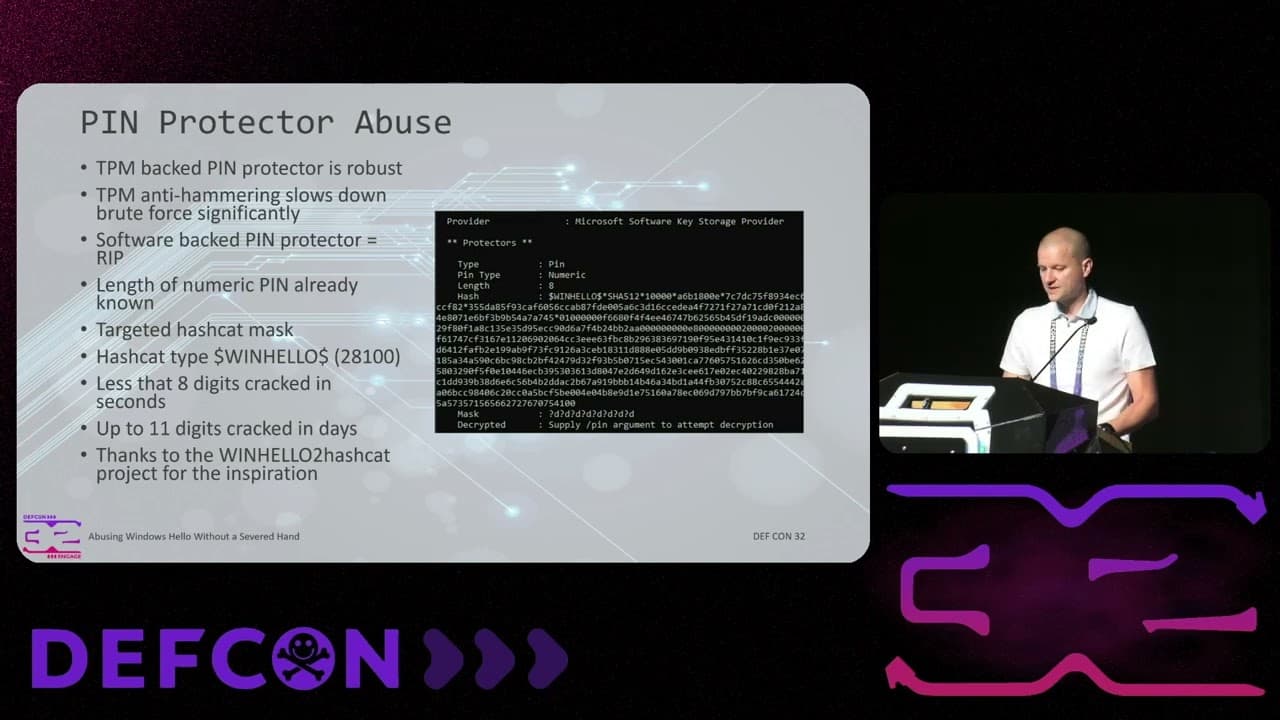
Abusing Windows Hello Without a Severed Hand
Similar Talks
Anyone Can Hack IoT: A Beginner's Guide to Hacking Your First IoT Device

Firewalls Under Fire: China's Ongoing Campaign to Compromise Network Protection Devices