Firmware Reverse Engineering and Security Analysis
This talk demonstrates techniques for extracting and analyzing encrypted firmware from embedded devices, specifically focusing on D-Link access points. The speaker details how to identify and bypass encryption mechanisms, including the use of XOR operations and hardcoded keys, to gain access to the underlying file system. The presentation highlights the importance of hardware-level analysis, such as identifying UART ports and using bootloader commands, to facilitate firmware extraction and analysis. The speaker also introduces a custom tool, 'delink', designed to automate the decryption and analysis of these firmware images.
Breaking D-Link Firmware Encryption: A Practical Guide to Embedded Exploitation
TLDR: This research demonstrates how to bypass weak, custom firmware encryption on D-Link access points by identifying XOR-based obfuscation and hardcoded keys. By leveraging UART access and bootloader manipulation, researchers can extract and decrypt firmware to uncover critical vulnerabilities like command injection. This workflow provides a repeatable methodology for pentesters to analyze similar embedded devices that rely on security-through-obscurity.
Embedded devices are often treated as black boxes by security teams, but the reality is that most consumer-grade hardware is built on a foundation of fragile, custom security implementations. When vendors attempt to protect their firmware with encryption, they frequently fall into the trap of using static keys or simple XOR operations that are easily reversed. This research into D-Link access points proves that even when a vendor tries to lock down their firmware, a bit of patience and the right hardware access can turn a "secure" device into a playground for vulnerability research.
The Mechanics of Weak Encryption
Most of the D-Link devices analyzed in this research share a common, flawed approach to firmware protection. Instead of using industry-standard cryptographic primitives, the vendor opted for custom obfuscation. When you pull the firmware apart, you will often find a header followed by a string marked as "salted." In the context of these devices, that salt is a dead giveaway for OpenSSL-based encryption, but the implementation is where the vulnerability lies.
The encryption process often relies on a pass-phrase that is derived from static hardware identifiers, such as the device's hardware ID and model name. By performing a SHA hash on these identifiers, the firmware generates a key used for the encryption. Because this key generation process is deterministic and the inputs are easily discoverable, the encryption provides zero protection against a motivated researcher.
To automate the decryption process, the research introduced a tool called delink. This tool handles the heavy lifting of identifying the encryption parameters and applying the correct decryption logic. If you are dealing with similar devices, the first step is always to check for these patterns in the binary header. If you see a "salted" string, you are likely looking at a standard OpenSSL implementation that can be cracked once you identify the pass-phrase derivation logic.
Hardware Access and Bootloader Exploitation
Software analysis is only half the battle. To get the firmware off the device in the first place, you need to interact with the hardware. Identifying the UART port is the standard starting point for any embedded engagement. Once you have a serial connection, you can often drop into the U-Boot shell.
U-Boot is a powerful tool for an attacker. It allows you to manipulate the boot process, pass arguments to the kernel, and, most importantly, dump the contents of the flash memory. By setting the init argument to /bin/sh or a similar shell, you can often force the device to drop you into a root shell during the boot sequence.
Once you have a shell, you can use standard Linux utilities to read the flash chip directly. If the device lacks a convenient UART port, you can always resort to desoldering the flash chip and using a hardware programmer to read the raw data. This is more time-consuming, but it is a guaranteed way to get a clean image for analysis.
Finding Vulnerabilities in the Wild
Once you have the decrypted file system, the real work begins. The research identified multiple instances of command injection within the web management interfaces of these devices. These vulnerabilities are common in embedded systems where user input from a web form is passed directly to a system call without proper sanitization.
For example, the web server might take a time zone setting and pass it to a shell command to update the system clock. If you can inject shell metacharacters into that input, you can execute arbitrary code with root privileges. During the research, this was achieved by manipulating the tz_location parameter in the admin interface. By setting this to a crafted string, the web server executed a telnet command, granting a root shell.
This type of vulnerability is a goldmine for bug bounty hunters. If you are testing a device, focus your efforts on the administrative endpoints that interact with system-level configurations. These are the areas where developers are most likely to take shortcuts, assuming that only an authenticated administrator will ever touch these settings.
Defensive Considerations
For manufacturers, the lesson is clear: custom encryption is not security. If you must encrypt firmware, use established, peer-reviewed cryptographic libraries and ensure that keys are not derived from static, predictable hardware identifiers. Furthermore, disable or physically remove UART and JTAG headers in production units to prevent unauthorized access to the bootloader.
For the rest of us, the next time you encounter a "secure" embedded device, don't take the vendor's word for it. Assume the encryption is weak, look for the hardware debug ports, and start dumping the flash. The most interesting vulnerabilities are usually hidden in the code that the vendor thought no one would ever see.
Vulnerability Classes
Target Technologies
OWASP Categories
Up Next From This Conference

Reverse Engineering Go-Based Malware with AI

No Brain, No Gain: The Next Frontier in IoT/ICS Authentication
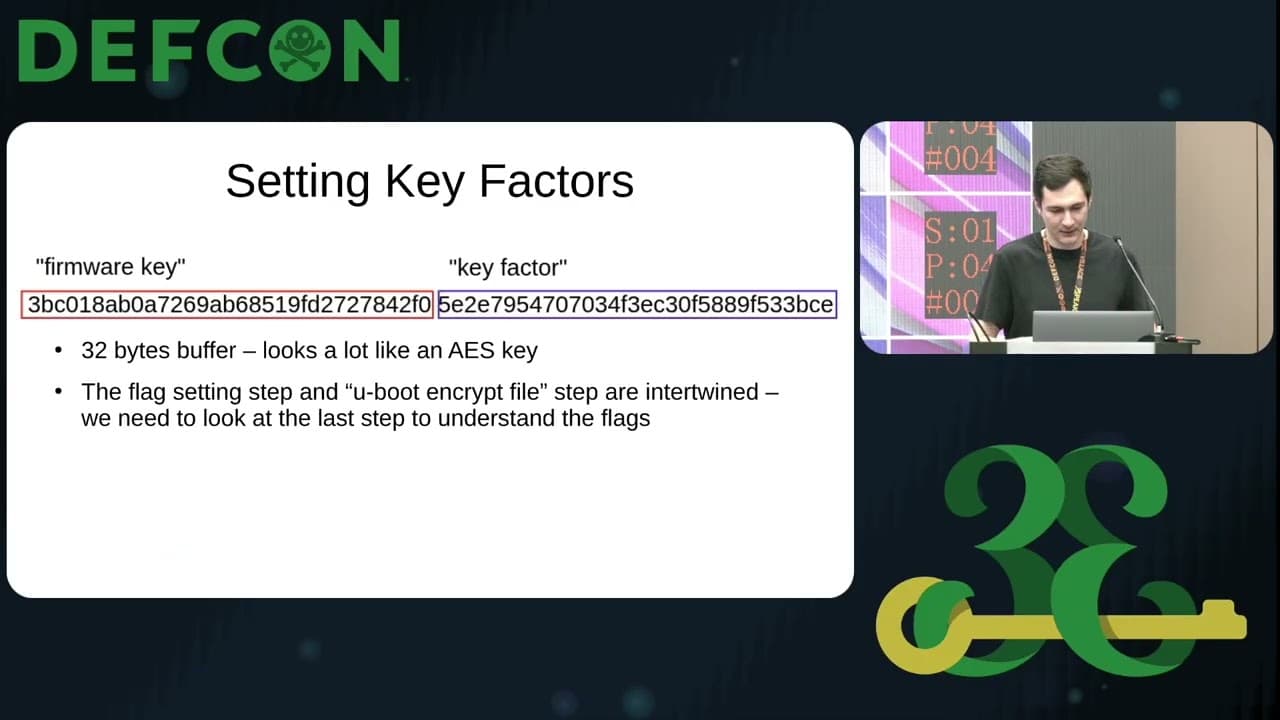
Never Enough About Cameras - The Firmware Encryption Keys Hidden Under the Rug
Similar Talks
Hacking Apple's USB-C Port Controller

Unmasking the Snitch Puck: The Creepy IoT Surveillance Tech in the School Bathroom