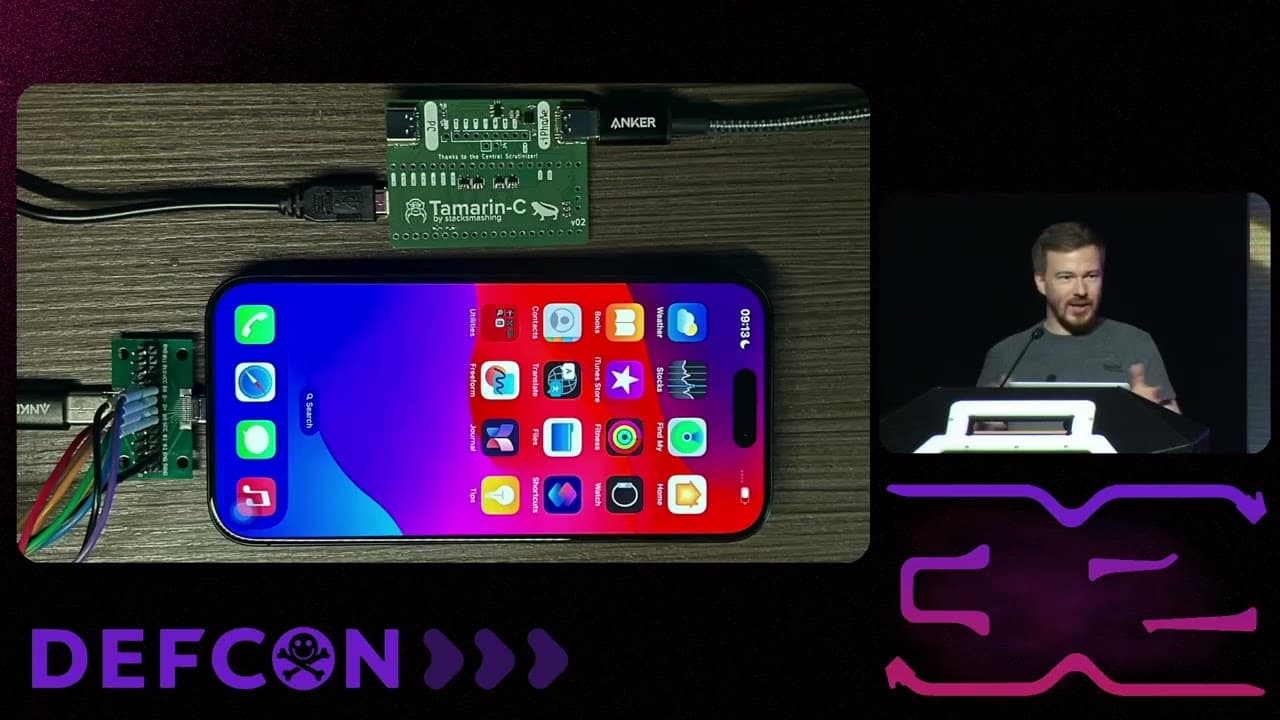
Grand Theft House: RF Lock Pick Tool to Unlock Smart Door Lock
This talk demonstrates multiple RF-based attack techniques, including rolling code replay, roll-back, and loop playback attacks, to bypass security on various smart door locks. The researchers analyze the proprietary RF protocols and weak key generation schemes used by multiple vendors to identify vulnerabilities in the authentication process. The presentation provides a practical guide for building a custom RF-based lock-picking tool using low-cost hardware like Arduino and RF chips. The findings highlight the critical need for robust, non-predictable key generation and secure synchronization mechanisms in IoT door lock systems.
Why Your Smart Door Lock Is Just a Radio-Controlled Toy
TLDR: Researchers at Black Hat 2023 demonstrated that many commercial smart door locks rely on predictable, weak RF protocols that are trivial to intercept and replay. By analyzing proprietary baseband encoding and key generation schemes, they built a low-cost "Code Crusher" tool capable of bypassing authentication without physical access. This research proves that security through obscurity in IoT hardware is a failed strategy, and manufacturers must move toward non-predictable, cryptographically sound synchronization mechanisms.
Security researchers often treat IoT hardware as a black box, assuming that if the protocol is proprietary, it is inherently difficult to reverse. The reality, as demonstrated by the "Grand Theft House" research, is that proprietary protocols are often just poorly implemented, custom-built wrappers around standard RF chips. When vendors attempt to secure these systems using nothing more than a hardcoded key or a predictable counter, they aren't building a fortress; they are building a house of cards that can be knocked down with a few dollars worth of hardware.
The Anatomy of an RF Bypass
The core issue identified in this research is the reliance on insecure synchronization and key generation. Many smart locks use a rolling code mechanism to prevent simple replay attacks, but the implementation is frequently flawed. The researchers found that by capturing consecutive signals, an attacker can extract the device ID and the current counter value. Once these two pieces of data are known, the attacker can generate a valid, future-dated signal that the lock will accept as legitimate.
The attack flow is straightforward for anyone familiar with Software Defined Radio (SDR). Using a combination of a HackRF One or similar SDR and GNU Radio, the researchers identified the center frequency and modulation parameters of the target locks. Most of these devices operate in the 447 MHz range with a narrow bandwidth, making them highly susceptible to targeted jamming and signal capture.
Breaking Proprietary Encryption
What makes this research particularly compelling is the deep dive into how these vendors generate their encryption keys. Rather than using a robust, industry-standard key exchange, many vendors use a "Key Generation Seed" derived from the device's current counter or a hardcoded lookup table.
The researchers discovered that by analyzing the baseband encoding, they could reverse-engineer the key derivation function. In one instance, the lock used a simple XOR operation combined with a lookup table to generate the key. Because the lookup tables were static across product lines, once the researchers cracked the algorithm for one device, they effectively compromised the entire vendor's ecosystem.
If you are performing a penetration test on an IoT device, the first step is always to move past the application layer and look at the physical signal. You can use a tool like Universal Radio Hacker to analyze the captured waveforms. If you see a pattern that repeats or shifts predictably based on the counter, you have found your entry point.
# Conceptual logic for generating a valid future signal
def generate_next_packet(device_id, current_counter, secret_key):
    # The vulnerability lies in the predictability of the next counter
    next_counter = current_counter + 1
    # Replicating the vendor's weak key derivation
    derived_key = derive_key(secret_key, next_counter)
    # Constructing the packet with the forged counter
    return encrypt(device_id, next_counter, derived_key)
Real-World Implications for Pentesters
During a red team engagement, the ability to unlock a door without leaving a trace is the ultimate objective. This research shows that you don't need a high-end lab to achieve this. The "Code Crusher" tool described in the talk can be built for under $50 using an Arduino, a basic RF transceiver chip, and an EEPROM programmer.
For a pentester, the impact is clear: if the target facility uses these smart locks, the physical security perimeter is effectively non-existent. You can deploy a small, battery-powered sniffer near an entrance, wait for a legitimate user to unlock the door, and capture the signal. Even if the lock uses a rolling code, the "rollback" or "loop playback" techniques demonstrated allow you to force the lock into a state where it accepts your captured, forged signal.
The Defensive Reality
Defending against these attacks requires a fundamental shift in how IoT manufacturers approach security. The OWASP IoT Top 10 clearly identifies "Insecure Authentication" as a primary failure point. Manufacturers must stop relying on security through obscurity.
If you are working with a client to secure these devices, the recommendation is simple: move to a challenge-response authentication model. A static or predictable counter is not enough. The device and the key fob must perform a mutual authentication handshake that involves a cryptographically secure, non-predictable challenge. If the device cannot support this, it should not be used in any environment where physical security is a requirement.
Security researchers should continue to push for transparency in these protocols. When a vendor claims their RF protocol is "secure," they should be prepared to open it up for public scrutiny. If they refuse, assume the worst. The next time you walk past a smart lock, remember that the security it provides is only as good as the math behind its signal, and right now, that math is failing.
Vulnerability Classes
Target Technologies
Attack Techniques
OWASP Categories
Up Next From This Conference

A New Attack Interface In Java Applications
Inference Attacks on Endpoint Privacy Zones in Fitness Tracking Social Networks

Abusing Azure Active Directory: From MFA Bypass to Listing Global Administrators
Similar Talks
Inside the FBI's Secret Encrypted Phone Company 'Anom'
Kill List: Hacking an Assassination Site on the Dark Web