Ground Control to Major Threat: Hacking the Space Link Extension Protocol
This talk demonstrates how to perform man-in-the-middle (MitM) attacks against the Space Link Extension (SLE) protocol, which is used for communication between ground stations and spacecraft. The researcher shows how to intercept, decode, and manipulate SLE protocol data units (PDUs) to hijack control sessions and send unauthorized telecommands. The presentation highlights the lack of encryption and authentication in the protocol, allowing for session hijacking and command injection. The researcher provides a proof-of-concept demonstration using custom Python scripts to perform ARP spoofing and manipulate SLE traffic.
How to Hijack Spacecraft Telemetry via the Unencrypted SLE Protocol
TLDR: The Space Link Extension (SLE) protocol, a standard for ground-to-spacecraft communication, lacks native encryption and robust authentication, making it trivial to intercept and manipulate. By performing an adversary-in-the-middle (MitM) attack on the ground segment, an attacker can capture session credentials and inject unauthorized telecommands. Security researchers must prioritize testing these ground-based interfaces, as they represent the most accessible and vulnerable attack surface in modern space missions.
Space missions are often viewed as impenetrable, high-security environments, but the reality is that the ground segment is built on standard, often insecure, networking infrastructure. The Space Link Extension (SLE) protocol is the primary mechanism used by major space agencies and private contractors to bridge the gap between mission control systems and ground stations. While the satellite itself is physically isolated, the ground segment is just another network node. If you can compromise the local network where these systems reside, you can effectively take control of the spacecraft.
The Vulnerability: Protocol Design Over Security
At its core, the SLE protocol is designed for reliability and interoperability, not for a hostile network environment. It relies on TCP/IP for transport and uses Abstract Syntax Notation One (ASN.1) for data encoding. The protocol defines various operations, such as BIND, START, and TRANSFER-DATA, which are used to establish sessions and send telecommands.
The critical failure here is the complete absence of native encryption. Because the protocol assumes a trusted environment, all data transmitted between the Mission Control System (MCS) and the ground station is sent in the clear. Furthermore, while the protocol includes sequence numbering to prevent basic command injection, these mechanisms are insufficient against a determined attacker who can intercept and modify traffic in real-time. This falls squarely into the OWASP A07:2021 – Identification and Authentication Failures category, as the lack of encryption allows for session hijacking and credential theft.
Exploiting the Ground Segment
During a penetration test or a red team engagement, the ground segment is your primary target. You do not need to target the satellite directly; you only need to be in a position to perform an adversary-in-the-middle attack on the network segment connecting the MCS to the ground station.
The attack flow is straightforward:
- ARP Spoofing: Use standard tools to poison the ARP tables of the MCS and the ground station, forcing traffic through your machine.
- Traffic Capture: Use netfilter-queue to intercept the TCP frames containing the SLE PDUs.
- Decoding and Manipulation: Since the protocol uses ASN.1, you can easily decode the traffic. By identifying the BIND operation, you can extract the authentication credentials.
- Command Injection: Once you have the credentials, you can either drop the legitimate session or inject your own malicious telecommands into the stream.
Because the SLE provider (the ground station) simply drops the connection upon an authentication failure without providing meaningful feedback to the user, you can perform these actions in a stealthy manner. The operators at the mission control center often have no visibility into why a session dropped, making it difficult to detect that an attacker is actively manipulating the link.
Practical Implications for Researchers
If you are auditing space-related infrastructure, your focus should be on the ground segment's network architecture. Look for weak segmentation between the office LAN and the operational LAN. If the MCS is accessible from a compromised workstation on the same network, the entire mission is at risk.
The impact of this vulnerability is severe. An attacker who successfully hijacks an SLE session can send arbitrary telecommands to the spacecraft. Depending on the mission, this could range from dumping sensitive telemetry data to altering the satellite's operational state.
Moving Toward Secure Ground Links
Defending against these attacks requires moving away from the assumption of a trusted network. While the CCSDS (Consultative Committee for Space Data Systems) is working on security standards like the Space Data Link Security (SDLS) protocol, these are often only implemented between the ground station and the spacecraft. The link between the MCS and the ground station remains the weak point.
Implementing TLS for the transport layer between the MCS and the ground station is the most immediate and effective mitigation. This would prevent the interception of credentials and the manipulation of PDUs. Additionally, adopting Public Key Infrastructure (PKI) concepts for authentication, rather than relying on static credentials, would significantly raise the bar for any attacker.
Space security is no longer a theoretical exercise. As the number of commercial and government satellites increases, the reliance on standardized, unencrypted protocols like SLE creates a massive, overlooked attack surface. For those of us in the security community, the challenge is to treat these ground-based systems with the same rigor we apply to any other critical infrastructure. If you can reach the ground station, you can reach the stars.
Vulnerability Classes
Tools Used
Target Technologies
Attack Techniques
OWASP Categories
Up Next From This Conference
Breaking Secure Web Gateways for Fun and Profit
Listen to the Whispers: Web Timing Attacks That Actually Work
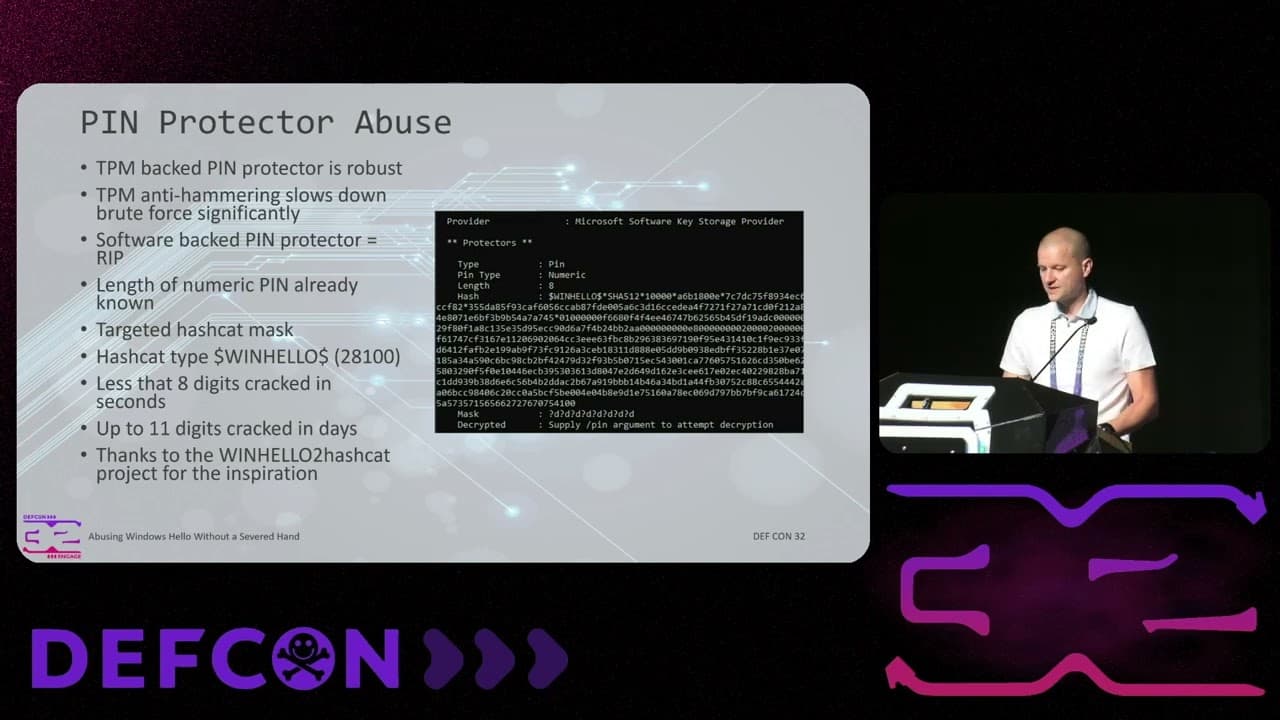
Abusing Windows Hello Without a Severed Hand
Similar Talks
Inside the FBI's Secret Encrypted Phone Company 'Anom'
Kill List: Hacking an Assassination Site on the Dark Web