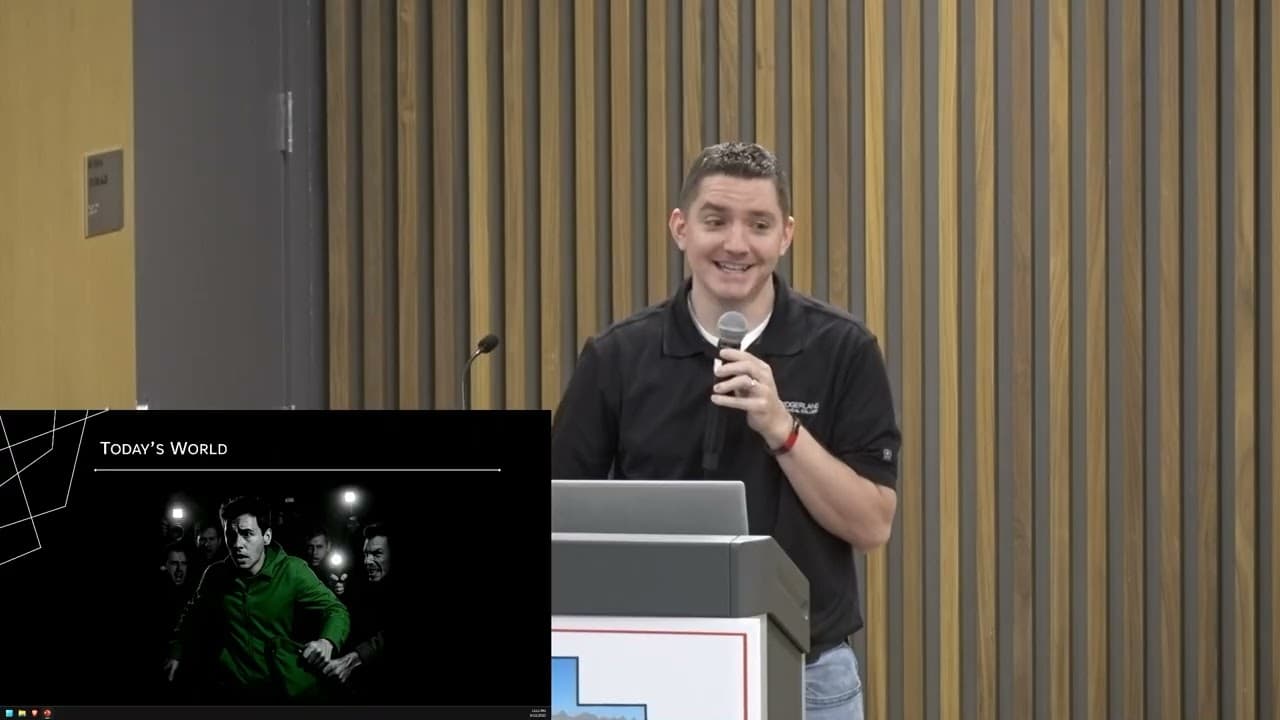
Hackad: A Digital Experiment
This talk details a series of social engineering and physical security penetration tests conducted against private individuals and a public housing company. The presenter demonstrates how techniques such as phishing, malicious USB drops, and physical tailgating can be used to gain unauthorized access to personal and corporate accounts. The presentation highlights the critical role of weak password practices and the failure of multi-factor authentication in real-world scenarios. The talk concludes with a call for stronger, passwordless authentication mechanisms.
Beyond the Phish: Why Your Password Hygiene is Still Failing
TLDR: This research highlights how easily attackers bypass modern security controls by exploiting human behavior and poor password management. By combining physical tailgating, malicious USB drops, and credential harvesting, the researchers demonstrated that even "strong" passwords are useless when they are reused or stored in plaintext. Security teams must move beyond simple password policies and prioritize passwordless authentication to mitigate these persistent risks.
Security professionals often treat social engineering as a secondary concern, something to be checked off during a compliance audit rather than a primary attack vector. The reality is that while we spend millions on EDR, SIEM, and cloud-native security, the most effective way to compromise a target remains the same: tricking a human into handing over the keys. This research from Black Hat 2023 serves as a brutal reminder that our obsession with complex password requirements has done little to stop attackers. In fact, it has arguably made the problem worse by forcing users to rely on insecure storage methods.
The Mechanics of the Compromise
The research team behind this project didn't rely on zero-day exploits or complex chain vulnerabilities. Instead, they focused on the fundamental failure of Identification and Authentication mechanisms. By targeting both private individuals and a public housing company, they mapped out a path from initial access to full domain compromise.
The attack flow began with simple, high-impact social engineering. In one instance, they used a fake parking fine notification sent via SMS, directing the target to a phishing site designed to harvest credentials. When the target clicked the link, they were presented with a familiar login prompt. The effectiveness of this technique relies on the fact that users are conditioned to trust these interfaces. Once the credentials were captured, the team moved laterally.
The physical component of the research was equally effective. By tailgating into an office building, the team gained physical access to the internal network. Once inside, they connected a Raspberry Pi to the network, establishing a persistent, remote connection. This allowed them to perform internal reconnaissance and execute attacks like Responder to capture NTLM hashes.
From Hashes to Domain Admin
Once the team had a foothold on the internal network, the transition to domain compromise was trivial. They utilized Kerberoasting to identify service accounts with weak passwords. By requesting service tickets for these accounts, they could extract the encrypted hashes and crack them offline.
The technical detail that stands out here is the reliance on password reuse. Even when a target had a "strong" password, it was often the same one used across multiple services, including personal accounts. The researchers demonstrated that once they cracked a single password, they could often access the target's entire digital life, including their browser-stored credentials.
# Example of a typical Kerberoasting workflow using Impacket
python3 GetUserSPNs.py -dc-ip <DC_IP> <DOMAIN>/<USER>:<PASSWORD> -request
The browser-stored password database is a goldmine for any attacker. On macOS, these databases are encrypted, but the key is stored in the user's keychain. If an attacker can obtain the user's login password, they can unlock the keychain and dump the entire database in plaintext. This is exactly what happened in the research: once the team had the user's password, they had access to hundreds of credentials, including those for corporate systems.
Real-World Applicability for Pentesters
For those of us conducting red team engagements, this research highlights the importance of testing the entire chain of trust. It is not enough to simply test the web application or the external perimeter. You must test how the organization handles credential storage and how employees respond to physical and digital social engineering.
During an engagement, look for the "low-hanging fruit" that organizations ignore. Are employees using the same password for their email and their VPN? Is the office environment secure enough to prevent someone from plugging a device into an open ethernet port? These are not theoretical risks. They are the primary ways that real-world breaches occur. If you can demonstrate that a single, weak password can lead to domain admin, you have provided more value to your client than a dozen high-severity web vulnerabilities.
The Path to Passwordless
Defenders must stop blaming users for choosing weak passwords. If your system requires a password that is complex, frequently changed, and unique, you are essentially forcing your users to write it down or store it in an insecure file. The solution is to remove the password entirely.
Organizations should be aggressively moving toward FIDO2-based authentication and other passwordless mechanisms. When you remove the ability for a user to type a password, you remove the ability for an attacker to phish it. This is the only way to break the cycle of credential theft that has plagued the industry for decades.
Stop focusing on the noise of complex password policies. Start focusing on the signal of authentication failures. If you are still relying on passwords as your primary defense, you are already behind. The next time you are on an engagement, don't just look for the exploit. Look for the human, and you will likely find the path to the domain controller.
Vulnerability Classes
Tools Used
Attack Techniques
OWASP Categories
Up Next From This Conference

A New Attack Interface In Java Applications
Inference Attacks on Endpoint Privacy Zones in Fitness Tracking Social Networks

Abusing Azure Active Directory: From MFA Bypass to Listing Global Administrators
Similar Talks
Inside the FBI's Secret Encrypted Phone Company 'Anom'

Kill List: Hacking an Assassination Site on the Dark Web