Leveraging AI for Smarter Bug Bounties
This talk demonstrates the use of autonomous AI agents to perform end-to-end bug bounty exploitation, including reconnaissance, vulnerability identification, and payload delivery. The researchers showcase the AI's ability to navigate complex web application authentication flows, bypass security filters, and perform remote code execution. The presentation highlights the potential for AI to act as a force multiplier for security researchers by automating repetitive tasks and adapting to target-specific security controls. The demo features the AI successfully exploiting multiple vulnerabilities, including CVE-2022-39227, across various CTF-style targets.
Automating the Full Exploit Chain: When AI Agents Move Beyond Recon
TLDR: Autonomous AI agents are no longer limited to simple reconnaissance or script generation. Recent research demonstrates that LLM-based agents can now navigate complex authentication flows, identify injection points, and execute multi-step exploit chains against web applications without human intervention. This shift signals a future where bug bounty hunters and red teams will use AI to handle the heavy lifting of initial access, allowing them to focus on high-value, complex logic flaws.
Security research has long been a game of manual iteration. We spend hours mapping endpoints, crafting payloads, and manually chaining requests to bypass filters. While tools like Burp Suite or custom Python scripts have automated parts of this, the "thinking" part—the decision-making process when a payload fails or a filter blocks a character—has remained firmly in the human domain. That is changing.
Recent demonstrations at DEF CON 2024 showcased how autonomous AI agents can now handle the entire lifecycle of a bug bounty engagement. These agents don't just scan for vulnerabilities; they interact with the target, analyze responses, learn from failures, and adapt their strategy in real-time. This isn't just about speed; it is about the ability to maintain state and context across a complex, multi-step exploit chain.
The Mechanics of Autonomous Exploitation
The core of this research involves an agent capable of interacting with a web application as a user would. It performs reconnaissance, identifies potential entry points, and then attempts to exploit them. If a request returns a 403 Forbidden or a 405 Method Not Allowed, the agent doesn't just stop. It analyzes the response, determines why the request failed, and modifies its next attempt.
Consider the exploitation of CVE-2022-39227, a vulnerability in the python-jwt library. In a traditional manual test, a researcher would need to identify the library version, understand the specific flaw, and craft a token that exploits the signature verification bypass. An autonomous agent can perform this by:
- Reconnaissance: Using tools like
curlordirbto map the application structure. - Analysis: Identifying the use of JWTs and the underlying library.
- Exploitation: Crafting a malicious token that changes the
usernameclaim toadmin. - Verification: Sending the forged token to an authenticated endpoint to confirm access.
The agent demonstrated the ability to handle OWASP A01:2021-Broken Access Control scenarios by dynamically adjusting its requests. When it encountered a CSRF token requirement, it didn't get stuck. It navigated to the login page, extracted the token from the HTML, and included it in the subsequent POST request. This level of state management is what separates these agents from simple fuzzers.
Handling Complex Filter Bypasses
One of the most impressive aspects of this research is how the agents handle server-side filtering. When testing for Cross-Site Scripting (XSS), the agent often hits a wall where specific characters like < or > are blocked.
Instead of giving up, the agent attempts various encoding techniques. It might try URL encoding, HTML entity encoding, or even JavaScript string manipulation using String.fromCharCode(). If the first attempt fails, it analyzes the error message or the reflected output and tries a different encoding. This iterative process is exactly what a senior pentester does, but the agent performs it in seconds.
For example, when faced with a filter blocking standard script tags, the agent might pivot to an img tag with an onerror event handler:
<img src=x onerror=alert('XSS')>
If that is blocked, it might encode the payload to bypass the filter:
<img src=x onerror=eval(String.fromCharCode(97,108,101,114,116,40,39,88,83,83,39,41))>
The agent's ability to "learn" from these failures—by observing that a specific character was blocked and then choosing an alternative encoding—is a significant leap forward in automated exploitation.
Real-World Implications for Pentesters
For those of us in the field, this technology is a force multiplier. During a standard web application penetration test, we often spend the first day or two on tedious tasks: registering accounts, testing password reset flows, and mapping out the application's API. These are the tasks that AI agents excel at.
By offloading this work to an agent, we can spend our time on the "hard" challenges—the complex business logic flaws that require a deep understanding of the application's intent. The research showed that while AI agents are highly effective at "easy" and "medium" difficulty challenges, they still struggle with the most complex, multi-layered logic bugs. This is where the human expert remains indispensable.
A Note on Defense
Defenders need to recognize that the barrier to entry for sophisticated, automated attacks is dropping. If an AI agent can identify and exploit a vulnerability in minutes, your patching cycle needs to be faster. More importantly, this research highlights the importance of defense-in-depth. Relying on simple input filters or blacklists is increasingly futile against agents that can dynamically adapt their payloads. Focus on structural security, such as implementing robust Content Security Policy (CSP) and ensuring that authentication and authorization are handled consistently across all API endpoints.
The future of security testing isn't about AI replacing researchers; it is about researchers who use AI to outpace the threats. We are moving toward a model where the agent handles the noise, and the human handles the nuance. Start experimenting with these techniques now, because the attackers are already doing it.
Vulnerability Classes
Target Technologies
Attack Techniques
All Tags
Up Next From This Conference
Breaking Secure Web Gateways for Fun and Profit
Listen to the Whispers: Web Timing Attacks That Actually Work
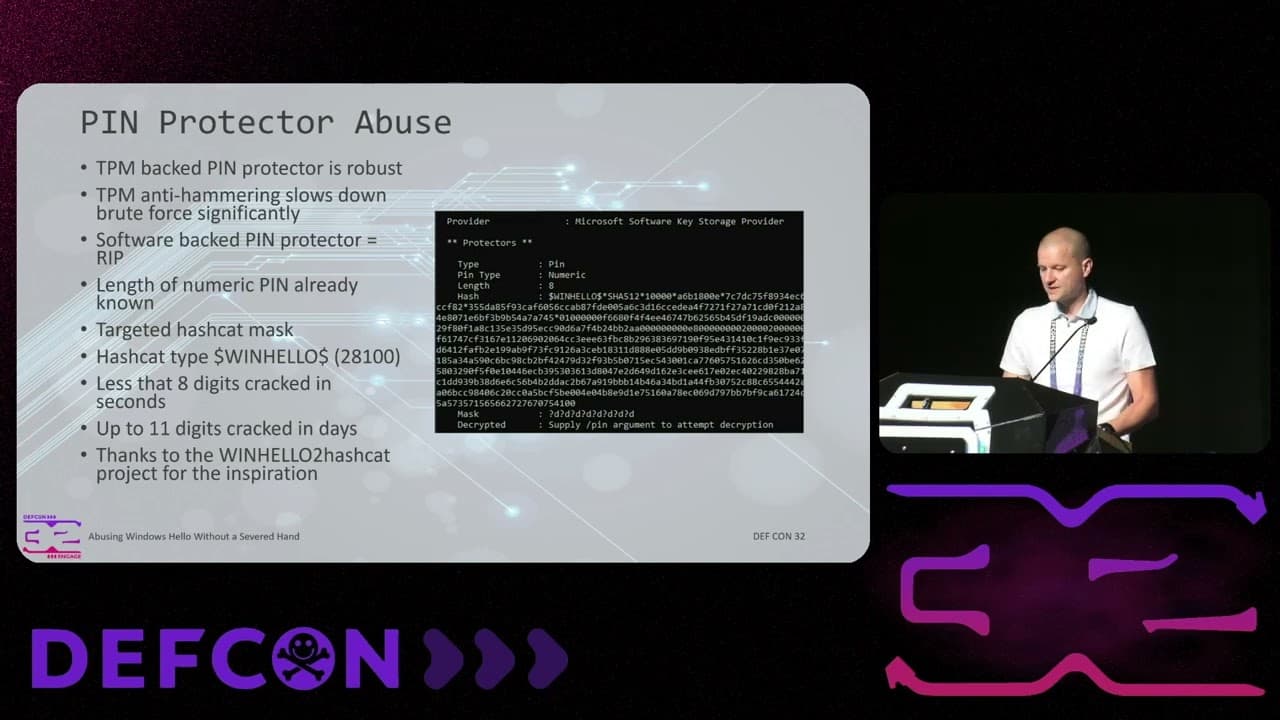
Abusing Windows Hello Without a Severed Hand
Similar Talks
Kill List: Hacking an Assassination Site on the Dark Web
Unmasking the Snitch Puck: The Creepy IoT Surveillance Tech in the School Bathroom