One for all and all for WHAD: wireless shenanigans made easy
The speakers introduce WHAD (Wireless Hacking Devices), an open-source framework designed to unify and simplify wireless protocol research and penetration testing. The framework provides a standardized communication protocol between a host and various wireless hardware, offloading complex operations to the host while maintaining time-critical functions in firmware. This approach addresses the fragmentation of existing wireless tools by providing a common ecosystem of libraries and tools for protocols like BLE, ZigBee, and Logitech Unifying. The talk demonstrates practical applications, including BLE device exploration, ZigBee network interaction, and cross-protocol bridging.
Stop Reinventing the Wheel: How the WHAD Framework Standardizes Wireless Hacking
TLDR: Wireless protocol research has long been plagued by fragmented, single-purpose tools that are difficult to maintain and even harder to extend. The WHAD (Wireless Hacking Devices) framework solves this by providing a standardized, modular protocol that offloads complex packet processing to the host while keeping time-critical operations in firmware. This allows researchers to build interoperable tools for BLE, ZigBee, and other protocols, effectively turning a collection of disparate hardware into a unified, extensible hacking ecosystem.
Wireless security research often feels like a constant battle against hardware fragmentation. You spend half your time writing custom firmware for a specific radio, another chunk of time debugging a flaky host-to-device communication protocol, and by the time you actually get to the vulnerability research, you are already burnt out. Every new protocol requires a new set of tools, new dependencies, and a new learning curve. This is why the release of the WHAD framework is a significant shift for anyone doing offensive work in the IoT space.
The Problem with Wireless Tooling
Most existing wireless tools are built as monolithic blocks. If you want to sniff BLE, you grab a specific dongle and a specific tool. If you want to interact with ZigBee, you switch hardware and switch tools. This creates a massive barrier to entry and makes cross-protocol research—like the Wazabee attacks—incredibly difficult to implement.
WHAD changes this by introducing a standardized communication protocol between the host and the wireless device. By offloading the heavy lifting—packet dissection, state management, and attack logic—to the host, the firmware on the device can remain minimal and focused on time-critical operations. This modularity means you can write a tool once and, provided the hardware supports the protocol, run it across different radio chipsets without rewriting your entire stack.
Under the Hood: Modularity and Offloading
The framework is built on a clean separation of concerns. The host side handles the complex logic using Python libraries, while the device side acts as a transparent bridge for radio operations. Because the protocol is based on Protocol Buffers, it is both efficient and easy to extend.
For a pentester, this means you can chain tools together using standard Unix-style pipes. For example, you can use wsniff to capture traffic, pipe it through wfilter to isolate specific packets, and then use wextract to pull out metadata like RSSI or specific field values. This is exactly how you should be building your testing pipeline:
wsniff -i uart0 --format=hexdump phy --gfsk --deviation=250000 | wfilter --filter="BTLE_ADV_IND" | wextract -p "P.metadata.rssi"
This command chain is a perfect illustration of the framework's power. You are not just running a static tool; you are composing a custom packet processing chain on the fly.
Real-World Impact and Research
The utility of this approach is not just theoretical. Researchers have already used the framework to identify and exploit vulnerabilities, such as the BLE GATT fuzzing project. By standardizing the interface, the team was able to implement complex fuzzing logic that would have been significantly more difficult to maintain in a custom, one-off tool.
Beyond fuzzing, the framework excels at emulation. During the Hardware.io CTF, the organizers used it to emulate BLE and LoRaWAN devices. If you are preparing for an engagement involving proprietary IoT devices, you can use wble-periph to create a fully customizable GATT profile. This allows you to test how a mobile application or a gateway reacts to specific, malformed, or unexpected data structures without needing the physical target device in front of you.
Defensive Considerations
While this framework is a boon for offensive researchers, it highlights a critical reality for defenders: the complexity of wireless protocols is often hidden behind proprietary, "black box" implementations. When you can easily emulate a device or perform a man-in-the-middle attack using a standard framework, it becomes clear that security through obscurity is failing.
Defenders should focus on implementing robust application-layer authentication and encryption that does not rely solely on the underlying wireless protocol's security features. If your device assumes that the BLE pairing process is sufficient to protect sensitive data, you are already behind.
What Comes Next
The most exciting part of this release is the potential for community contribution. Because the protocol is versioned and the architecture is modular, adding support for a new protocol is no longer a massive undertaking. If you have a specific radio chipset that is currently unsupported, you can implement the adaptation layer and immediately gain access to the entire suite of WHAD tools.
Stop wasting time on custom, fragile scripts that break every time a vendor updates their firmware. Start building your research on a foundation that actually scales. Check out the official documentation and start porting your favorite attack scripts to the framework. The next time you are staring at a proprietary radio, you will be glad you did.
CVEs
Vulnerability Classes
Tools Used
Target Technologies
Up Next From This Conference
Breaking Secure Web Gateways for Fun and Profit
Listen to the Whispers: Web Timing Attacks That Actually Work
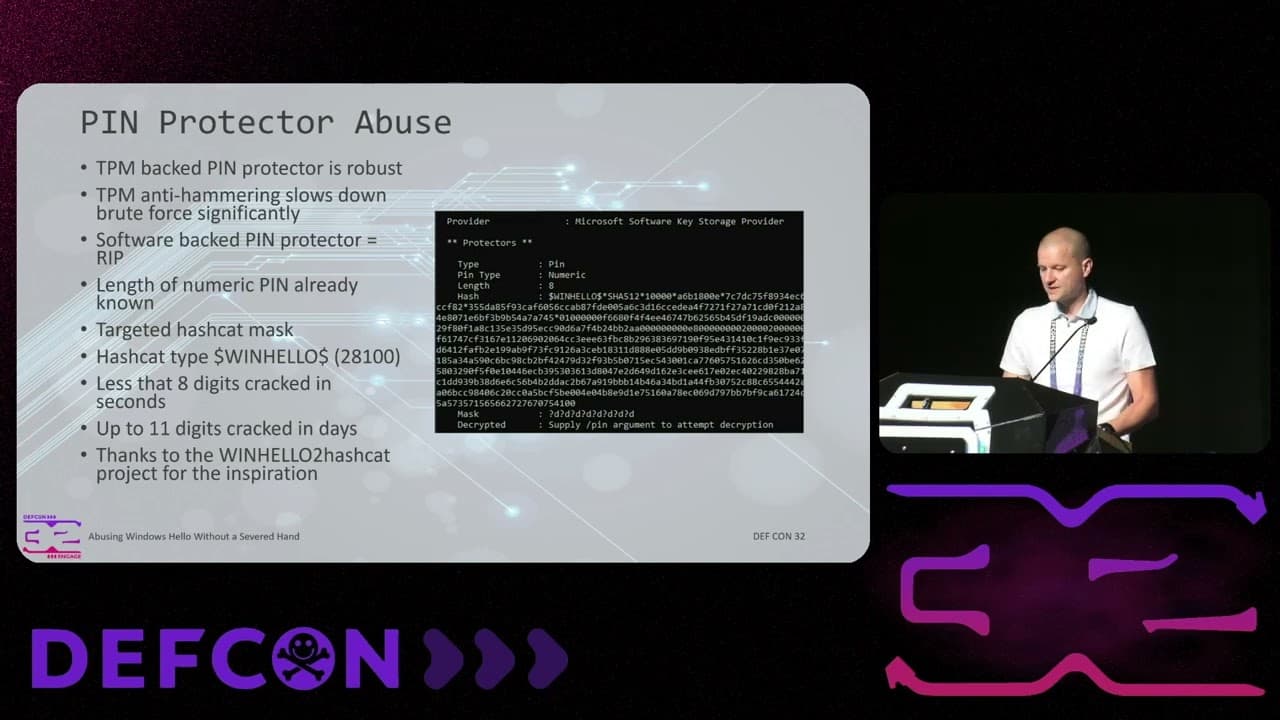
Abusing Windows Hello Without a Severed Hand
Similar Talks
Hacking Apple's USB-C Port Controller
Unmasking the Snitch Puck: The Creepy IoT Surveillance Tech in the School Bathroom