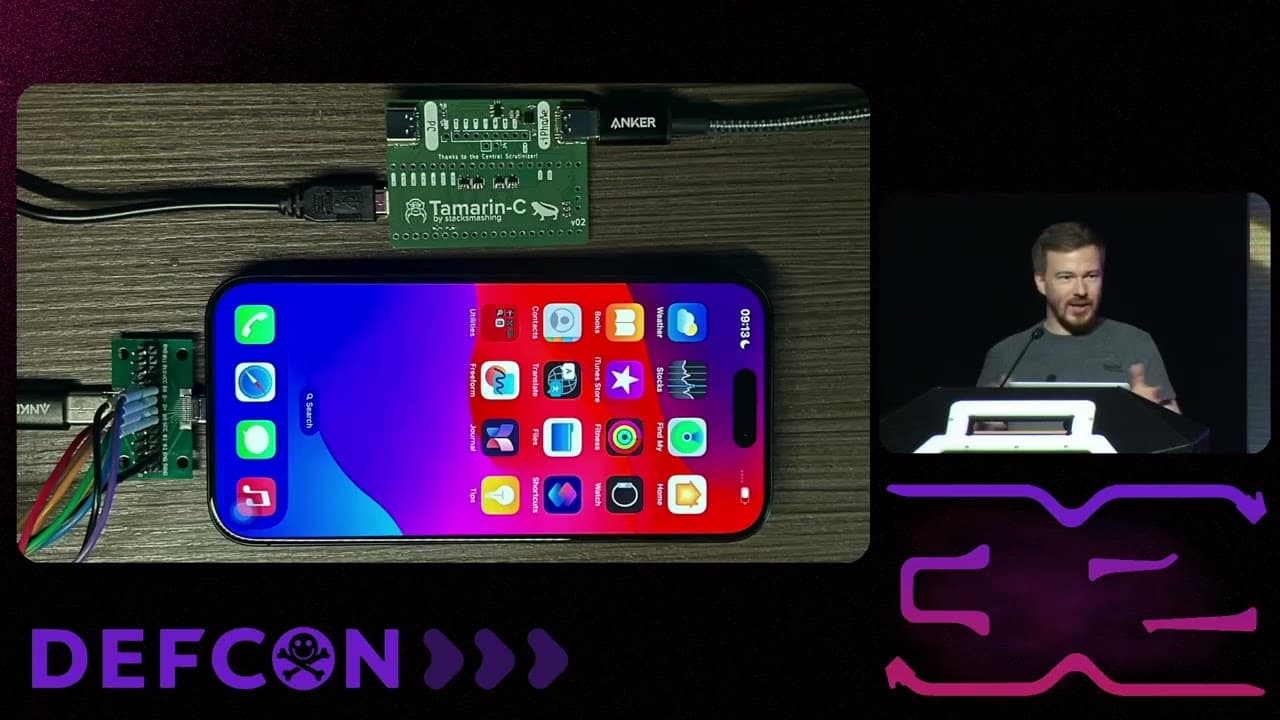
Operation BlackEcho: Voice Phishing using Fake Financial and Vaccine Apps
This talk details the Operation BlackEcho campaign, which utilizes sophisticated Android malware to facilitate voice phishing (vishing) attacks. The malware impersonates legitimate financial and vaccine applications to intercept calls, manipulate call logs, and exfiltrate sensitive user data. The researchers provide a comprehensive analysis of the attack infrastructure, including the use of custom intents for command execution and the deployment of multiple C2 servers. The presentation concludes with defensive strategies and indicators of compromise (IoCs) to help security professionals identify and mitigate these threats.
Anatomy of a Vishing Campaign: How Operation BlackEcho Weaponizes Android Accessibility
TLDR: Operation BlackEcho is a sophisticated Android malware campaign that uses fake financial and vaccine apps to hijack user devices for voice phishing. By abusing the Android Accessibility Service, the malware intercepts calls, manipulates call logs, and exfiltrates data to a multi-stage C2 infrastructure. Security researchers and mobile testers should prioritize auditing apps that request broad accessibility permissions, as these are increasingly used to bypass standard user interaction flows.
Mobile security assessments often focus on static analysis of binaries or basic API hooking, but the real-world threat landscape has shifted toward complex, multi-stage orchestration. Operation BlackEcho demonstrates how attackers are no longer relying on simple credential harvesting. Instead, they are building full-scale, automated call-center operations directly on the victim's device. This campaign is a masterclass in abusing legitimate OS features to turn a smartphone into a persistent, remote-controlled phishing terminal.
The Mechanics of the Hijack
At the core of this campaign is the abuse of the Android Accessibility Service. While intended to help users with disabilities interact with their devices, this service provides a powerful hook for malware to read screen content, perform gestures, and interact with UI elements on behalf of the user.
In the BlackEcho flow, the malware prompts the user to enable accessibility permissions under the guise of a "security update" or "vaccine verification." Once granted, the app gains the ability to effectively bypass the user's control. It can automatically accept permissions, dismiss security warnings, and even interact with the system dialer.
The technical implementation relies on custom intents to communicate between different components of the malicious app. By using a SocketService to receive commands from a C2 server, the malware can trigger specific actions like send_sms or call_control without the user ever seeing a notification. The following snippet illustrates how the malware processes these incoming commands:
// Simplified representation of command processing via custom intent
SocketService.receiveCommand(command, parameter) {
    if (command == "send_sms") {
        sendIntent("com.dagger.mc.intents.SEND_SMS", parameter);
    } else if (command == "call_control") {
        handleCallInterception(parameter);
    }
}
Infrastructure and Evasion
What makes BlackEcho particularly dangerous is its modular infrastructure. The attackers do not rely on a single, fragile C2 server. Instead, they use a multi-server architecture that separates the landing page, the distribution server, and the C2 server. This separation allows them to rotate infrastructure quickly if one component is flagged by security vendors.
The use of Cloudflare as a proxy layer is a standard but effective tactic here. By routing traffic through a CDN, the criminal organization masks the true IP addresses of their backend servers. Furthermore, they employ commercial packers like DexProtector and AppSealing to obfuscate their code. During the research period, over 50% of the analyzed samples utilized these packers to hinder static analysis and reverse engineering.
For a pentester, this means that simple signature-based detection is insufficient. You must look for the behavioral indicators: an app requesting accessibility services, an app that attempts to set itself as the default dialer, or an app that contains hardcoded, XOR-encoded strings that resolve to suspicious URLs.
Real-World Impact and Testing
During a mobile penetration test, you should treat any app requesting BIND_ACCESSIBILITY_SERVICE with extreme skepticism. If you are testing an application that handles sensitive financial data, verify that it does not attempt to perform actions outside of its documented scope.
The impact of this exploit is total device compromise. Because the malware can intercept incoming calls and place outgoing ones, it can effectively "man-in-the-middle" the victim's communication with their actual bank. If a victim calls their bank to report fraud, the malware can intercept that call, play a pre-recorded message, and keep the victim in a loop while the attacker drains their accounts. This is a direct violation of OWASP Mobile Top 10 principles, specifically regarding insecure authorization and improper platform usage.
Defensive Strategies
Defending against this requires a layered approach. From a development perspective, implement Android App Links to ensure that your app is the only one capable of handling your specific deep links, preventing attackers from hijacking your traffic.
For the blue team, the focus should be on Fraud Detection Systems (FDS) that monitor for anomalous call patterns or unexpected device behavior. If an app is suddenly making calls to numbers not in the user's contact list or attempting to access the dialer while the screen is off, the FDS should trigger an immediate account freeze.
The shift toward these automated, accessibility-abusing campaigns shows that the barrier to entry for sophisticated mobile fraud has dropped significantly. We are no longer just fighting against malicious code; we are fighting against an automated, persistent presence on the device. When you are auditing your next mobile application, don't just look for vulnerabilities in the code — look for the ways the app asks the user to hand over the keys to the kingdom.
Vulnerability Classes
Tools Used
Target Technologies
Attack Techniques
OWASP Categories
All Tags
Up Next From This Conference


Similar Talks
Inside the FBI's Secret Encrypted Phone Company 'Anom'

Kill List: Hacking an Assassination Site on the Dark Web