Redefining V2G: How to use your vehicle as a game controller
This talk demonstrates how to interface with a vehicle's Controller Area Network (CAN) bus to extract real-time telemetry data and map it to game controller inputs. The researchers analyze the CAN bus architecture of a Volkswagen ID.3 and a Tesla Model 3 to identify relevant signals for steering, braking, and lighting. The presentation provides a practical guide on using hardware like the Raspberry Pi with a CAN hat to perform reverse engineering of automotive protocols and implement a custom game controller interface. The project serves as an educational tool to introduce students and researchers to automotive cybersecurity and protocol analysis.
From CAN Bus to Cockpit: Turning Your Car Into a Game Controller
TLDR: Researchers at DEF CON 32 demonstrated how to bridge the gap between automotive Controller Area Network (CAN) bus traffic and standard game controller inputs. By reverse engineering signals from a Volkswagen ID.3 and Tesla Model 3, they mapped vehicle telemetry to game actions, effectively turning a real car into a high-fidelity simulator controller. This research highlights the accessibility of automotive internal networks and the potential for unauthorized command injection if diagnostic ports are left exposed.
Automotive security research often feels like a black box, reserved for those with deep pockets and proprietary vendor tools. Most of us assume that the internal networks of modern vehicles are segmented and hardened against casual interference. The reality, as demonstrated by Timm Lauser and Jannis Hamborg, is that the barrier to entry for interacting with a vehicle's CAN bus is significantly lower than the industry would like to admit. When you can map a steering wheel angle to a racing game input, you have essentially proven that the vehicle's internal communication is not just readable, but potentially manipulatable by anyone with a basic understanding of the protocol.
The Mechanics of CAN Bus Interfacing
The core of this research relies on the fact that the CAN bus is a broadcast-based, multi-master protocol. Every Electronic Control Unit (ECU) on the bus sees every message sent by every other ECU. In the Volkswagen ID.3, the researchers identified that the gateway ECU acts as a central hub, but the diagnostic access provided by the OBD-II port is the primary gateway for an attacker.
To get started, the team used a Raspberry Pi equipped with a CAN hat to interface with the bus. For those who prefer a more plug-and-play approach, the PCAN-USB Pro is the industry standard for this type of work. Once connected, the goal is to sniff traffic and identify the specific CAN IDs associated with driver inputs.
The command to bring up the interface on a Linux-based system is straightforward:
sudo ip link set can0 up type can bitrate 500000
Once the interface is up, using can-utils allows you to dump the traffic. The challenge is not reading the data, but filtering the noise. With thousands of messages per second, you need a way to correlate physical actions with bus activity. The researchers used SavvyCAN to visualize the data, which is essential for identifying which bytes change when you turn the steering wheel or press the brake pedal.
Bridging the Gap to Game Inputs
Mapping these signals to a game controller requires a translation layer. The researchers utilized vgamepad, a library that allows a script to emulate a standard Xbox 360 controller. By writing a Python script that listens to the CAN bus, parses the relevant CAN IDs, and translates the hex values into controller axis or button states, they created a real-time bridge.
The technical hurdle here is the Unified Diagnostic Services (UDS) protocol. UDS is the standard for diagnostic communication, and it operates on top of the CAN bus. If you are trying to read specific data points that aren't being broadcasted continuously, you have to send a request message and wait for the ECU to respond. This request-response cycle is slower than the broadcast traffic, but it is necessary for accessing deeper vehicle telemetry.
Real-World Pentesting Implications
For a penetration tester, this research is a wake-up call regarding the lack of bus segmentation. If an attacker can gain access to the CAN bus via the OBD-II port, they are not just reading data; they are in a position to perform message injection. While the researchers focused on a benign use case—gaming—the same technique can be used to spoof sensor data or trigger vehicle functions.
During an engagement, you should look for "ready-to-buy" adapters that allow for non-destructive access to the CAN bus. If you want to be even less intrusive, contactless CAN readers allow you to sniff the bus by clamping onto the wires, avoiding the need to physically tap into the harness. This is a critical capability when you need to perform analysis without leaving physical traces or triggering tamper-detection systems.
Defensive Considerations
Defending against this level of access is difficult because the CAN protocol was never designed with security in mind. It lacks authentication and encryption by default. The most effective defense is physical security—ensuring that the OBD-II port is not easily accessible to unauthorized individuals. Furthermore, manufacturers are moving toward CAN FD and implementing secure gateways that require cryptographic authentication before allowing diagnostic commands to be processed.
If you are working with automotive systems, your focus should be on identifying where the bus is exposed and whether the gateway ECU properly filters diagnostic requests. The goal is to ensure that even if an attacker gains access to the physical layer, they cannot escalate their privileges to control critical vehicle systems.
This research proves that the barrier to entry for automotive security is lower than ever. Whether you are a researcher looking to build a custom tool or a pentester evaluating a vehicle's security, the tools are readily available and the protocols are well-documented. The next time you see a vehicle with an exposed diagnostic port, remember that it is not just a maintenance interface; it is a potential entry point into the vehicle's entire nervous system. Start by sniffing the broadcast traffic, identify the signals that matter, and see what else you can control.
Vulnerability Classes
Target Technologies
All Tags
Up Next From This Conference
Breaking Secure Web Gateways for Fun and Profit
Listen to the Whispers: Web Timing Attacks That Actually Work
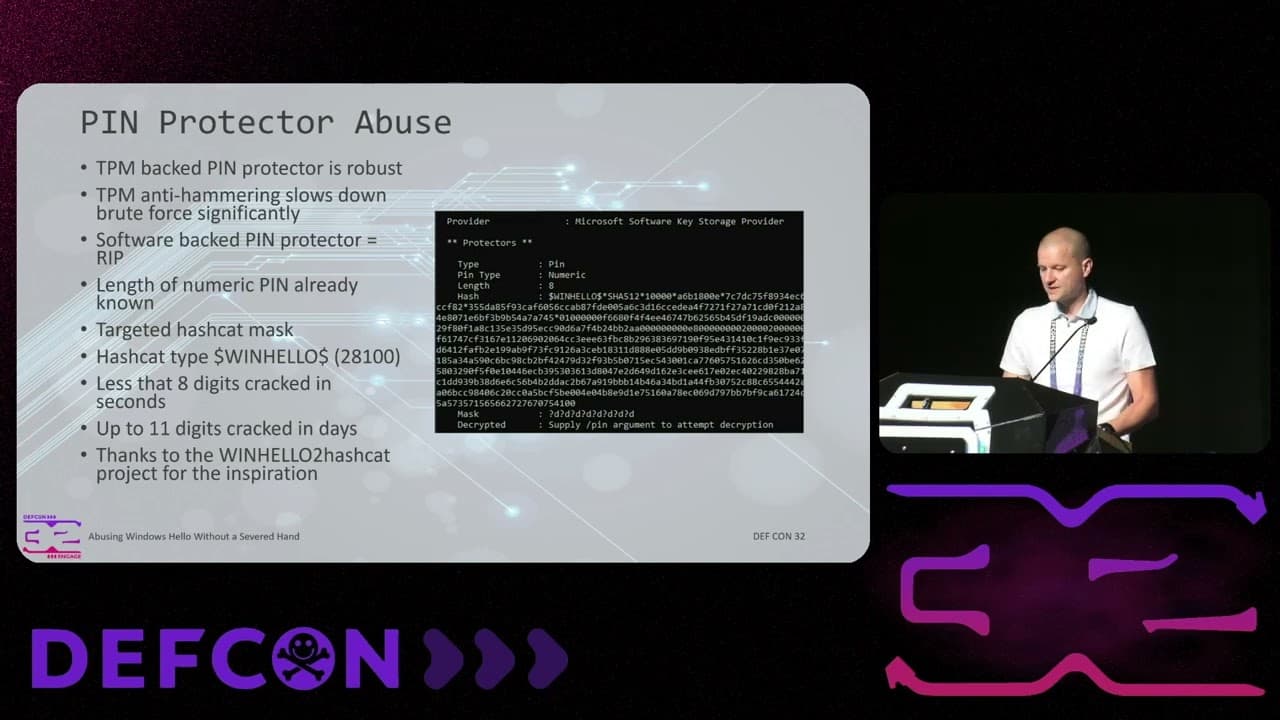
Abusing Windows Hello Without a Severed Hand
Similar Talks
Hacking Apple's USB-C Port Controller
Unmasking the Snitch Puck: The Creepy IoT Surveillance Tech in the School Bathroom