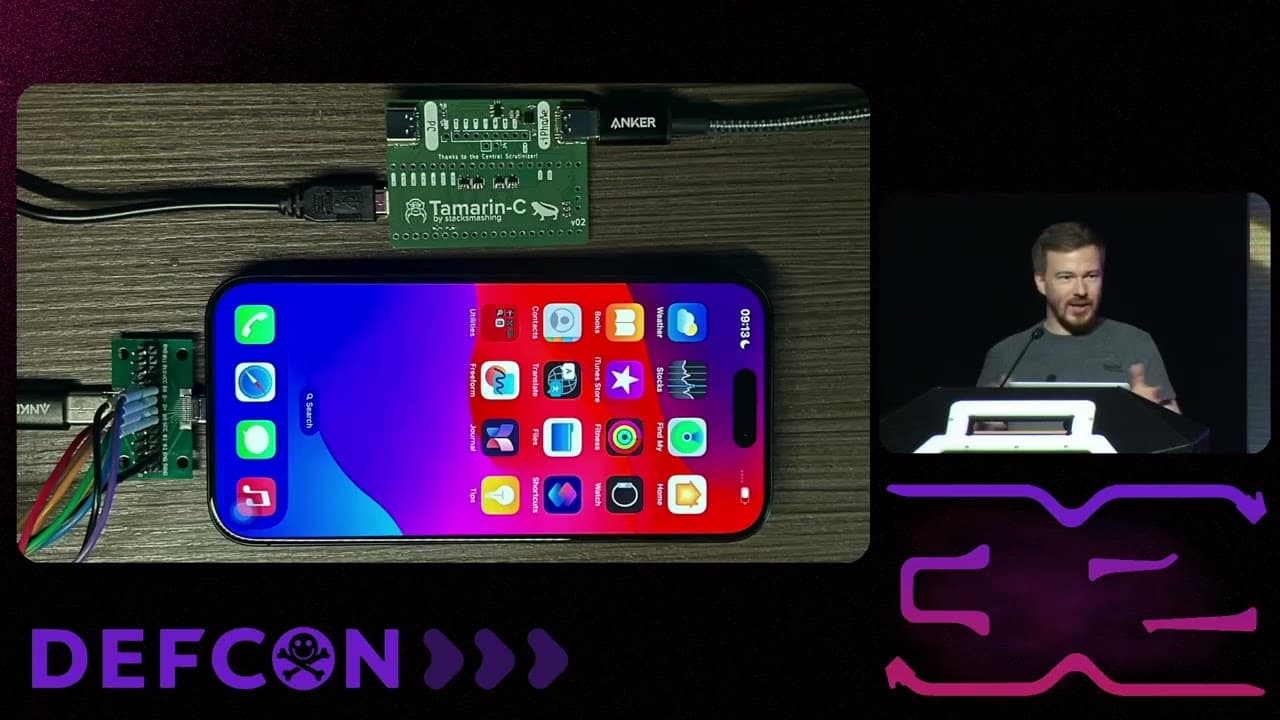
Sweet Quadreams or Nightmare Before Christmas? Dissecting an iOS 0-Day Attack
This talk details the forensic analysis of a sophisticated zero-click iOS exploit chain used by the Quadream mercenary spyware vendor. The researchers demonstrate how the attack leverages vulnerabilities in the iCalendar protocol and XML parsing to achieve remote code execution and persistence on target devices. The presentation highlights the use of dylib injection and function hooking to bypass iOS security mitigations like PAC and PPL. The findings emphasize the importance of cross-sector collaboration in identifying and mitigating advanced mobile threats.
How Mercenary Spyware Abuses iCalendar to Bypass iOS Security
TLDR: Researchers at Citizen Lab and Microsoft recently dissected a zero-click iOS exploit chain used by the Quadream mercenary spyware vendor. The attack abuses the iCalendar protocol and XML parsing to achieve remote code execution and bypass critical iOS mitigations like PAC and PPL. This research demonstrates that even hardened mobile platforms remain vulnerable to sophisticated, multi-stage chains that target seemingly benign system services.
Mobile security research often focuses on the high-profile, flashy exploits that dominate headlines, but the real danger lies in the quiet, persistent abuse of system-level protocols. The recent analysis of Quadream’s spyware operations proves that attackers are moving beyond simple memory corruption to exploit the complex, often overlooked logic within system services like iCalendar. When a vendor like Quadream targets high-value individuals, they aren't relying on a single bug. They are chaining together multiple primitives to bypass modern hardware-backed security features.
The Mechanics of the Zero-Click Chain
The attack vector identified in this research centers on the iCalendar protocol. While most developers view calendar invites as simple text files, the underlying implementation on iOS is a complex XML-based system. The researchers found that the spyware operator could send a specially crafted calendar invitation that, when processed by the device, triggered a series of vulnerabilities.
The core of the exploit relies on XML injection. By manipulating the structure of the iCalendar data, the attacker forces the device's XML parser to process malicious input. This is not just a simple crash; it is a gateway to remote code execution. Once the parser is compromised, the attacker gains a foothold in the execution context of the calendar service. From there, the chain proceeds to bypass ASLR and NX, eventually leading to full system compromise.
Bypassing Hardware-Backed Mitigations
What makes this research particularly compelling for security researchers is how the exploit handles modern iOS protections. The Quadream chain was designed to circumvent Pointer Authentication Codes (PAC) and Page Protection Layer (PPL). These are not trivial hurdles. PAC, in particular, is a hardware-level feature that signs pointers to prevent unauthorized modification.
The attackers used dylib injection to load malicious code into the target process. By hooking functions within the adid (Anisette) process, they were able to manipulate the generation of two-factor authentication codes. This is a brilliant, albeit terrifying, use of function hooking. By intercepting the gettimeofday function, the spyware could trick the system into generating valid 2FA codes for arbitrary future times, effectively granting the attacker persistent access to the victim's iCloud account without ever needing the physical device.
Real-World Implications for Pentesters
For those of us conducting penetration tests or hunting for bugs, this research highlights a critical shift in the threat landscape. We can no longer assume that system-level services are inherently secure. When auditing mobile applications or device configurations, you must look at how the device handles external data formats. If an application or service parses XML, JSON, or any complex data structure, it is a potential attack surface.
During an engagement, focus on the interaction between user-supplied data and system-level parsers. The use of Frida to hook functions and observe data flow is essential. If you can identify where a service parses an incoming message or file, you have found the most likely entry point for an exploit chain. The Quadream research shows that the "zero-click" nature of these attacks is achieved by automating the interaction with these services, removing the need for any user interaction.
Defensive Strategies
Defending against this level of sophistication is difficult, but not impossible. The most effective defense is to minimize the attack surface. Features like Lockdown Mode are a direct response to these types of targeted attacks. By restricting the types of attachments and data that system services will process, Lockdown Mode effectively closes the door on many of the vectors used in this chain.
For enterprise environments, the focus should be on monitoring for anomalous behavior at the system level. The researchers noted that the spyware left behind specific forensic traces, such as the execution of binaries from unexpected directories like /private/var/db/com.apple.xpc.roleaccountd.staging/. While these are difficult to detect without deep forensic analysis, they serve as a reminder that even the most advanced spyware must eventually interact with the file system.
Security researchers should continue to push for more transparency in how these system services handle data. The fact that an old, archived project like the Calendar and Contacts Server can still provide insights into modern vulnerabilities is a testament to the value of open-source research. Keep digging into the protocols that power our devices, because that is exactly where the next generation of exploits will be found.
Vulnerability Classes
Attack Techniques
OWASP Categories
All Tags
Up Next From This Conference
A Security RISC? The State of Microarchitectural Attacks on RISC-V

REDIScovering HeadCrab: A Technical Analysis of a Novel Malware and the Mind Behind It
TsuKing: Coordinating DNS Resolvers and Queries into Potent DDoS Amplifiers
Similar Talks
Inside the FBI's Secret Encrypted Phone Company 'Anom'
Kill List: Hacking an Assassination Site on the Dark Web