The Hack@DAC Story: Learnings from Organizing the World's Largest Hardware Hacking Competition
This talk details the methodology and educational impact of the Hack@DAC hardware security competition, which focuses on identifying and mitigating vulnerabilities in pre-silicon System-on-a-Chip (SoC) designs. The competition utilizes open-source hardware targets, such as RISC-V based designs, to teach participants how to perform security analysis at the Register Transfer Level (RTL). A key takeaway is the importance of a 'shift-left' security mindset, where hardware bugs are identified and patched during the design phase to avoid the high costs of post-silicon remediation. The presentation highlights the use of formal verification, RTL simulation, and static analysis tools to uncover hardware-level vulnerabilities.
Why Hardware Security Needs a Shift-Left Strategy
TLDR: Hardware security is no longer just about physical access; modern SoC designs are vulnerable to software-based exploitation that can bypass security features like secure boot and memory encryption. By adopting a shift-left approach and using RTL-level analysis, researchers can identify and patch these critical flaws before the silicon is even manufactured. This post breaks down how hardware hacking competitions are teaching the industry to treat hardware bugs with the same urgency as software vulnerabilities.
Hardware security has historically been treated as a "set it and forget it" component of the stack. Once the RTL is signed off and the chip is sent to the fab, the security posture is effectively locked in stone. If a vulnerability is discovered post-silicon, the remediation cost is astronomical, often requiring a full hardware revision or a complex, performance-draining microcode patch. We are seeing a shift where attackers are moving down the stack, targeting the microarchitecture and RTL logic directly. This is not just theoretical; the industry is finally waking up to the reality that bugs in hardware can be exploited by software, turning a minor design oversight into a catastrophic privilege escalation vector.
The Reality of Pre-Silicon Vulnerabilities
Most hardware security testing happens too late. By the time a chip is in the hands of a customer, the attack surface is already defined. The research presented at Black Hat 2024 regarding the Hack@DAC competition underscores a critical gap: the lack of security-aware design automation tools. When we look at the computing stack, we have robust tooling for software—code scanners, protocol checkers, and binary analysis frameworks. At the hardware level, specifically the Register Transfer Level (RTL), our options are limited.
The core of the problem is that hardware design teams often lack the "hacker mindset" required to anticipate how a specific logic gate or state machine can be abused. For example, consider a secret key stored in an internal register. A standard functional verification team might ensure the key is loaded correctly, but they rarely test whether that key leaks to an attacker-controlled interface under specific, non-standard conditions. This is where MITRE’s Hardware CWE list becomes essential. It provides a taxonomy of hardware-specific weaknesses, such as CWE-1245, which covers finite state machine issues that can lead to unexpected privilege states.
Why Shift-Left Matters for Hardware
The "shift-left" philosophy is standard in modern DevSecOps, but it is still maturing in hardware engineering. In the context of an SoC, shifting left means performing security analysis during the RTL design phase. This allows teams to use formal verification and static analysis to prove that certain security properties hold true before the design is committed to gates.
If you are a pentester or a researcher, you should be looking at how these designs are verified. The Hack@DAC competition uses open-source hardware targets like OpenTitan, which is a transparent, community-driven silicon root of trust. By analyzing the RTL of these designs, you can identify vulnerabilities that would be impossible to find once the chip is packaged. For instance, you might find that a specific debug interface, intended for factory testing, remains active in production, allowing an attacker to dump memory or bypass secure boot.
Bridging the Tooling Gap
One of the biggest hurdles in hardware security is the lack of accessible, security-aware design automation tools. Most commercial EDA tools are optimized for performance and power, not security. However, the research shows that we can repurpose existing verification flows. By integrating security-focused plugins into standard RTL simulation and emulation environments, we can automate the detection of common bug classes.
For those of you working in bug bounty or red teaming, the takeaway is clear: start looking at the hardware documentation and open-source RTL implementations of the devices you target. If a vendor claims their device uses a hardware-based secure enclave, find the RTL or the technical reference manual. Look for how they handle data integrity and access control. Are there undocumented registers? Is the debug port truly locked? These are the areas where the next generation of high-impact vulnerabilities will be found.
Moving Forward
Hardware security is no longer a niche field for electrical engineers. It is a critical frontier for anyone who cares about the integrity of the entire computing stack. The industry is moving toward a model where hardware and software security are developed in tandem, and the tools to support this are finally starting to emerge. If you want to stay ahead of the curve, stop treating the hardware as a black box. Start digging into the RTL, understand the threat model of the SoC, and look for the logic flaws that software-only security controls will never catch. The next big exploit might not be in the kernel; it might be in the silicon itself.
Vulnerability Classes
Tools Used
Attack Techniques
Up Next From This Conference
How to Read and Write a High-Level Bytecode Decompiler

Opening Keynote: Black Hat Asia 2024

AI Governance and Security: A Conversation with Singapore's Chief AI Officer
Similar Talks
Inside the FBI's Secret Encrypted Phone Company 'Anom'
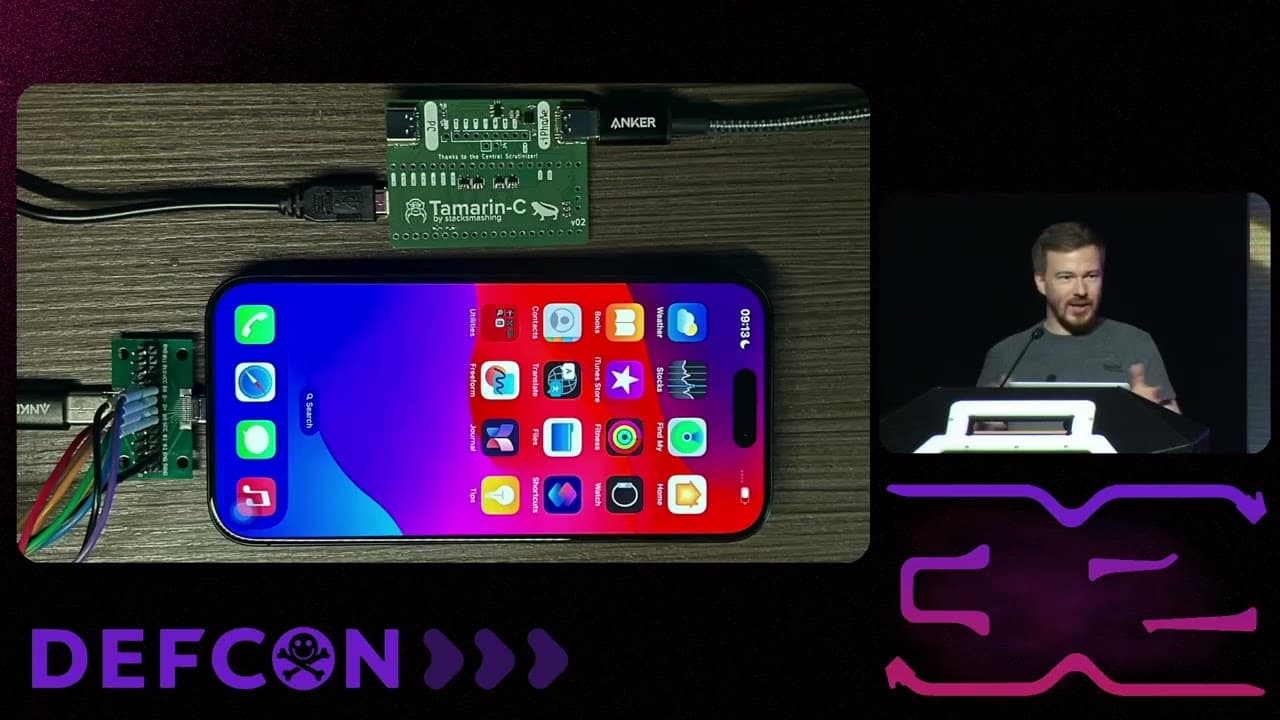
Hacking Apple's USB-C Port Controller