The Rise and Fall of Binary Exploitation
This talk explores the evolution of binary exploitation techniques and the corresponding rise of modern OS-level mitigations. It analyzes how specific bug classes like use-after-free and type confusion have been impacted by security controls such as Control Flow Guard (CFG) and Data Execution Prevention (DEP). The speaker demonstrates how to perform patch diffing and use automated agents to identify exploitable vulnerabilities in the Windows kernel. The presentation concludes with a practical guide on how to bypass these mitigations using techniques like stack pivoting and token manipulation.
Why Your Kernel Exploits Are Failing: The Reality of Modern Mitigation Chains
TLDR: Modern OS-level mitigations have effectively killed off the "golden age" of simple memory corruption exploits, forcing researchers to chain multiple vulnerabilities to achieve code execution. This talk breaks down how to use automated patch diffing and AI-assisted agents to identify exploitable paths in the Windows kernel. For pentesters and bug hunters, the takeaway is clear: stop looking for single-bug wins and start mastering the art of chaining complex primitives.
Binary exploitation has changed. If you are still trying to land a simple stack overflow or a basic use-after-free in a modern Windows environment, you are likely hitting a wall of mitigations that didn't exist a decade ago. The days of "one bug, one shell" are largely behind us. Today, successful exploitation requires a deep understanding of how these mitigations interact and where the gaps in the chain exist.
The End of the Golden Age
We used to live in a world where memory corruption was straightforward. You found a buffer overflow, you overwrote a return address, and you redirected execution to your shellcode. Then came Data Execution Prevention (DEP) and Address Space Layout Randomization (ASLR). Then came Control Flow Guard (CFG), and eventually, hardware-backed protections like Intel CET.
Each of these controls was introduced to kill a specific class of exploit. When Microsoft introduced Control Flow Guard, it wasn't just a minor hurdle; it fundamentally changed how we approach control-flow hijacking. The result is that researchers now have to perform "mitigation bypass" research, which is essentially a cat-and-mouse game between the OS developer and the exploit developer.
Patch Diffing and Automated Agents
The most effective way to find new vulnerabilities today is through patch diffing. When a vendor releases a security update, they are effectively publishing a roadmap of where their code was weak. By comparing the binary before and after the patch using tools like BinDiff, you can identify the exact logic changes that fixed a vulnerability.
However, manual diffing is slow and prone to human error. This is where AI-assisted agents come into play. By feeding these diffs into an LLM-based agent, you can automate the process of identifying which patches are actually security-relevant and which are just noise. The goal is to build a pipeline: a data collector agent that pulls CVEs and patches, a patch-diffing agent that isolates the vulnerable function, and a corpus generation agent that creates the fuzzer input needed to trigger the bug.
If you are not using these automated workflows, you are working at a massive disadvantage. The goal is to identify the "delta" in the code and then use that knowledge to craft a trigger that bypasses the current mitigation state.
The Mechanics of Mitigation Bypass
Consider the "Do Not Allow Child Processes" mitigation. This is a classic example of a user-land control that, when enabled, prevents a process from spawning new ones. If you are trying to execute a payload that requires spawning cmd.exe or powershell.exe, this mitigation will stop you dead in your tracks.
To bypass this, you need to understand the underlying kernel structures. When you call CreateProcess, the kernel checks specific flags in the process environment block. If you can manipulate these flags—or if you can find a way to execute your code within the context of a process that already has the necessary permissions—you can bypass the restriction entirely.
This is where techniques like token manipulation come in. By using tools to impersonate a token with higher privileges or fewer restrictions, you can trick the kernel into believing your process is authorized to perform actions that would otherwise be blocked. This is not about finding a "magic" exploit; it is about understanding the state of the system and finding the path of least resistance.
Defensive Realities
For those on the blue team, the lesson is that you cannot rely on a single mitigation to protect your environment. These controls are complementary. If you have CFG enabled but your application is still using outdated libraries that don't participate in the mitigation, you are still vulnerable.
The most important thing you can do is ensure that your applications are compiled with the latest security flags and that you are monitoring for the right events. When a mitigation is triggered, it leaves a trail in the event logs. If you are not actively monitoring for these "mitigation blocked" events, you are missing the early warning signs of an active exploitation attempt.
What Comes Next
The price of a high-quality exploit is skyrocketing, and for good reason. It takes months of research to chain together the primitives needed to bypass modern protections. If you want to stay relevant in this field, you need to move beyond the basics.
Stop looking for the easy win. Start looking for the gaps in the mitigation chain. Learn how to use WinDbg to inspect kernel structures in real-time, and get comfortable with the Windows Internals documentation. The future of binary exploitation is not in finding more bugs; it is in understanding the system well enough to make the bugs you find actually matter.
Vulnerability Classes
Target Technologies
All Tags
Up Next From This Conference
Breaking Secure Web Gateways for Fun and Profit
Listen to the Whispers: Web Timing Attacks That Actually Work
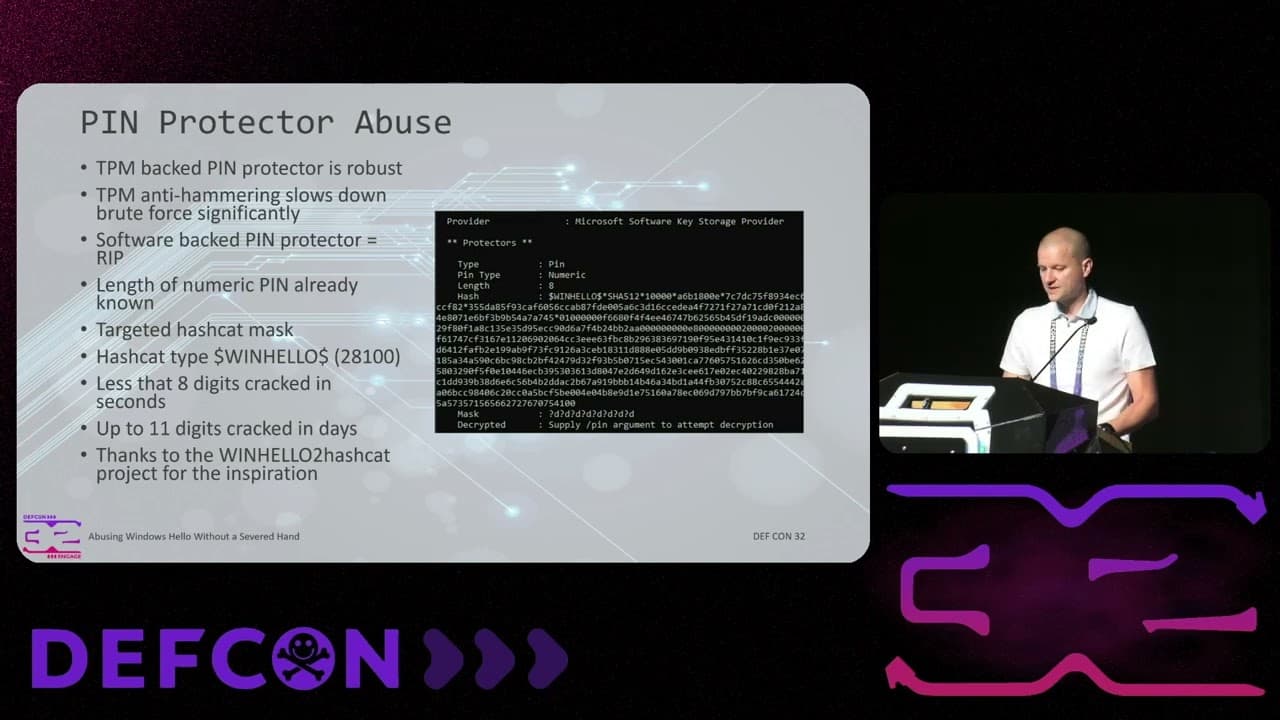
Abusing Windows Hello Without a Severed Hand
Similar Talks
Hacking Apple's USB-C Port Controller
Unmasking the Snitch Puck: The Creepy IoT Surveillance Tech in the School Bathroom