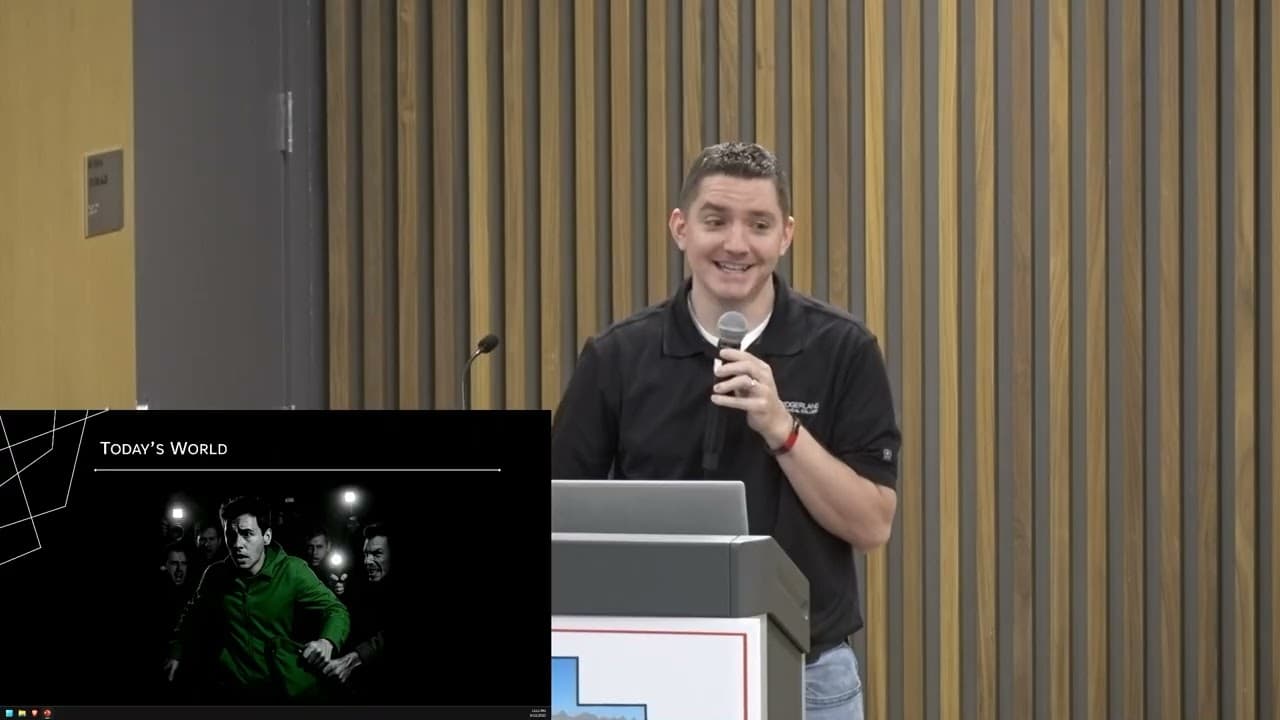
Weaponized Deception: Lessons from Indonesia's Muslim Cyber Army
This talk analyzes the operational techniques of the 'Muslim Cyber Army' (MCA), a hacktivist collective that utilized social engineering and coordinated information operations to influence public opinion and target specific communities. The speaker demonstrates how the group employed the Bell-Whaley deception framework—specifically masking, repackaging, and mimicking—to manipulate social media narratives and orchestrate mass reporting campaigns. The presentation highlights the importance of behavioral analysis in threat intelligence, showing how non-technical groups can achieve significant impact through coordinated, low-tech deception strategies.
Weaponized Deception: How the Muslim Cyber Army Used Behavioral Profiling for Mass Reporting
TLDR: The Muslim Cyber Army (MCA) demonstrated that sophisticated information operations do not require elite technical exploits, but rather a deep understanding of behavioral psychology and platform mechanics. By applying the Bell-Whaley deception framework, the group successfully orchestrated mass reporting campaigns to silence targets on Facebook and Twitter. Pentesters and researchers should recognize that non-technical social engineering, when scaled through coordinated persona management, remains one of the most effective ways to manipulate digital discourse.
Information operations often conjure images of state-sponsored APTs deploying zero-day exploits or custom malware. However, the research presented at Black Hat 2025 on the Muslim Cyber Army (MCA) serves as a stark reminder that the most effective weapon in a threat actor's arsenal is often the platform's own moderation policy. The MCA did not need to compromise a server to silence their targets; they simply needed to understand how to trigger the automated reporting systems of major social media platforms.
The Mechanics of Weaponized Deception
At its core, the MCA’s operation was a masterclass in social engineering and coordinated persona management. The group operated by creating hundreds of accounts that mimicked the behavior of legitimate users. These accounts were not just static bots; they were curated to appear authentic, engaging in local discourse and sharing content that resonated with specific community values.
The group utilized the Bell-Whaley deception framework to structure their activities. This framework categorizes deception into two primary modes: dissimulation (hiding the real) and simulation (showing the false).
Dissimulation: Masking and Repackaging
Masking involves making the real intent invisible. The MCA admins managed dozens of accounts that blended into the noise of everyday social media activity. By using common hashtags and participating in mundane community discussions, they ensured their accounts were not flagged as malicious by platform heuristics.
Repackaging, the second technique, involved taking existing content and reframing it to suit their narrative. They would create Facebook groups that appeared to be legitimate news outlets. These groups would aggregate real news, but intersperse it with inflammatory content designed to provoke a reaction. For a pentester, this is a critical observation: the vulnerability here is not a software bug, but the trust model of the platform's recommendation engine.
Simulation: Mimicking and Inventing
Mimicking involves showing the false by imitating legitimate behavior. The MCA used automated scripts to boost content, creating a false sense of consensus. When a target was identified, these accounts would swarm the target's posts, creating an illusion of widespread public outrage.
Inventing, the most aggressive technique, involved fabricating events. The MCA would create fake scenarios where their targets were supposedly attacking religious figures or community leaders. They would then use their network of accounts to report these fabricated posts for violating community standards. Because the reports were coming from hundreds of distinct, aged accounts, the platforms' automated systems often prioritized the takedowns, effectively de-platforming the targets without human intervention.
Behavioral Analysis as Threat Intelligence
The most striking aspect of this research is the focus on the "idealized self" of the threat actors. By analyzing the social media footprint of key MCA admins, researchers were able to build a psychological profile that contradicted the "reclusive hacker" stereotype. These individuals were often active community members, parents, and professionals.
For those of us in the threat intelligence space, this highlights a massive blind spot. We are trained to look for indicators of compromise (IoCs) like malicious IPs, file hashes, or suspicious user agents. We are rarely trained to look for behavioral indicators of intent. If you are conducting a red team engagement or a social engineering assessment, the most valuable data is not the technical vulnerability, but the target's emotional triggers.
Practical Application for Pentesters
If you are tasked with assessing the security of an organization's digital presence, you must look beyond the technical stack. Consider the following during your next engagement:
- Persona Mapping: How easily can an external actor create a network of accounts that appear to be part of your organization's community?
- Reporting Resilience: Does your organization have a process for handling mass-reporting campaigns? If your social media accounts are suddenly flooded with reports, how do you escalate this to a human moderator at the platform level?
- Narrative Vulnerability: What are the emotional triggers of your user base? An attacker will use these to bait your users into the kind of inflammatory exchanges that lead to account bans.
The MCA’s success was not due to a lack of security controls on Facebook or Twitter, but due to the inherent design of these platforms, which prioritize user engagement and community-driven moderation. When that community is subverted by a coordinated, behaviorally-aware group, the platform's own tools become the primary attack vector.
Defenders must move toward a model of "narrative defense." This involves proactive monitoring of the discourse surrounding your brand and identifying the early signs of coordinated inauthentic behavior. If you see a sudden spike in negative sentiment that relies on fabricated narratives, you are likely witnessing the early stages of a simulation-based attack. Do not wait for the platform to act; document the activity, report the network as a whole rather than individual accounts, and communicate the reality of the situation to your community before the narrative takes hold.
The era of relying solely on technical defenses is over. Understanding the human element, and the ways it can be manipulated at scale, is the next frontier for anyone serious about security.
Vulnerability Classes
Target Technologies
Attack Techniques
All Tags
Up Next From This Conference
Similar Talks
Inside the FBI's Secret Encrypted Phone Company 'Anom'

Kill List: Hacking an Assassination Site on the Dark Web