DEF CON Academy: A New Paradigm for Cybersecurity Education
This talk introduces the DEF CON Academy, a new educational initiative designed to bridge the gap between theoretical cybersecurity knowledge and practical, hands-on exploitation skills. The platform utilizes a gamified, browser-based environment called pwn.college to teach complex topics like binary exploitation, reverse engineering, and kernel security through a curated, guided path. By providing dedicated mentorship and a structured curriculum, the initiative aims to accelerate the development of cybersecurity talent and prepare students for real-world security challenges.
Beyond the CTF: Why Pwn.college is the New Standard for Binary Exploitation
TLDR: Most cybersecurity training fails because it separates theory from practice, leaving students unable to apply concepts to real-world targets. Pwn.college solves this by providing a browser-based, gamified environment that forces students to exploit actual Linux kernel and binary vulnerabilities. This platform is a massive step forward for anyone looking to move from "script kiddie" to a serious exploit developer.
Traditional cybersecurity education is broken. We spend years teaching students about buffer overflows, heap spraying, and kernel exploitation through slides and static code analysis, only to watch them freeze when they face a real, hardened binary. The gap between understanding a concept and executing an exploit is where most talent dies. We have all seen the "learning pyramid" that claims teaching others or practicing by doing is the only way to retain knowledge, yet we continue to rely on passive lectures.
The DEF CON Academy is changing this by shifting the focus from passive consumption to active, hands-on exploitation. By integrating pwn.college into a structured, guided curriculum, the initiative provides a path that mirrors the real-world progression of a security researcher. It is not just about solving a CTF challenge; it is about understanding the underlying mechanics of the system you are attacking.
The Problem with Traditional CTFs
CTFs are fantastic for engagement, but they are often terrible for education. A typical CTF challenge is a puzzle designed to be solved in a specific way, often relying on "gotchas" or obscure knowledge rather than fundamental security principles. If you are a novice, you spend hours banging your head against a wall, eventually looking up a write-up, and moving on without actually learning the underlying vulnerability class.
This is where the pwn.college approach differs. Instead of a one-off challenge, it offers a series of modules that build on each other. You start with basic file permissions and piping, and you end up performing blind ROP against remote network services or escaping sandboxes. It is a curriculum, not a competition.
From Theory to Kernel Exploitation
The platform covers the entire stack, from user-space binary exploitation to kernel-level privilege escalation. For a pentester, the most valuable part of this is the focus on "edge cases." Most tutorials show you the "happy path" of an exploit. In the real world, the happy path rarely exists. You are dealing with ASLR, stack canaries, and non-executable memory.
The modules on pwn.college force you to deal with these mitigations head-on. For example, when learning about memory corruption, you are not just overflowing a buffer; you are learning how to bypass Stack Canaries and how to manipulate the instruction pointer to redirect execution flow.
Consider the complexity of modern binary analysis. Tools like Ghidra and angr are standard in the industry, but they have steep learning curves. The academy integrates these tools directly into the workflow, allowing students to practice binary reversing in a browser-based environment that feels like a real terminal. You can pull up a Wireshark capture, analyze the traffic, and then use that information to craft your payload, all without leaving your browser.
Real-World Applicability
Why should a professional pentester care about this? Because the techniques taught here are the same ones used in high-end red team engagements. When you are on a network, you are not just looking for low-hanging fruit. You are looking for ways to escalate privileges from a low-privileged service account to root.
The pwn.college modules on kernel security and privilege escalation are directly applicable to modern Linux environments. Understanding how to exploit a race condition in a kernel driver or how to leverage a misconfigured setuid binary is the difference between a successful engagement and a failed one. By the time a student finishes the "Software Exploitation" track, they have a deep, practical understanding of how to break software, which is the prerequisite for knowing how to secure it.
The Defensive Angle
Defenders often view exploitation as a black box. They see the alert, but they do not understand the mechanics of the attack. By training on pwn.college, blue teamers can gain a much better understanding of what they are defending against. If you know how a buffer overflow works at the assembly level, you are much better equipped to write effective detection rules and implement robust mitigations.
The goal of the DEF CON Academy is to create a common language between offensive and defensive security. When both sides understand the mechanics of an exploit, the conversation shifts from "how do we block this" to "how do we architect our systems to be resilient against this class of vulnerability."
What Comes Next
The DEF CON Academy is still in its early stages, but the potential is massive. By providing a structured, gamified path to mastery, it is lowering the barrier to entry for high-level security research. If you are a professional, use this to sharpen your skills. If you are a mentor, use this to train your team.
The industry is desperate for people who can do more than just run a vulnerability scanner. We need people who can read assembly, understand memory layouts, and craft exploits when the standard tools fail. The DEF CON Academy is building that pipeline. Go to pwn.college, pick a module, and start building your skills. The only way to get better is to get your hands dirty.
Vulnerability Classes
Tools Used
Target Technologies
Up Next From This Conference
Breaking Secure Web Gateways for Fun and Profit
Listen to the Whispers: Web Timing Attacks That Actually Work
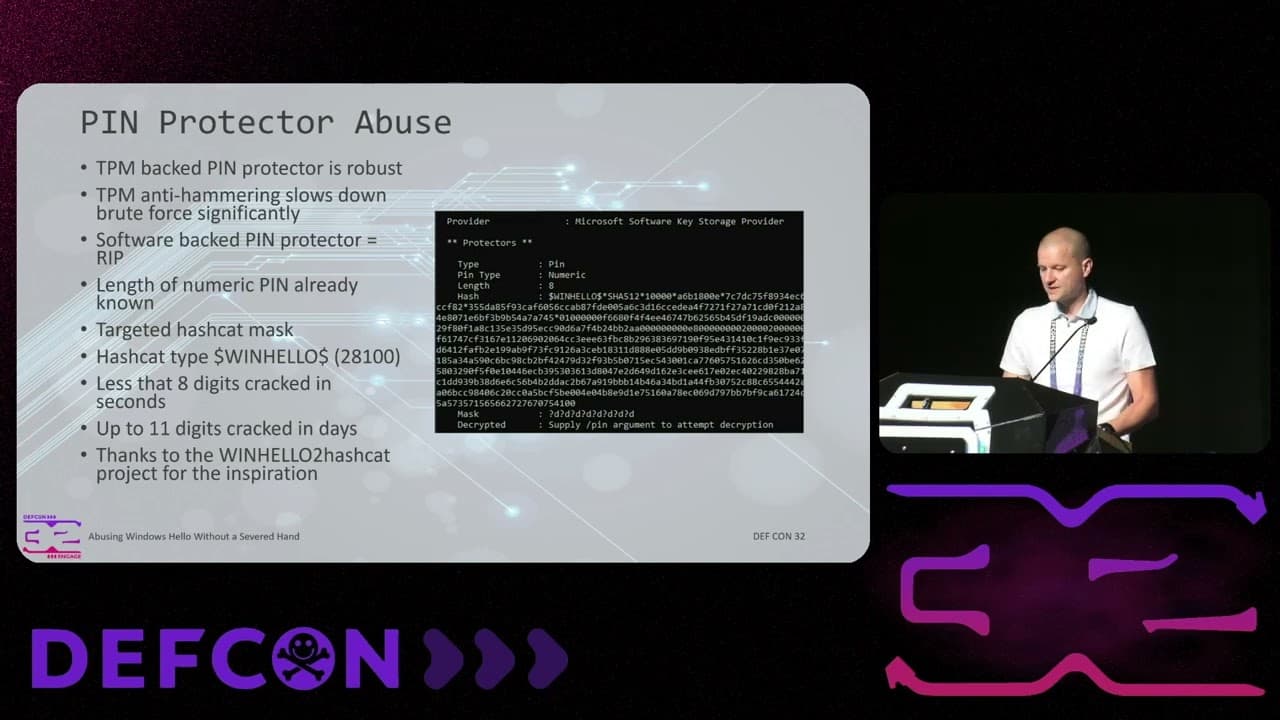
Abusing Windows Hello Without a Severed Hand
Similar Talks
Hacking Apple's USB-C Port Controller

Unmasking the Snitch Puck: The Creepy IoT Surveillance Tech in the School Bathroom