Dragon Slaying Guide: Bug Hunting in VMware Device Virtualization
This talk demonstrates advanced techniques for identifying and exploiting vulnerabilities within VMware's device virtualization layer, specifically focusing on USB and SCSI emulation. The researchers detail the internal architecture of VMX and VMM, highlighting how improper handling of shared memory and device state leads to critical security flaws. The presentation provides a comprehensive guide for security researchers to perform reverse engineering and vulnerability discovery on hypervisor components. The talk includes the disclosure of multiple vulnerabilities, including use-after-free and out-of-bounds read/write conditions.
Breaking VMware Virtualization: Exploiting USB and SCSI Emulation
TLDR: This research exposes critical vulnerabilities in VMware’s device virtualization layer, specifically within USB and SCSI emulation. By reverse engineering the VMX and VMM components, the researchers identified heap overflows, use-after-free conditions, and uninitialized memory leaks that allow for potential virtual machine escapes. Security researchers should focus on auditing the interaction between the host-side VMX process and the VMM kernel module to identify similar state-handling flaws.
Virtualization is the bedrock of modern infrastructure, but it is also a massive, complex attack surface that most researchers treat as a black box. When you are performing a red team engagement or hunting for bugs in a cloud environment, the hypervisor is often the ultimate prize. The recent research presented at DEF CON 32 on VMware device virtualization proves that the boundary between the guest and the host is far more porous than many assume. By dissecting the VMX and VMM architecture, the team from TianGong Lab demonstrated that the complexity of device emulation is exactly where the most dangerous bugs hide.
The Mechanics of the VMX and VMM Boundary
The core of the issue lies in how VMware handles device emulation. The VMX process, which runs in user space, is responsible for the heavy lifting of device emulation, while the VMM kernel module manages the execution environment. The communication between these two is facilitated by mechanisms like UserRPC and SharedArea.
Most researchers focus on the device emulation code itself, but the real vulnerabilities often exist in the state management logic that bridges the guest and the host. For example, the researchers found that the UserRPC mechanism, which is similar to a hypercall, is a primary vector for exploitation. When a guest OS triggers a device operation, the VMX process must translate that request into a host-side action. If the state of the device—such as a USB endpoint or a SCSI disk—is not tracked correctly during this transition, you end up with race conditions or memory corruption.
Exploiting USB and SCSI Emulation
The research highlights four specific vulnerabilities that illustrate these architectural weaknesses: CVE-2024-22255, CVE-2024-22252, CVE-2024-22251, and CVE-2024-37086.
In the case of CVE-2024-22252, a classic use-after-free vulnerability, the flaw stems from the way the host controller manages transfer rings. When a guest issues a command to configure an endpoint, the host controller might free a transfer ring object while a pointer to that object is still held by another part of the system. By manipulating the device state through commands like Configure Endpoint, an attacker can trigger this free and then reallocate the memory, leading to arbitrary code execution within the VMX process.
The researchers used Ghidra to reverse engineer the VMX binary and APIMonitor to observe the communication between the VMX process and the host OS. This combination is essential for anyone looking to replicate this work. You need to identify the main loop in the VMX process that handles IOCTLs, as this is where the device emulation logic is dispatched.
Real-World Implications for Researchers
For a pentester, these findings change the threat model for virtualized environments. If you have gained access to a guest VM, you are no longer limited to attacking the guest OS. You can now target the virtual hardware itself. During an engagement, look for devices that are passed through to the guest, such as USB controllers or virtual SCSI disks. These are the entry points. If you can trigger an out-of-bounds read or write in the VMX process, you can potentially leak memory from the host or overwrite function pointers to hijack the process.
The impact of these bugs is severe. A successful exploit leads to a virtual machine escape, granting the attacker code execution on the host machine. In a multi-tenant cloud environment, this is the holy grail for an attacker, as it breaks the isolation between different customers.
Defensive Strategies
Defending against these vulnerabilities is notoriously difficult because they are rooted in the fundamental design of device emulation. However, the most effective mitigation is to minimize the attack surface. Disable any virtual hardware that is not strictly necessary for the VM's function. If you do not need a virtual USB controller or a smart card reader, remove them from the VM configuration.
Blue teams should also monitor for unusual IOCTL patterns originating from guest VMs. While this is not a silver bullet, it can help detect attempts to fuzz the hypervisor interface. Furthermore, keeping the hypervisor patched is non-negotiable. VMware has released security advisories addressing these issues, and applying these updates is the only way to close the specific code paths identified by the researchers.
The complexity of modern hypervisors is a double-edged sword. It provides the flexibility we need for cloud computing, but it creates a massive, opaque surface for vulnerabilities to thrive. This research is a reminder that the most critical bugs are often found in the glue code that connects different parts of a system. If you are serious about hypervisor security, stop looking at the guest OS and start looking at the interface between the virtual hardware and the host. The next big escape is likely waiting in a poorly handled IOCTL or a race condition in a device state machine.
Vulnerability Classes
Tools Used
Target Technologies
All Tags
Up Next From This Conference
Breaking Secure Web Gateways for Fun and Profit
Listen to the Whispers: Web Timing Attacks That Actually Work
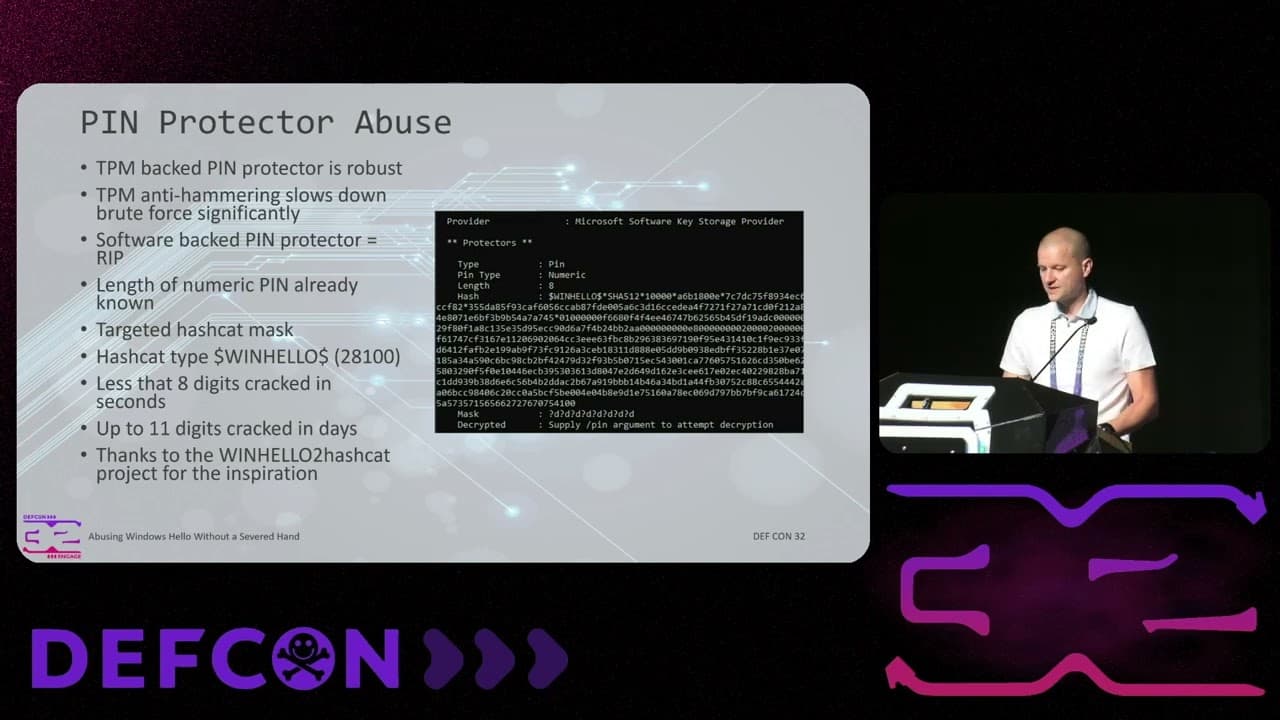
Abusing Windows Hello Without a Severed Hand
Similar Talks
Hacking Apple's USB-C Port Controller
Unmasking the Snitch Puck: The Creepy IoT Surveillance Tech in the School Bathroom