Exploiting Bluetooth: From Your Car to the Bank Account
This talk demonstrates novel Bluetooth exploitation techniques, specifically focusing on Man-in-the-Middle (MitM) attacks against automotive infotainment systems and mobile devices. The researchers detail how to leverage Bluetooth profiles like PBAP and MAP to extract sensitive information, including contacts and SMS messages, to bypass multi-factor authentication (MFA). The presentation highlights the inherent insecurity of Bluetooth standards and implementations, providing a practical framework for testing these vulnerabilities in automotive and mobile environments. The speakers also release a tool, BlueToolkit, to automate the discovery and exploitation of these Bluetooth-based vulnerabilities.
Bypassing MFA and Hijacking Accounts via Bluetooth Infotainment Exploits
TLDR: Researchers at DEF CON 2024 demonstrated that Bluetooth remains a massive, unpatched attack surface in modern vehicles, allowing for Man-in-the-Middle (MitM) attacks that bypass MFA. By leveraging Bluetooth profiles like PBAP and MAP, an attacker can extract contacts and SMS messages from a paired phone to intercept OTPs and hijack sensitive accounts. This research highlights the critical need for security researchers to audit automotive infotainment systems and provides a new tool, BlueToolkit, to automate this testing process.
Bluetooth is often treated as a legacy convenience, a "solved" problem that just works when you get into your car. That assumption is a liability. Modern automotive infotainment systems are essentially complex, interconnected IoT networks with dozens of interfaces, and they are rarely updated. When you pair your phone to a rental car or a new vehicle, you are often establishing a trust relationship with a system that hasn't seen a security patch in years.
The research presented at DEF CON 2024 proves that this trust is misplaced. By targeting the Bluetooth stack in automotive systems, an attacker can move from a simple pairing request to full account takeover, effectively bypassing multi-factor authentication (MFA) by intercepting the very SMS messages meant to secure your accounts.
The Mechanics of the Bluetooth MitM
The core of this attack lies in the shared responsibility model of Bluetooth. The protocol is not a single, monolithic standard but a collection of profiles and layers maintained by different entities. This complexity breeds implementation errors and misunderstandings.
Attackers can exploit these gaps by positioning themselves as a Man-in-the-Middle between the victim's phone and the car's infotainment system. The researchers identified that many vehicles are vulnerable to pairing manipulation. By spoofing the MAC address of a previously paired device or forcing a re-pairing event, an attacker can trick the phone into connecting to their malicious hardware.
Once the connection is established, the attacker leverages the Phone Book Access Profile (PBAP) and the Message Access Profile (MAP) to pull data. While PBAP is commonly used to sync contacts, MAP is the real prize. It allows for the extraction of SMS messages and emails. Because many services still rely on SMS-based OTPs for MFA, intercepting these messages provides the final piece of the puzzle for account hijacking.
Automating the Attack with BlueToolkit
Testing these vulnerabilities manually is tedious and prone to error. To address this, the researchers released BlueToolkit, a framework designed to automate the discovery and exploitation of Bluetooth-based vulnerabilities.
The tool operates by executing a series of predefined exploit profiles against a target. It handles the heavy lifting of establishing the connection, negotiating the pairing, and querying the device for sensitive data. For a pentester, this means you can quickly gauge the security posture of an infotainment system without needing to manually reverse-engineer the Bluetooth stack of every vehicle you encounter.
The tool is particularly effective because it balances automation with manual control. While the initial discovery and data extraction can be automated, the researchers emphasize that some attacks, particularly those involving complex application-level interactions, still require a human in the loop.
Real-World Applicability and Risk
If you are performing a penetration test on a vehicle or an automotive platform, Bluetooth should be at the top of your list. The impact of a successful exploit is severe. By gaining access to the victim's SMS messages, an attacker can trigger password resets for services like PayPal, Coinbase, or Google.
The attack flow is straightforward:
- Establish a MitM position using USRP or Ubertooth hardware to sniff and inject traffic.
- Request access to the victim's phone via the MAP profile.
- Once granted, monitor incoming SMS messages for OTPs.
- Use the intercepted OTP to complete the account takeover on the target service.
This is not theoretical. The researchers successfully tested this against a wide range of vehicles from top manufacturers, proving that even high-end, modern cars are susceptible to these protocol-level flaws.
Defensive Considerations
Defending against these attacks is difficult because the vulnerability often resides in the Bluetooth standard implementation itself, which is baked into the vehicle's hardware. Manufacturers are notoriously slow to provide firmware updates for infotainment systems, and in many cases, the hardware simply cannot be patched to support newer, more secure Bluetooth versions.
For organizations, the best defense is to treat the infotainment system as an untrusted network. Users should be educated to avoid pairing their primary mobile devices with rental or shared vehicles. If pairing is necessary, users should be vigilant about the pairing requests they accept and should remove their device from the vehicle's memory immediately after use.
For developers and automotive engineers, the focus must shift toward implementing stricter authorization policies for Bluetooth profiles. Access to sensitive profiles like MAP should require explicit, persistent user consent that is not easily bypassed by spoofing or re-pairing attempts.
Bluetooth security in the automotive sector is currently in a state of neglect. As researchers, we have the tools to expose these flaws, but the industry must prioritize the security of these systems before they become the primary vector for large-scale identity theft. The next time you sit in a car and see that "Pairing Request" pop up on your phone, remember that you might be handing over the keys to your digital life.
Vulnerability Classes
Tools Used
Attack Techniques
OWASP Categories
All Tags
Up Next From This Conference
Breaking Secure Web Gateways for Fun and Profit
Listen to the Whispers: Web Timing Attacks That Actually Work
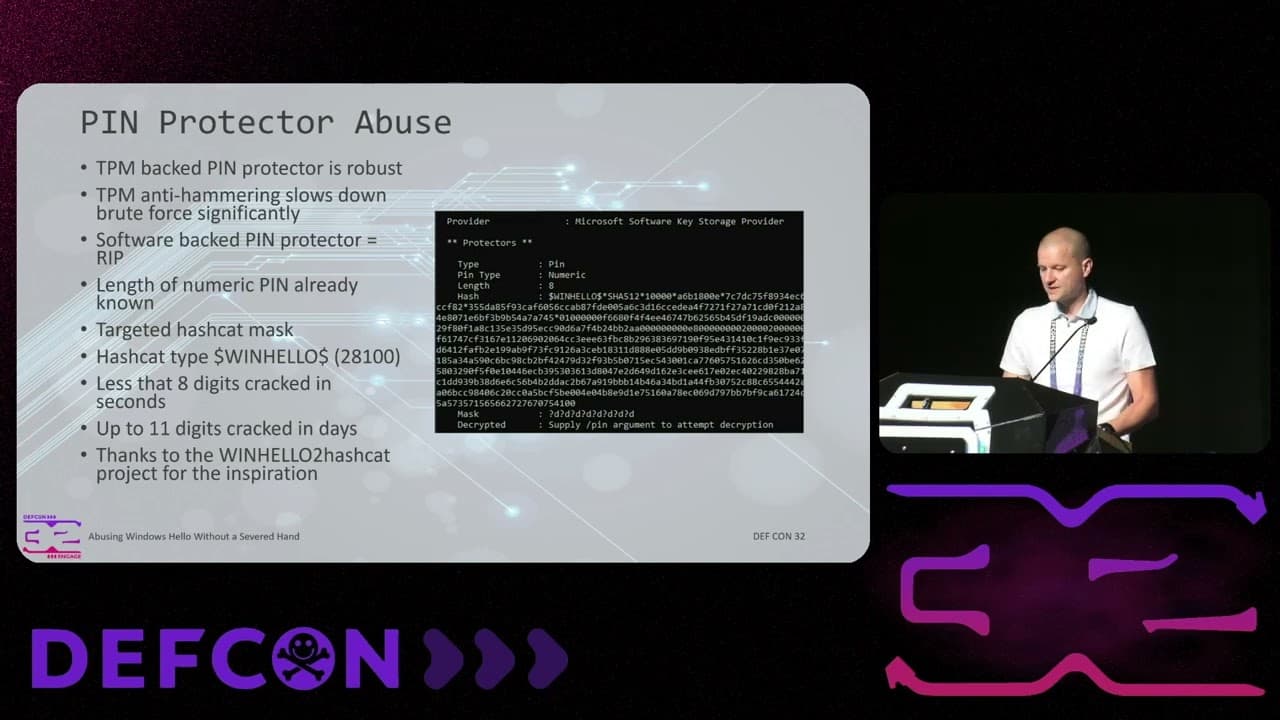
Abusing Windows Hello Without a Severed Hand
Similar Talks
Kill List: Hacking an Assassination Site on the Dark Web

Unmasking the Snitch Puck: The Creepy IoT Surveillance Tech in the School Bathroom