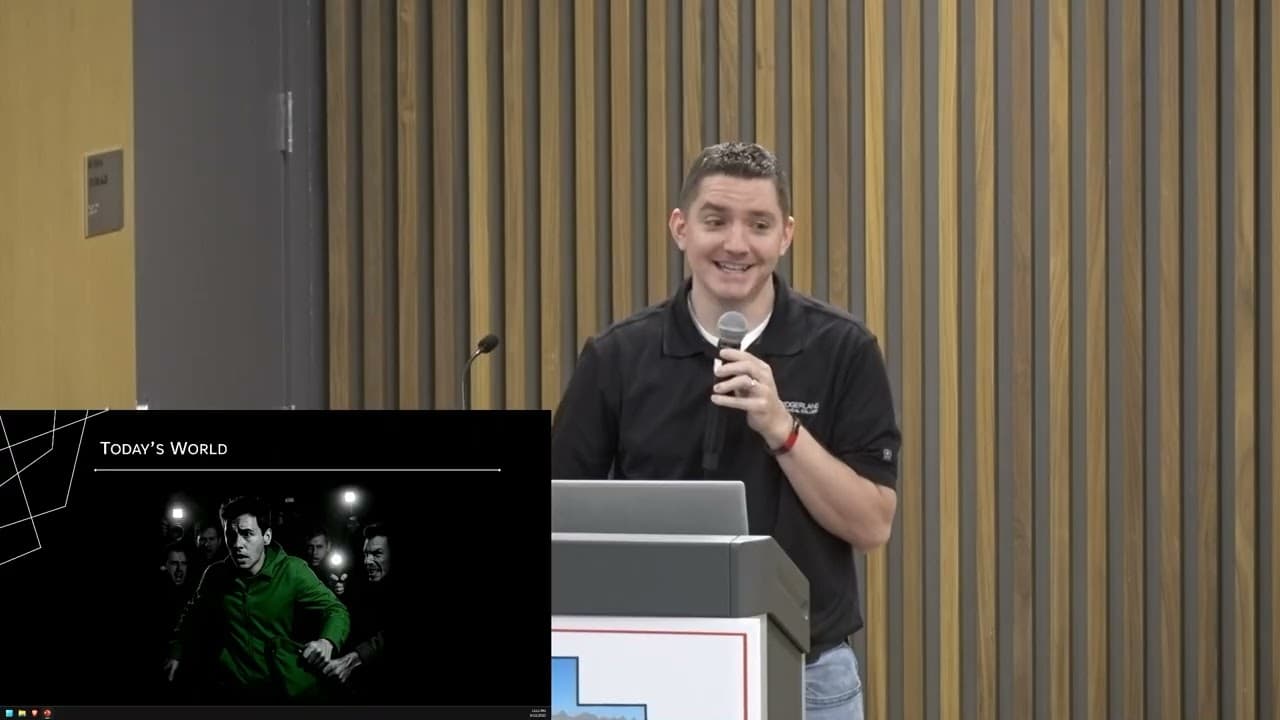
Here & Now: Exploiting the Human Layer at the Right Moment
This talk explores advanced social engineering techniques that leverage situational awareness and psychological manipulation to bypass physical security controls. The speaker demonstrates how to integrate into an organization's environment by appearing as a legitimate, authorized entity, thereby reducing suspicion and gaining access to restricted areas. The methodology emphasizes the importance of timing, improvisation, and the use of pretexts to manipulate human perception and decision-making processes. The presentation provides a framework for planning and executing these social engineering engagements effectively.
Why Your Physical Security Audit Needs to Stop Focusing on the Hardware
TLDR: Most physical security assessments fail because they focus on the hardware, like the RFID reader or the lock, rather than the human element that controls access. This talk demonstrates that the most effective way to bypass physical security is to integrate into the environment by appearing as a legitimate, authorized entity. By mastering timing and improvisation, researchers can manipulate human perception to gain access to restricted areas without ever needing to clone a badge or pick a lock.
Physical security testing is often treated as a binary exercise. You either clone the badge, or you don't. You either pick the lock, or you don't. This approach misses the reality of how modern facilities actually function. When you spend your entire engagement staring at an RFID reader, you are ignoring the fact that the person standing next to it is the real vulnerability. The most successful physical penetrations rely on social engineering, not because it is easier, but because it is more effective at bypassing the human layer that hardware-based security cannot account for.
The Failure of the "Perfect Pretext"
Many social engineering consultants operate under the assumption that if they have the perfect costume, the perfect badge, and the perfect script, they will succeed. This is a dangerous misconception. In a real-world environment, the unexpected happens. A company changes its access protocols overnight. A security guard asks a question you didn't rehearse. A simple, rigid script is a liability because it forces you to act like a machine in a world that is inherently chaotic.
The research presented at DEF CON 2025 highlights that the most successful infiltrations are not those that follow a script, but those that adapt to the environment in real-time. When you are in the field, your goal is not to be a perfect actor; it is to be a part of the background. You want to be the person who is supposed to be there, doing exactly what they are supposed to be doing. If you are too focused on your own performance, you will miss the signals that the environment is giving you.
The OODA Loop in Social Engineering
To move beyond rigid scripts, we can apply the OODA loop (Observe, Orient, Decide, Act) to social engineering. This framework, originally developed for military tactics, is perfectly suited for physical security assessments.
- Observe: You must constantly scan your environment for internal and external signals. Are people rushing? Is there a maintenance issue? What is the current mood of the staff?
- Orient: You analyze these signals against your goal. Does the current situation allow you to proceed, or do you need to pivot?
- Decide: You choose the best course of action based on your orientation. This is where you drop the script and improvise.
- Act: You execute your decision with confidence.
The key is that this loop must be continuous. If you stop observing, you stop adapting. If you stop adapting, you become an anomaly, and anomalies get caught.
Practical Application: The "Water Leak" Scenario
Consider a scenario where you need to access a server room. Instead of trying to force your way in, you create a situation where the environment demands your presence. You report a water leak that might be affecting electrical systems. This is a high-urgency, low-suspicion pretext. You aren't asking for access; you are offering a solution to a problem that the staff is now worried about.
When you arrive, you don't need to be a master of disguise. You need to be a master of the situation. You listen to the staff, you acknowledge their concerns, and you guide them toward the outcome you want. If they ask for your credentials, you provide them, but you do it in a way that makes the request seem like a formality, not a challenge. You are not fighting the security; you are working within it.
The Defensive Reality
For those of you working with blue teams, the lesson here is simple: stop relying on physical access control systems as your only line of defense. Hardware is only as good as the policies and training that surround it. If your staff is not trained to verify the identity of anyone who claims to be a technician, your expensive RFID readers are useless.
Defenders should focus on creating a culture of verification. This doesn't mean making everyone paranoid; it means making verification a standard, non-confrontational part of the daily workflow. If someone claims to be from headquarters to fix a leak, the staff should have a clear, documented process to verify that claim before granting access.
Moving Forward
The next time you are on a physical security engagement, stop looking for the "big red button" that will magically grant you access. There is no such thing. Instead, focus on the human layer. Observe the environment, listen to the people, and be prepared to improvise. The most effective way to bypass security is to make the security work for you.
If you want to get better at this, stop practicing your scripts and start practicing your situational awareness. Go to a public space and observe how people interact. Look for the signals that indicate someone is in charge, someone is stressed, or someone is just going through the motions. The more you understand how people behave in their natural environment, the better you will be at manipulating that environment to your advantage. The goal is not to be a better actor; it is to be a better observer.
Vulnerability Classes
Target Technologies
Attack Techniques
Up Next From This Conference


Similar Talks
Inside the FBI's Secret Encrypted Phone Company 'Anom'

Kill List: Hacking an Assassination Site on the Dark Web