Open Sesame - How Secure Is Your Stuff in Electronic Lockers
This talk demonstrates techniques for extracting firmware and configuration data from electronic locker systems to bypass security controls. The researchers analyze the hardware and communication protocols of various electronic locks, including those from Digilock and SAG, to identify vulnerabilities such as unencrypted EEPROM and exposed debug interfaces. The presentation highlights the risk of lateral movement and unauthorized access through the extraction of master keys and user PINs. The researchers also discuss the practical implications of these findings for physical security and the importance of security-by-design in embedded systems.
How to Bypass Electronic Locker Security via Firmware Extraction
TLDR: Electronic lockers from vendors like Digilock and SAG often rely on insecure embedded designs, including unencrypted EEPROM and exposed debug interfaces. By interfacing with these hardware components, researchers can extract master keys and user PINs to gain unauthorized access. This research highlights the critical need for security-by-design in physical access control systems and provides a roadmap for hardware-focused penetration testers.
Physical security is often the weakest link in an otherwise hardened environment. While organizations spend millions on network firewalls and endpoint detection, they frequently secure their most sensitive physical assets—laptops, credentials, and hardware tokens—inside electronic lockers that are essentially wide open to anyone with a basic understanding of embedded systems. The recent research presented at DEF CON 2024 on electronic locker vulnerabilities proves that these systems are rarely designed with a threat model that includes a motivated attacker with a logic analyzer and a Pickit3.
The Anatomy of an Insecure Lock
The core issue identified in this research is the lack of fundamental security controls in the embedded architecture of common locker systems. Many of these devices, including those from Digilock and SAG, utilize Microchip PIC18 or PIC24 microcontrollers. While these chips are efficient for battery-operated devices, they are frequently deployed without enabling basic protection bits like Readout Protection (RDP) or Code Protection (CP).
When these protection bits are left disabled, an attacker can connect directly to the exposed debug pins on the PCB. Using a standard programmer, the entire flash memory can be dumped. Even when code protection is enabled, researchers found that the external EEPROM—where configuration data, master keys, and audit logs are stored—is often completely unencrypted. This allows for trivial extraction of sensitive data.
Exploiting the Communication Protocol
Many of these locks use a one-wire communication protocol to interface between the key and the lock mechanism. This protocol is well-documented and widely used in various industrial applications. By intercepting the communication stream with a logic analyzer, an attacker can observe the exchange of data.
The research demonstrated that the locks often rely on a simple "Read ROM" command to identify the key. Because there is no cryptographic handshake or challenge-response mechanism, the system is vulnerable to simple replay or emulation attacks. An attacker can use an Arduino or a Flipper Zero to emulate a valid master key. Once the device is programmed with the extracted ID, it can unlock any locker in the system, effectively granting the attacker administrative access.
Real-World Pentesting Implications
For a penetration tester, these findings change the scope of physical security assessments. If you are tasked with a red team engagement, do not assume that the electronic lockers in the lobby or the server room are secure. During a physical assessment, look for exposed debug headers on the underside of the lock housing or behind the plastic faceplate.
If you encounter a system that uses a proprietary key, check if the key itself has exposed contacts. If you can read the key's ID, you can likely clone it. The impact of such an exploit is significant; it allows for lateral movement within a facility. An attacker who gains access to a single master key can compromise every locker in that specific deployment, potentially harvesting credentials or secondary access tokens that lead to further network compromise.
Defensive Strategies for Embedded Systems
Defending against these attacks requires a shift toward security-by-design. Manufacturers must move away from "security through obscurity" and implement robust hardware-level protections. At a minimum, this includes:
- Enabling Readout Protection: Always set the appropriate configuration bits on the MCU to prevent unauthorized flash dumping.
- Encrypting External Storage: Any data stored on external EEPROM or flash must be encrypted using a unique, per-device key.
- Implementing Cryptographic Authentication: Move away from simple ID-based protocols. Use OWASP-recommended authentication patterns that include mutual authentication between the key and the lock.
- Physical Hardening: Design the enclosure to prevent access to debug headers and motor power lines.
If you are a security professional responsible for procuring these systems, demand a security audit from the vendor. Ask if they have performed a hardware-level penetration test and if they support signed firmware updates. If a vendor cannot provide documentation on how they protect against physical debug access, assume the device is vulnerable.
Hardware hacking is not just for academic research; it is a practical, high-impact vector that is often overlooked. The next time you see an electronic locker, remember that it is just another computer—and like any other computer, it can be compromised if the developer forgot to lock the front door.
Vulnerability Classes
Target Technologies
Attack Techniques
OWASP Categories
All Tags
Up Next From This Conference
Breaking Secure Web Gateways for Fun and Profit
Listen to the Whispers: Web Timing Attacks That Actually Work
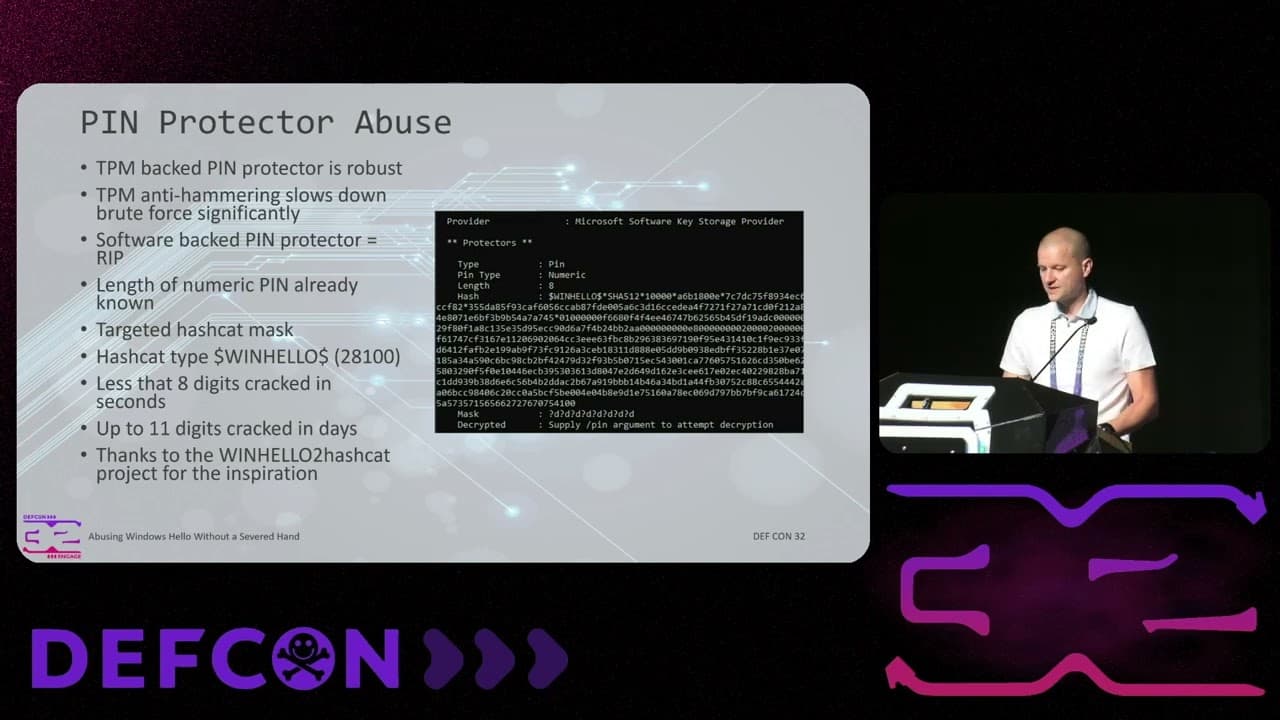
Abusing Windows Hello Without a Severed Hand
Similar Talks
Hacking Apple's USB-C Port Controller
Unmasking the Snitch Puck: The Creepy IoT Surveillance Tech in the School Bathroom