Safe Cracking for Everyone
This talk demonstrates the mechanical principles and exploitation techniques for opening Group 2 mechanical safe locks. It explains the internal components of these locks, including the drive cam, wheels, and fence, and how they interact to secure the bolt. The speaker details a systematic method for identifying the correct combination by isolating each wheel and identifying gate signatures through tactile feedback. The presentation provides a practical guide for physical security testing and lock manipulation.
Mechanical Exploitation: Bypassing Group 2 Safe Locks via Tactile Feedback
TLDR: This research details the mechanical vulnerabilities inherent in Group 2 safe locks, specifically the Sargent and Greenleaf 6730 and similar models. By isolating individual wheels and identifying gate signatures through tactile feedback, an attacker can determine the combination without destructive entry. This technique highlights why physical security remains a critical, often overlooked, vector in high-stakes environments.
Physical security is the ultimate air gap, but it is rarely as impenetrable as the marketing brochures claim. While most of our work focuses on memory corruption or web-based authentication bypasses, the mechanical locks securing server rooms and sensitive hardware are often just as vulnerable to systematic exploitation. The research presented at DEF CON 2024 on Group 2 mechanical safe locks is a masterclass in understanding hardware-level logic flaws. These locks rely on a series of rotating wheels and a drive cam, and their security is entirely dependent on the precision of their manufacturing and the operator's ability to interpret subtle physical feedback.
The Mechanics of the Lock
At the heart of a standard Group 2 lock are three primary components: the drive cam, the wheels, and the fence. The drive cam is directly connected to the dial. As you rotate the dial, the drive cam rotates, eventually picking up the wheels one by one. Each wheel has a small notch called a gate. When the correct combination is dialed, all three gates align under the fence. Once aligned, the fence drops into the gates, allowing the bolt to retract and the safe to open.
The vulnerability here is not a software bug, but a design limitation. Because manufacturers cannot produce perfectly circular, identical wheels, there is always a slight variance in the diameter and the placement of the gates. This variance creates a unique "gate signature" that can be felt through the dial. When the fence is resting on the wheels, the resistance you feel while turning the dial changes as the fence encounters the edges of the gates.
Exploiting the Gate Signature
To exploit these locks, you do not need to guess the combination. You need to isolate the wheels. By rotating the dial in a specific sequence, you can pick up the wheels and move them independently. The goal is to find the "common low point" for each wheel. This is the position where the fence drops deepest into the gate, indicating the wheel is in the correct alignment.
The process involves taking contact point readings every few increments. As you rotate the dial, you feel for the resistance caused by the fence interacting with the wheel's edge. When you hit a gate, the resistance drops. By mapping these drops across the entire rotation of the dial, you can identify the exact position of the gate for each wheel.
For a Sargent and Greenleaf 6741, the process is slightly more forgiving due to the internal tolerances, but the principle remains the same. You are essentially performing a side-channel attack on a mechanical system. You are measuring the physical displacement of the fence to infer the state of the internal wheels.
Real-World Applicability
For a penetration tester, this is not just a parlor trick. If you are tasked with a physical security assessment of a facility, the ability to bypass a mechanical safe can be the difference between a successful engagement and a failed one. These locks are still widely deployed in critical infrastructure, retail, and banking.
The impact of this vulnerability is total. Once the combination is recovered, the lock is fully compromised. Unlike a digital system where you might trigger an alarm or lock out after multiple failed attempts, these mechanical systems have no such telemetry. If you have the time and the patience to map the gate signatures, the lock will open every single time.
Defensive Considerations
Defending against this type of manipulation is difficult because the flaw is inherent to the mechanical design. The most effective mitigation is to move away from mechanical combination locks entirely. Modern electronic locks, such as those compliant with UL 2058, offer audit trails, time-delay features, and lockout mechanisms that make this kind of tactile exploitation impossible. If you are forced to use mechanical locks, ensure they are regularly serviced and consider adding secondary security layers like biometric access or physical surveillance that monitors the area around the safe.
Mastering this technique requires hours of practice. It is not something you can learn from a single video or a blog post. It requires developing the tactile sensitivity to distinguish between the subtle vibrations of a gate and the friction of the wheel pack. If you are serious about physical security, start by picking up a practice lock and a copy of the documentation for the LaGard 3330. The barrier to entry is high, but the ability to read the internal state of a locked device is a skill that will serve you well in any red team engagement.
Vulnerability Classes
Target Technologies
Attack Techniques
All Tags
Up Next From This Conference

Breaking Secure Web Gateways for Fun and Profit

Listen to the Whispers: Web Timing Attacks That Actually Work
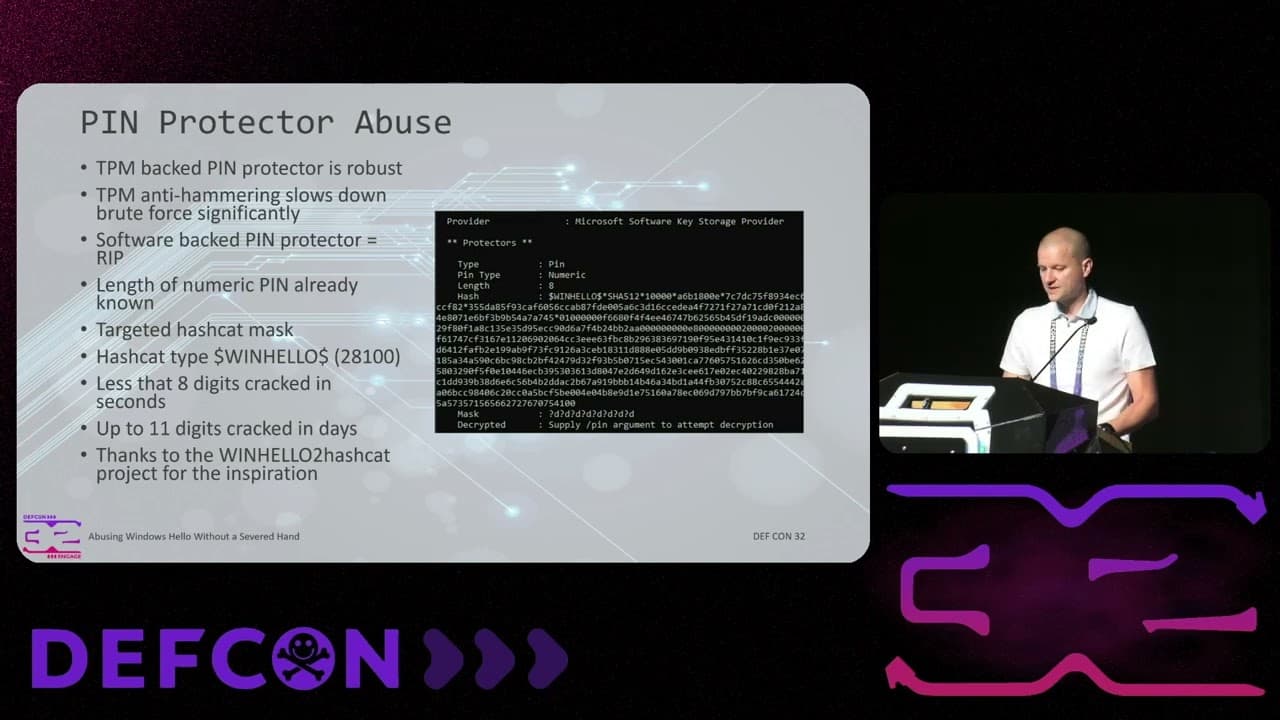
Abusing Windows Hello Without a Severed Hand
Similar Talks

Hacking Apple's USB-C Port Controller

Anyone Can Hack IoT: A Beginner's Guide to Hacking Your First IoT Device