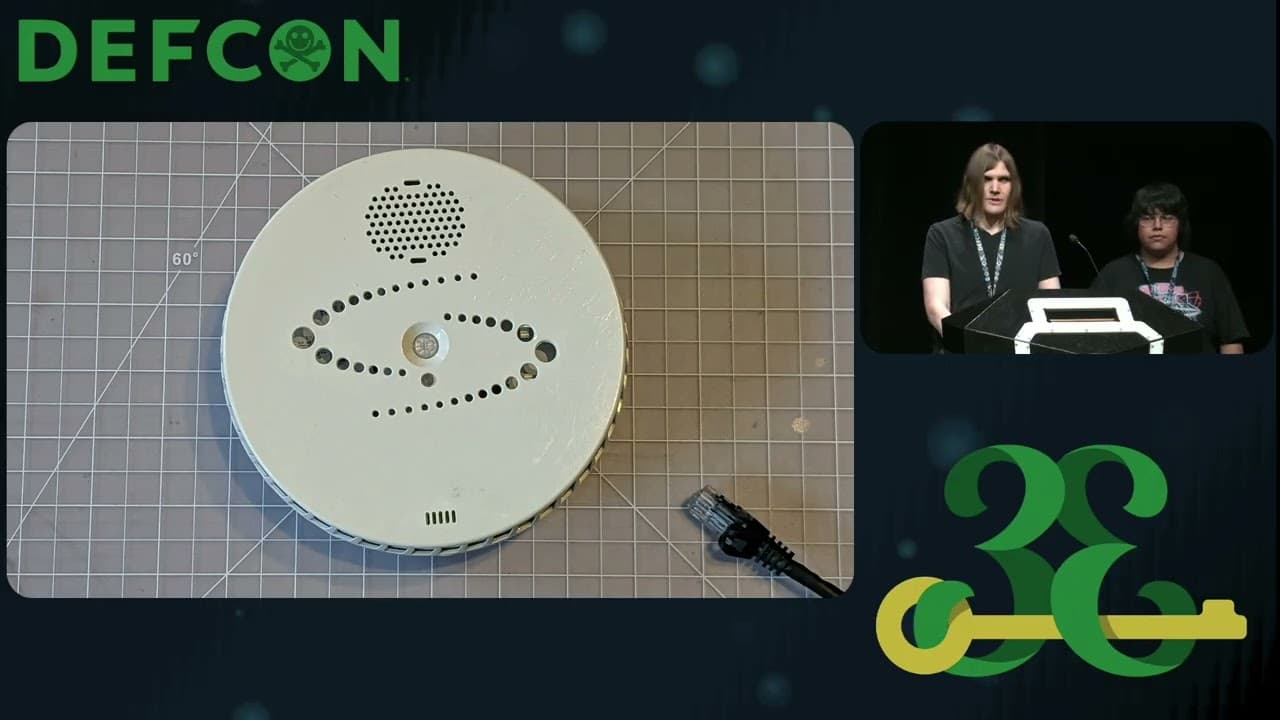
Sonos Over-The-Air Remote Kernel Exploitation and Covert Wiretap
This talk demonstrates a remote kernel exploitation technique against Sonos smart speakers, leveraging a buffer overflow vulnerability in the WPA2 handshake process. The researchers detail how they achieved arbitrary code execution by manipulating the stack and bypassing security mitigations like KASLR and stack canaries. The presentation concludes with a practical demonstration of a custom Rust-based implant used to establish a persistent backdoor and perform covert audio capture. The talk also covers a secondary research effort involving a secure boot bypass on the newer Sonos Era-100 device.
Remote Kernel Exploitation and Audio Wiretapping on Sonos Devices
TLDR: Researchers at Black Hat 2024 demonstrated a remote kernel exploitation chain against Sonos speakers, triggered by a buffer overflow in the WPA2 handshake process. By manipulating the stack and bypassing KASLR and stack canaries, they achieved arbitrary code execution and established a persistent Rust-based implant for covert audio capture. This research highlights the critical need for rigorous input validation in embedded Wi-Fi drivers and the importance of secure boot configurations in consumer IoT hardware.
Embedded security research often feels like a game of cat and mouse, but the latest work on Sonos devices proves that even well-defended consumer hardware can be compromised through the wireless stack. When we look at IoT security, we often focus on web interfaces or cloud APIs, but the real attack surface frequently lies in the kernel modules handling low-level protocols. The recent research presented at Black Hat 2024 regarding remote kernel exploitation on Sonos speakers is a masterclass in how to chain seemingly minor memory corruption bugs into full device control.
The WPA2 Handshake Vulnerability
The core of this research centers on a buffer overflow vulnerability within the Wi-Fi driver, specifically during the WPA2 handshake process. The researchers identified that the Wi-Fi kernel module, which handles the parsing of wireless frames, lacked sufficient input validation. Specifically, the function responsible for parsing the EAPOL key data, which is part of the WPA2 handshake, was vulnerable to a classic stack-based buffer overflow.
The vulnerability, tracked as CVE-2023-50809, exists because the length field of the key data is not properly validated against the size of the destination buffer. By crafting a malicious EAPOL frame, an attacker can trigger an overflow, overwriting the stack and gaining control over the instruction pointer.
The researchers demonstrated that because the kernel module was compiled without stack canaries and with KASLR disabled, they could reliably redirect execution flow. The attack flow involves:
- Establishing a WPA2 connection with the target device.
- Sending a specially crafted EAPOL frame during the handshake.
- Triggering the buffer overflow to overwrite the return address.
- Pivoting the stack to a controlled memory location containing a ROP chain.
This ROP chain is used to disable memory protections, specifically by calling a function to mark the heap as executable, allowing the execution of shellcode.
From Code Execution to Persistence
Once arbitrary code execution is achieved in the kernel context, the researchers moved to establish persistence. They developed a custom implant written in Rust. Rust is an excellent choice for this kind of work because it provides memory safety guarantees that are invaluable when writing code that runs in a privileged context.
The implant allows for remote command execution and, more alarmingly, covert audio capture. By interacting with the device's ALSA (Advanced Linux Sound Architecture) drivers, the implant can open a handle to the microphone, unmute it, and stream audio data back to the attacker. The demo showed the researchers successfully capturing and playing back audio from the room where the speaker was located, proving the feasibility of using these devices as remote wiretaps.
Secure Boot Bypass on the Era-100
The research also extended to the newer Sonos Era-100, which features a more hardened boot process. The researchers found that while the device implements secure boot, the implementation of the bootloader, U-Boot, had a critical flaw. The bootloader was configured to load the environment from a fixed offset in the eMMC, and this configuration was not properly validated.
By modifying the boot arguments in the eMMC, the researchers were able to force the device to boot into a state that allowed for the execution of custom code. This secure boot bypass, combined with the ability to modify the eMMC contents, effectively nullified the device's security posture. This highlights a recurring theme in IoT security: even if you have secure boot, if the bootloader configuration is mutable and unauthenticated, the entire chain of trust collapses.
Real-World Implications for Pentesters
For those of us performing penetration tests on IoT devices, this research serves as a reminder to look beyond the obvious. When you are assessing a device, don't just scan for open ports or look for hardcoded credentials. Use a logic analyzer to identify UART headers, dump the firmware, and start looking at the kernel modules.
The use of Ghidra or IDA Pro to reverse engineer kernel modules is standard, but the real value comes from understanding how these modules handle data from the network. If you see a driver parsing complex network protocols, that is where you should be focusing your fuzzing efforts. The OWASP IoT Top 10 project provides a great framework for identifying these kinds of risks, particularly under the category of vulnerable and outdated components.
Defensive Considerations
Defenders must prioritize the hardening of the boot process and the implementation of modern exploit mitigations. Compiling kernel modules with stack canaries, enabling KASLR, and ensuring that bootloader configurations are signed and immutable are non-negotiable requirements for modern embedded systems. Furthermore, the principle of least privilege should be applied to kernel modules; if a module doesn't need to handle raw network frames, it shouldn't have the permissions to do so.
Security is not a static state but a continuous process of learning from past failures. The fact that Sonos worked with the researchers to patch these vulnerabilities within a few months is a positive sign, but it also underscores the reality that no device is impenetrable. Keep your firmware updated, keep your attack surface minimal, and never assume that the hardware you are using is as secure as the marketing claims.
Vulnerability Classes
Target Technologies
Attack Techniques
OWASP Categories
All Tags
Up Next From This Conference


Similar Talks
Inside the FBI's Secret Encrypted Phone Company 'Anom'
Hacking Apple's USB-C Port Controller