The Future of Privacy and Software Engineering
This keynote explores the evolution of privacy-enhancing technologies and the challenges of software development at scale. It highlights the tension between vision and engineering, arguing that deep technical understanding is essential for both effective security research and building robust, privacy-focused products. The talk emphasizes that software is never finished and requires ongoing maintenance, contrasting this with the static nature of traditional creative works.
The Hidden Cost of Abstraction: Why Your Security Toolchain is Leaking State
TLDR: Modern software development relies heavily on abstraction layers to manage complexity, but these layers often obscure critical state transitions that lead to memory corruption and logic vulnerabilities. By treating complex systems like black boxes, developers and security researchers miss the underlying state machines that define how data is actually processed. Pentesters should stop treating these interfaces as static and start mapping the state transitions beneath them to find high-impact bugs.
Software engineering has spent the last two decades obsessed with hiding complexity. We build layers upon layers of abstractions—relational databases, ORMs, game engines, and managed cloud services—all designed to let us focus on "the vision" rather than the bits and bytes. While this has undoubtedly increased the velocity of feature delivery, it has created a dangerous blind spot for security researchers. We have become so comfortable with the abstraction that we have forgotten how to look at the machine underneath.
The core problem is that software is never finished. Unlike a painting or a song, software is a living, breathing state machine that requires constant maintenance. When we treat a complex system as a black box, we lose the ability to reason about its state. This is where the most interesting vulnerabilities live. If you are only testing the API surface, you are only testing the interface, not the logic that governs the state transitions behind it.
The Illusion of the Black Box
Consider the evolution of privacy-enhancing technologies like PGP, S/MIME, and OTR. These tools were designed to solve the fundamental problem of end-to-end encryption. Yet, they never achieved mass adoption. Why? Because they required the user to understand the underlying mechanics of the system. They forced the user to manage keys, verify fingerprints, and handle state.
When we build software today, we try to solve this by pushing the complexity onto the user or hiding it behind a platform. We think that if we just build a "secure enough" virtual machine or a "hardened" mail server, we have solved the problem. But security is not a feature you can bolt onto an abstraction layer. Security is the process of looking through those layers to understand how things actually work.
If you are a pentester, your job is to break the abstraction. When you encounter a target that uses a complex microservices architecture, you are not just testing a set of endpoints. You are testing a distributed state machine. If you treat each service as a black box, you will miss the race conditions, the inconsistent state updates, and the logic flaws that occur when these services interact.
Mapping the State Machine
To find real bugs, you need to move beyond the interface. Look at how data flows through the system. If you are testing a web application, don't just look at the HTTP requests. Look at how the application state changes in the database. Use tools like QEMU to inspect the execution environment if you suspect memory corruption.
Memory corruption vulnerabilities, such as those that might arise in poorly managed C-based components, are often the result of a mismatch between the expected state and the actual state of the memory. If you can map the state transitions, you can identify the exact conditions required to trigger an overflow or a use-after-free. This is not about finding a magic payload; it is about understanding the constraints of the system well enough to know what is possible.
The Pentester’s Advantage
The most effective security researchers are those who understand the tools they are testing better than the people who built them. When you are on an engagement, do not just run your automated scanners. Take the time to understand the underlying architecture. Ask yourself: what is the state machine here? What are the transitions? Where is the state stored?
If you are testing a system that relies on a specific cryptographic protocol, do not just assume the implementation is correct. Look for the edge cases. Look for the ways in which the implementation deviates from the specification. These deviations are almost always where the vulnerabilities are hidden.
Moving Forward
We need to stop being passive consumers of abstractions. The next generation of high-impact vulnerabilities will not be found by fuzzing the same old API endpoints. They will be found by researchers who take the time to understand the complex, intertwined relationship between vision and engineering.
Stop looking at your target as a collection of black boxes. Start looking at it as a system of state machines. The more you understand about how the system is built, the more creative you can be in finding ways to break it. The tools are there, the documentation is there, and the complexity is waiting to be unraveled. The only secret is to begin.
Vulnerability Classes
Up Next From This Conference

Similar Talks
Inside the FBI's Secret Encrypted Phone Company 'Anom'
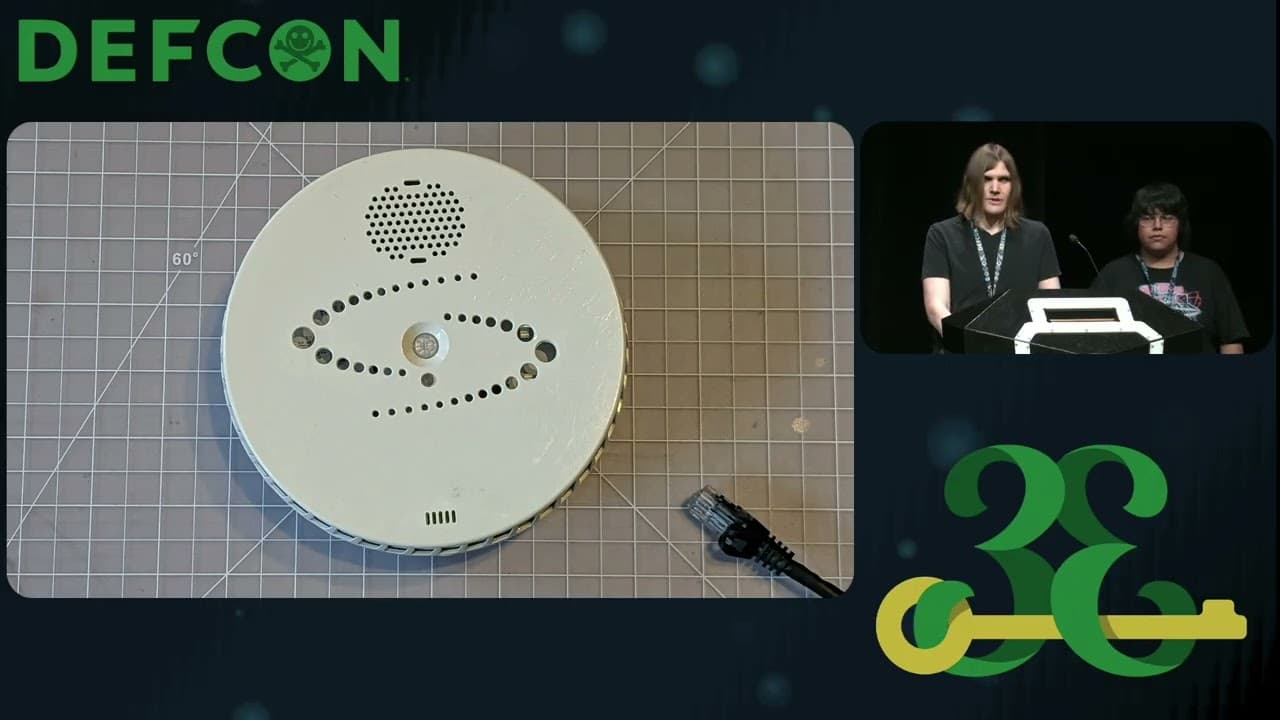
Unmasking the Snitch Puck: The Creepy IoT Surveillance Tech in the School Bathroom