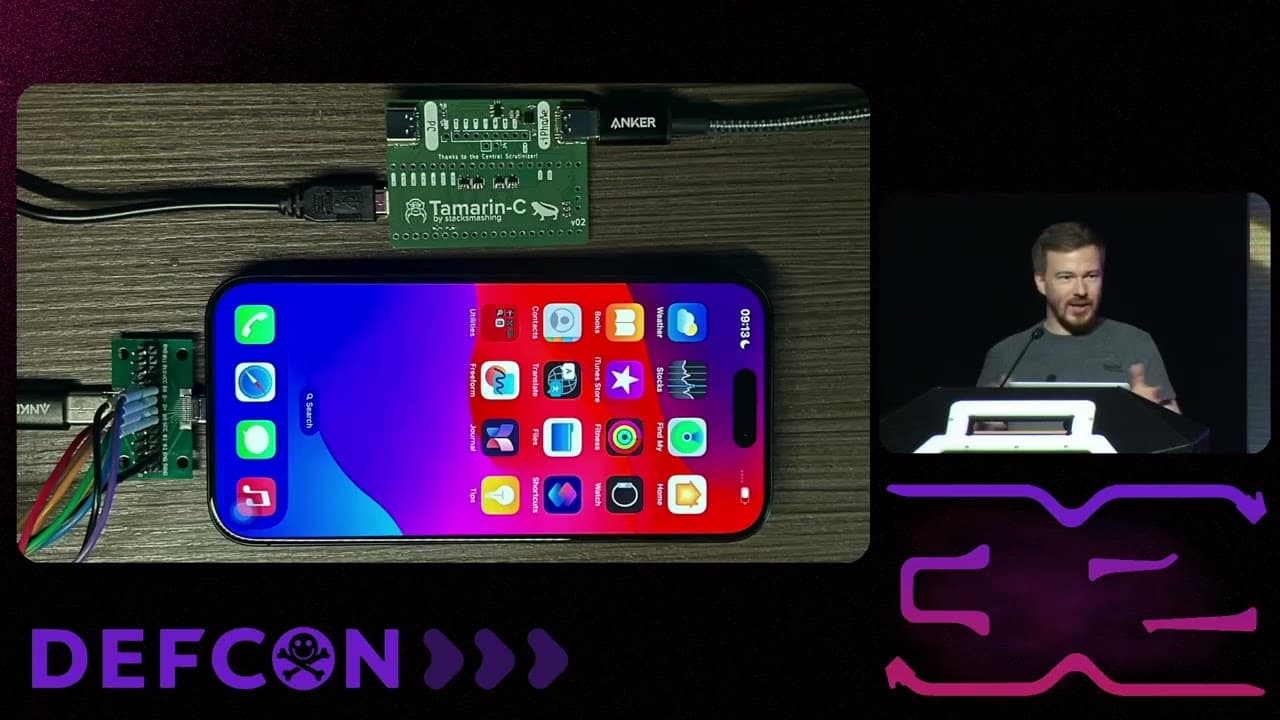
The Secret Life of a Rogue Device
This talk demonstrates techniques for identifying and acquiring sensitive prototype hardware leaked through secondary online marketplaces. It details the development of an automated scraping and OCR pipeline to identify listings containing proprietary hardware identifiers and internal markings. The research highlights significant supply chain security risks, including the exposure of internal credentials, support documentation, and sensitive corporate data on decommissioned devices. The speaker also showcases the use of custom hardware arrays and automated workflows to bypass anti-bot protections and rate-limiting on e-commerce platforms.
How to Source Sensitive Prototype Hardware from Public Marketplaces
TLDR: This research exposes how easily sensitive prototype hardware and internal corporate data can be acquired through secondary online marketplaces like eBay and Xianyu. By building an automated pipeline using OCR and custom proxying, researchers can identify and purchase decommissioned devices that still contain internal credentials, support documentation, and proprietary software. This highlights a critical, often overlooked, supply chain vulnerability where physical asset disposal fails to sanitize data effectively.
Hardware security often focuses on side-channel attacks or fault injection, but the most effective way to compromise a device is to simply buy it. When companies decommission hardware, they often assume that physical destruction or a basic factory reset is sufficient. This research proves that assumption is dangerously wrong. By scraping secondary markets for specific hardware identifiers and internal markings, it is possible to acquire prototype devices that have not been properly sanitized, providing a direct window into a company’s internal development environment.
The Automated Pipeline for Hardware Reconnaissance
Finding a needle in a haystack of millions of listings requires more than manual searching. The core of this research is an automated pipeline that treats e-commerce platforms as a target for data collection. The process begins with scraping platforms like eBay and the Chinese marketplace Xianyu.
The primary challenge here is rate limiting. Major platforms employ sophisticated anti-bot protections that detect and block automated requests. To bypass these, the research utilizes Cloudflare Workers as a proxy layer. By routing requests through these workers, the scraper can circumvent IP-based rate limiting. For more complex environments like the Xianyu app, which uses custom signing APIs and proprietary encryption, the researchers employed Frida to hook into the application and automate the signing process. This allows for the execution of authenticated requests at scale, effectively turning a mobile app into a headless data-gathering tool.
Once the listings are scraped, the next step is identifying the "rogue" hardware. Sellers rarely label a device as a "sensitive prototype." Instead, the critical information is hidden in the images. The pipeline processes these images using Tesseract OCR and, where necessary, more advanced vision APIs to extract text from labels, asset tags, and stickers. By maintaining a dynamic list of keywords—such as "Property of," "Confidential," or specific internal project codenames—the system flags relevant listings for human review.
From Metadata to Full System Compromise
Acquiring the device is only the first step. Once the hardware is in hand, the goal is to extract the data that the previous owner failed to wipe. In the case of the Apple Time Capsule mentioned in the research, the device was listed as part of an office clearance. Despite the seller’s claim that it had been powered on, the drive appeared empty upon initial inspection.
However, a forensic scan revealed that the data had not been securely wiped; it had merely been marked as deleted. Using a head swap technique—a standard procedure in data recovery—the researchers were able to bypass the physical damage caused by the seller’s attempt to destroy the drive. The recovered data included internal support tickets, sales reports, and even internal memes, which provide significant context for an attacker looking to map out a company’s internal culture and security practices.
This is not limited to older hardware. The research also details the acquisition of "dev-fused" iPhone 14 prototypes. These devices are particularly valuable because they lack the standard production fuses that prevent debugging of the application processor and the Secure Enclave. For a researcher, these devices are the holy grail of exploit development, as they allow for the inspection of code that is otherwise locked behind hardware-backed security.
Real-World Applicability for Pentesters
For a penetration tester or a bug bounty hunter, this research changes the definition of "reconnaissance." If you are tasked with testing a company’s security, you should be looking at their physical footprint. Are they disposing of hardware through third-party recyclers that might be leaking assets?
During an engagement, check if the client has a clear policy for the physical destruction of storage media. If they are simply selling old laptops or servers on public marketplaces, they are effectively handing over their internal network documentation, credentials, and potentially even pre-production software to anyone with a search query. The impact of such a leak is massive; it provides an attacker with the same level of access as an insider, bypassing traditional perimeter defenses entirely.
Securing the Hardware Supply Chain
Defending against this requires a shift in how organizations view asset retirement. Physical destruction must be verified, not just assumed. If a device contains sensitive data, the storage media should be shredded, not just wiped. Furthermore, organizations should implement a robust Asset Management policy that tracks the lifecycle of every device from procurement to destruction.
If you are a security researcher, the next time you see a "for parts" listing for a device from a major tech company, look closer at the images. You might find more than just a broken screen. The most interesting vulnerabilities are often the ones that have been sitting in a box in a warehouse, waiting for someone to plug them in.
Vulnerability Classes
Target Technologies
Attack Techniques
OWASP Categories
Up Next From This Conference
Breaking Secure Web Gateways for Fun and Profit
Listen to the Whispers: Web Timing Attacks That Actually Work
Abusing Windows Hello Without a Severed Hand
Similar Talks
Inside the FBI's Secret Encrypted Phone Company 'Anom'

Kill List: Hacking an Assassination Site on the Dark Web