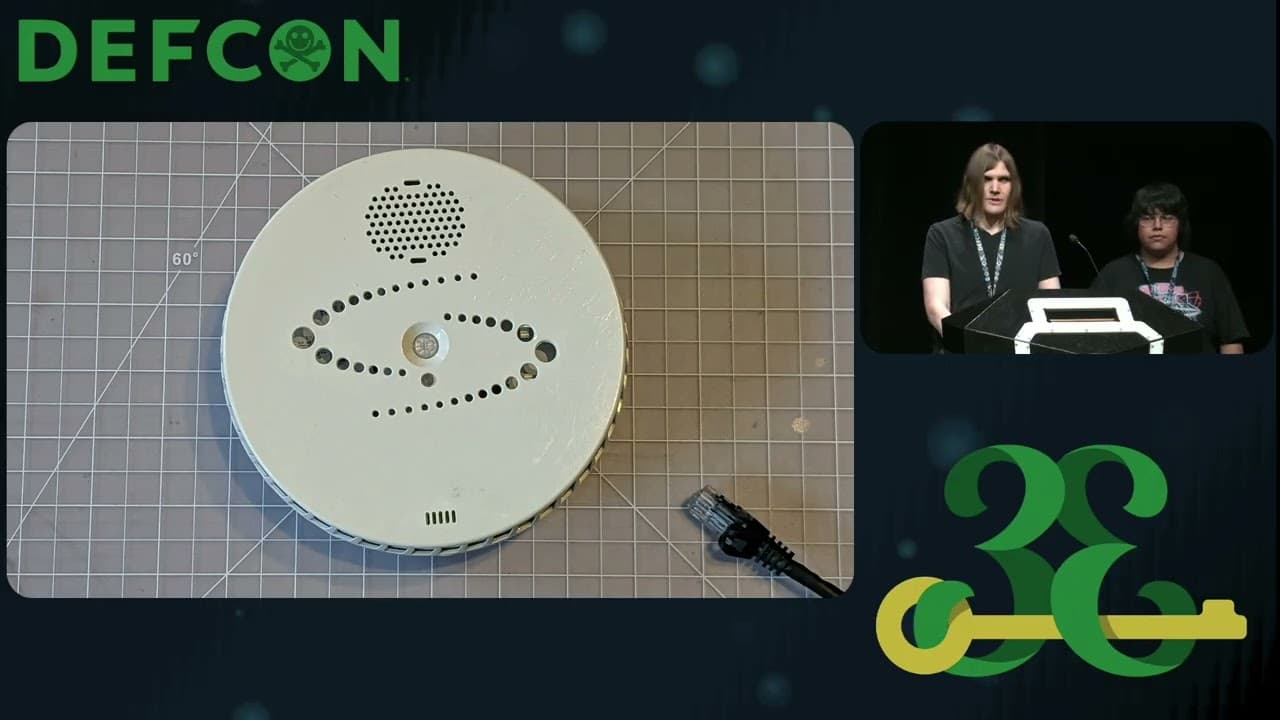
Adventures and Findings in ISP Hacking
This talk demonstrates multiple vulnerabilities in ISP-provided hardware, including command injection, hardcoded credentials, and insecure debug interfaces. The research focuses on Adtran 411 optical network terminals (ONTs) and the risks posed by exposed control plane networks. The speaker highlights how these basic flaws can lead to full device compromise and potential lateral movement within an ISP's infrastructure. The presentation includes a live demonstration of exploiting telnet command injection to gain a root shell.
Root Shells and Hardcoded Secrets: Exploiting ISP-Grade Hardware
TLDR: Researchers recently demonstrated how exposed control plane networks on ISP-provided Adtran 411 ONTs allow for trivial remote command injection and credential harvesting. By leveraging insecure telnet interfaces and hidden web pages, an attacker can gain root access to the device and potentially pivot into the ISP's internal infrastructure. This research underscores the critical need for network segmentation and the removal of legacy management services on customer-premises equipment.
Hardware security often feels like a niche pursuit until you realize that the device sitting in your living room is a gateway to a massive, poorly segmented network. The recent research presented at BSidesSF 2025 on Adtran 411 Optical Network Terminals (ONTs) is a masterclass in why we cannot trust ISP-provided hardware. These devices are not just simple bridges; they are complex, embedded Linux systems that often ship with legacy management services enabled by default, creating a massive attack surface for anyone on the local network or, worse, the ISP's control plane.
The Anatomy of an ISP Compromise
The research highlights a recurring failure in embedded security: the assumption that the control plane is unreachable. By analyzing the device firmware, the researchers identified multiple vulnerabilities, including CVE-2025-22937, CVE-2025-22938, CVE-2025-22939, CVE-2025-22940, and CVE-2025-22941. These vulnerabilities range from hardcoded credentials to command injection flaws in both the telnet and web interfaces.
The most egregious finding was the command injection vulnerability in the telnet interface. Because the device uses a standard BusyBox implementation, the shell environment is predictable. The researchers discovered that the ping utility, accessible to low-privileged users, failed to sanitize input, allowing for arbitrary command execution via a semicolon.
# Example of the command injection vector
ping 127.0.0.1; /bin/sh
Once the shell is spawned, the user is dropped into a root context. This is a classic example of A03:2021-Injection and A07:2021-Identification and Authentication Failures. The device essentially hands over the keys to the kingdom because it trusts the input provided to its management utilities.
From Web Pages to Root Access
Beyond the telnet interface, the web management portal contained hidden, unlinked pages that provided a treasure trove of information. One such page, dump_sysinfo.html, generated an XML dump of the system configuration. This file included plaintext passwords for the admin and support accounts.
For a pentester, this is the ultimate low-hanging fruit. If you are performing a physical or local network assessment, checking for these hidden endpoints should be part of your standard reconnaissance. The impact of this vulnerability is total device compromise. With admin credentials, an attacker can modify routing tables, enable mirror ports for traffic interception, or even push malicious firmware updates if the ISP's update mechanism is not cryptographically signed.
The Danger of the Control Plane
Perhaps the most concerning aspect of this research is the exposure of the control plane network. Many ISPs use a separate VLAN for management traffic, but as the research demonstrated, these networks are often reachable from the customer-facing side of the ONT. If an attacker can reach the control plane, they are no longer limited to attacking a single device. They can scan the ISP's internal infrastructure, identify other vulnerable ONTs, and potentially move laterally across the provider's network.
When testing these devices, always use tools like nmap to map the available services and netcat to interact with them. If you find a telnet or web interface, assume it is vulnerable until proven otherwise. The goal is to identify if the device is part of a larger, exposed management network. If it is, the risk profile shifts from a single-user compromise to a systemic threat.
Defensive Strategies for Embedded Systems
Defending against these attacks requires a shift in how ISPs deploy and manage hardware. First, management interfaces like telnet must be disabled entirely in favor of secure, encrypted protocols like SSH, though even that is insufficient if the underlying services are flawed. Second, network segmentation is non-negotiable. The control plane must be physically or logically isolated from the customer-facing network.
If you are a developer working on similar hardware, ensure that all input is strictly validated and that management services are not accessible by default. Use U-Boot to lock down the boot process and ensure that debug interfaces are physically disabled or require hardware-level authentication.
The reality is that these devices are often treated as "set and forget" by both the ISP and the consumer. As researchers, we need to keep pushing for better security in these ubiquitous gateways. If you find yourself auditing an ONT, don't just look for the obvious bugs. Look for the hidden pages, the debug interfaces, and the assumptions made by the engineers who built the device. Often, the most critical vulnerabilities are the ones that were never meant to be exposed in the first place. Keep digging, and keep sharing your findings.
Vulnerability Classes
Target Technologies
OWASP Categories
All Tags
Up Next From This Conference

Similar Talks

Kill List: Hacking an Assassination Site on the Dark Web

Hacking Apple's USB-C Port Controller