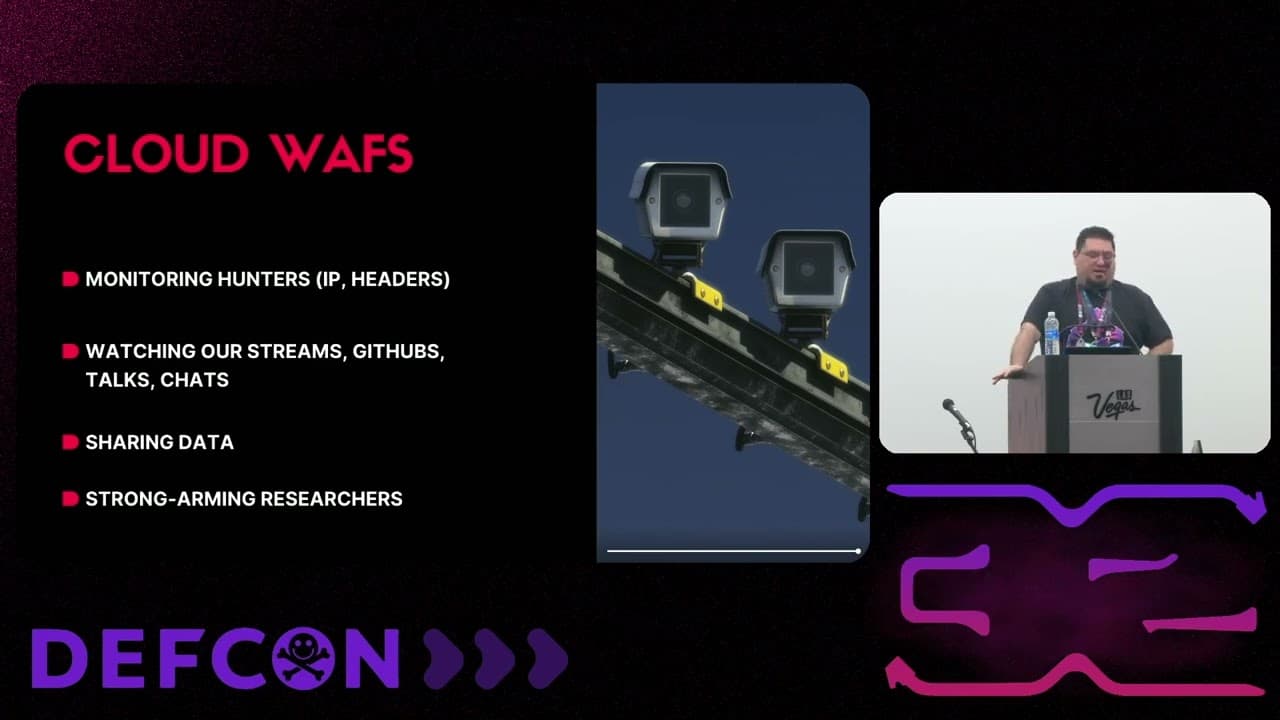
Your Intrusion Detection Still Sucks (And What To Do About It)
This talk presents a framework for improving intrusion detection systems by focusing on data enrichment, context, and cross-correlation of security events. The speaker demonstrates how to reduce false positives and improve detection efficacy by integrating disparate data sources like HR records, infrastructure-as-code, and endpoint telemetry. The presentation emphasizes the importance of a structured, automated response pipeline to handle alerts effectively. It also highlights the role of hardware-backed authentication in mitigating session hijacking and credential-based attacks.
Stop Chasing Ghosts: Why Your SIEM Alerts Are Failing You
TLDR: Most security teams are drowning in high-volume, low-fidelity alerts because they lack the context to distinguish between benign administrative activity and actual compromise. By integrating HR data, infrastructure-as-code repositories, and endpoint telemetry, you can transform atomic security events into actionable intelligence. This approach moves beyond simple signature matching to identify the intent behind an attacker's actions, significantly reducing false positives and dwell time.
Security operations centers are currently failing because they treat every alert as an isolated incident. When you see a login from a new IP address, your first instinct is to trigger an incident response workflow. That is a mistake. Without context, you are just noise-generating machinery. The reality of modern detection is that you need to correlate disparate data sources to understand the "who, what, and why" of an event before you ever consider paging an engineer.
The Failure of Atomic Detection
Most detection engineering efforts focus on atomic indicators—a single IP, a specific user agent, or a file hash. This is a losing game. Attackers know this. They rotate infrastructure, use legitimate tools, and blend into the background noise of your environment. If your detection strategy relies on static thresholds or simple pattern matching, you are only catching the script kiddies.
Consider the case of a suspicious SSO login. If you only look at the login event, you see a new IP, a new device, and a new location. It looks malicious. But if you cross-reference that event with your HR database, you might find that the user is a remote employee who just started their shift. If you further correlate that with your endpoint telemetry, you might see that the user is running a legitimate browser process on a company-managed laptop. Suddenly, the "malicious" event is just a standard business process.
Building Context into Your Pipeline
To move beyond atomic detection, you need to enrich your data at the point of ingestion. This means your SIEM or data lake should not just store raw logs; it should perform lookups against your internal metadata. When an event hits your platform, it should be decorated with information about the user, the device, and the infrastructure.
For example, if you are using AWS CloudTrail to monitor your environment, don't just alert on every AssumeRole call. Enrich those events with data from your Terraform state files or your CI/CD pipeline logs. If an AssumeRole event is associated with a service account that is defined in your infrastructure-as-code, you can verify if that role change was part of a legitimate deployment. If it wasn't, you have a high-fidelity alert that warrants immediate investigation.
The Power of Cohort Analysis
Cohort analysis is one of the most underutilized techniques in detection engineering. By grouping users and machines into cohorts based on their behavior, you can establish a baseline of "normal" and identify outliers. If a machine in your production environment suddenly starts communicating with an external IP that no other machine in its cohort has ever contacted, that is a signal.
This technique is particularly effective against T1078-valid-accounts and T1550-use-alternate-authentication-material. Attackers often use stolen credentials to access legitimate services. If you know that a specific user typically accesses a service from a specific set of IP addresses and devices, any deviation from that pattern is a strong indicator of compromise. You don't need to know the attacker's identity; you only need to know that the behavior is inconsistent with the user's established cohort.
Moving to Detection-as-Code
If you are not managing your detection rules as code, you are doing it wrong. Your detection logic should be version-controlled, peer-reviewed, and tested just like your application code. This allows you to iterate on your detections, track changes over time, and ensure that your team is aligned on what constitutes a threat.
When you treat detection as code, you can also automate the testing of your rules. You can run your detection logic against historical data to see how many false positives it would have generated. This is the only way to ensure that your rules are effective and that you are not wasting your team's time on noise.
The Defensive Imperative
Defenders must prioritize hardware-backed authentication, such as FIDO2/WebAuthn, to mitigate the risk of session hijacking and credential theft. These standards provide a robust defense against phishing because they are not susceptible to traditional credential harvesting techniques. If you are still relying on SMS-based MFA or simple passwords, you are leaving the door wide open for attackers to bypass your defenses.
Ultimately, the goal of detection engineering is not to find every single malicious event. It is to provide your team with the information they need to make informed decisions. By focusing on data enrichment, context, and cross-correlation, you can cut through the noise and focus on the threats that actually matter. Stop chasing ghosts and start building a detection strategy that is as sophisticated as the attackers you are trying to stop.
CVEs
Vulnerability Classes
Target Technologies
Attack Techniques
OWASP Categories
All Tags
Up Next From This Conference

Similar Talks

Kill List: Hacking an Assassination Site on the Dark Web

Counter Deception: Defending Yourself in a World Full of Lies