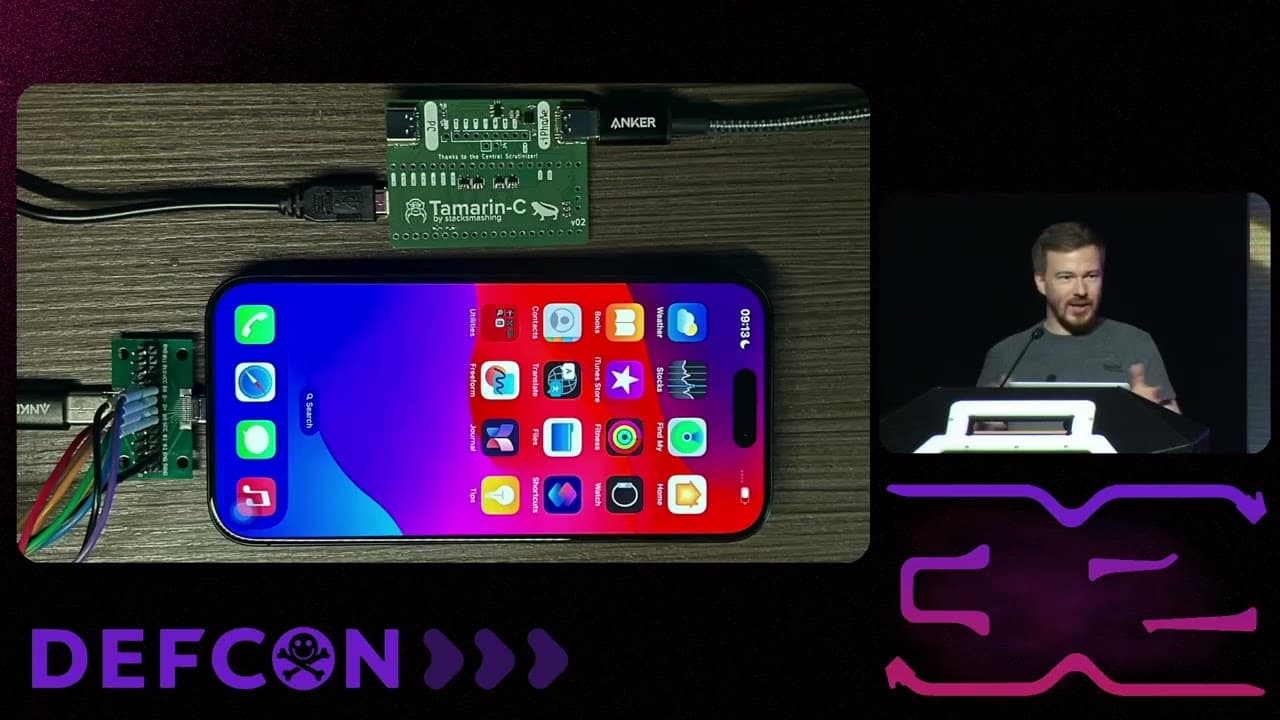
Dissecting the GoldBug
This panel discussion provides a retrospective analysis of the 'GoldBug' puzzle contest from a previous DEF CON, detailing the design and solution process for various complex challenges. The speakers explain the methodology behind creating multi-layered puzzles that incorporate steganography, cryptography, and logic-based riddles. The talk serves as a case study for puzzle design and collaborative problem-solving in a CTF environment, highlighting the importance of diverse skill sets within a team. It offers insights into how organizers craft engaging, multi-stage challenges that require both technical expertise and lateral thinking.
Beyond the CTF: Why Puzzle Design is the Ultimate Red Team Exercise
TLDR: The GoldBug puzzle contest at DEF CON demonstrates how multi-layered, non-linear challenges force researchers to move beyond automated scanning and into deep, manual analysis. By combining steganography, cryptography, and logic-based riddles, these puzzles mirror the complexity of real-world, high-stakes target environments. Mastering this type of lateral thinking is essential for any pentester or bug bounty hunter looking to find vulnerabilities that automated tools consistently miss.
Most security professionals view CTF competitions as a way to sharpen skills, but the best ones are actually simulations of complex, multi-stage exploitation. The GoldBug contest at DEF CON is a masterclass in this. It forces participants to stop relying on standard payloads and start treating the target as a cohesive, logical system. When you are staring at a 600-page PDF or a series of seemingly random images, you are not just solving a riddle. You are performing reconnaissance on an undocumented protocol.
The Mechanics of Multi-Layered Puzzles
Effective puzzle design, much like a sophisticated red team engagement, relies on layering. A single vulnerability is rarely the end goal. Instead, the organizers create a chain where the output of one stage is the input for the next. This forces the researcher to maintain state and context across different domains.
In the GoldBug challenges, the team often encountered puzzles that required a mix of Python for data manipulation and Blender for spatial analysis. The key is recognizing when a piece of data is not just noise. For example, when a puzzle involves rotating shapes or interpreting visual patterns, the researcher must determine if the information is encoded in the geometry or the metadata.
One of the most effective techniques discussed was the use of "mirroring" or "inverting" data. If you are looking at a set of images or a grid of characters, the solution often lies in how those elements relate to each other when transformed. This is exactly how you should approach an obfuscated JavaScript blob or a custom binary protocol. If the data looks like garbage, it is likely because you are looking at it in the wrong coordinate system.
When to Stop Automating and Start Thinking
Automation is a force multiplier, but it is also a crutch. The GoldBug challenges highlight the "Aha!" moment that occurs when you realize your tools are failing because they are looking for a standard vulnerability, like a classic Injection flaw, when the actual path forward requires manual decoding.
Consider the "Elephant's Foot" puzzle mentioned in the talk. It required participants to map visual cues to specific language translations, which then formed the basis for a final URL. This is a perfect analogy for a real-world engagement where you might find a series of seemingly unrelated configuration files or API endpoints. If you try to brute-force them, you will get nowhere. If you map them out and look for the underlying logic—the "author's intent"—the path to the vulnerability becomes clear.
Applying Puzzle Logic to Real Targets
Pentesting is often about finding the "hidden" path that the developers didn't intend for users to take. In a web application, this might be an Insecure Direct Object Reference that is only accessible if you understand the internal ID generation logic. In a network, it might be a misconfigured service that only accepts traffic if you craft a packet with specific, non-standard flags.
When you are stuck on a target, ask yourself: what is the "puzzle" here? Is there a piece of information I am ignoring because it doesn't look like a vulnerability? The GoldBug participants learned that the most rewarding solutions came from the most tedious manual work. They spent days staring at PDFs and counting pixels, not because they enjoyed the tedium, but because they knew the answer was hidden in the structure of the data.
Defensive Lessons from Offensive Design
Defenders can learn a lot from how these puzzles are constructed. If you want to secure your infrastructure, you need to understand how an attacker builds a mental model of your system. A well-designed puzzle is essentially a map of the system's logic. If you can identify the "weakest link" in your own puzzle—the point where the logic breaks or the obfuscation is too thin—you have found a potential entry point for an attacker.
The best way to improve your security posture is to think like the puzzle designer. Don't just patch the vulnerability; understand the logic that allowed the vulnerability to exist in the first place. If you can anticipate the "Aha!" moment an attacker will have, you can build defenses that make that moment impossible to reach.
Stop looking for the easy win. The next time you are on an engagement and your scanners come back clean, don't assume the target is secure. Start looking for the patterns, the hidden logic, and the connections that aren't immediately obvious. The most critical vulnerabilities are rarely the ones that are easy to find. They are the ones that require you to solve the puzzle first.
Up Next From This Conference

Similar Talks
Inside the FBI's Secret Encrypted Phone Company 'Anom'

Kill List: Hacking an Assassination Site on the Dark Web