LLM-Powered Network Intrusion Detection System
This talk demonstrates the integration of Large Language Models (LLMs) into network intrusion detection systems to improve the identification of sophisticated and novel attack patterns. By leveraging Natural Language Processing (NLP) techniques, the system parses and categorizes network logs as natural language to perform semantic analysis and detect anomalies. The proposed architecture utilizes DistilBERT for efficient log classification and Gemma for generating incident response recommendations. This approach aims to reduce false positives and enhance context-aware threat detection compared to traditional signature-based or anomaly-based NIDS.
Moving Beyond Signatures: Using LLMs for Real-Time Network Anomaly Detection
TLDR: Traditional network intrusion detection systems (NIDS) rely on static signatures that fail against modern, evolving attack patterns. This research demonstrates a novel architecture using DistilBERT for high-speed log classification and Gemma for automated incident response. By treating network logs as natural language, this approach identifies zero-day anomalies and reduces false positives without the constant overhead of manual rule updates.
Security teams are drowning in logs. Most organizations still rely on signature-based detection, which is a losing game against any attacker with a basic understanding of how to modify their payloads. When you rely on a database of known bad patterns, you are by definition always one step behind. The industry has spent years trying to solve this with anomaly-based detection, but those systems often generate so much noise that they get ignored by the very analysts they are supposed to help.
The shift toward using Large Language Models (LLMs) for network security is not just another hype cycle. It is a fundamental change in how we process telemetry. Instead of looking for specific byte sequences, we can now train models to understand the context of network events. This allows us to identify when a sequence of actions—even if each individual action looks benign—deviates from the established baseline of normal behavior.
The Architecture of Context-Aware Detection
The core of this research involves transforming raw network logs into a format that a transformer-based model can digest. By using a tokenizer to convert log entries into numerical vectors, the system can perform semantic analysis on the data. The choice of DistilBERT is critical here. While a full-sized BERT model might offer slightly higher accuracy, the latency penalty is too high for a production NIDS. DistilBERT provides a lightweight, fast alternative that is optimized for CPU inference, making it practical for real-time monitoring.
The pipeline is straightforward but effective. A file watcher monitors incoming logs and pushes them into a Redis queue. A worker process then pulls these logs, classifies them using the pre-trained DistilBERT model, and stores the results in a SQLite database. If the model flags an entry as anomalous, the system triggers a secondary analysis using Gemma to generate actionable incident response recommendations.
For a pentester, this is a significant hurdle. If you are running a red team engagement, you are used to bypassing signature-based systems by simply changing your user-agent string or obfuscating your shellcode. With an LLM-powered system, the detection is based on the intent and the sequence of events. If your lateral movement looks like a series of T1548 privilege escalation attempts or T1068 exploitation patterns, the model will flag it regardless of how well you have obfuscated your specific commands.
Practical Implementation and Testing
The researchers released their implementation as an open-source Python package, which is the only way to verify these claims. You can pull the model directly from Hugging Face to test it against your own datasets. The key to making this work is the training data. The project uses the AIT Log Data Set, which includes a wide variety of simulated attacks on web servers, VPNs, and firewalls.
When you are testing this in your own environment, focus on the "drift" in the model. The most interesting part of the demo is the 3D visualization of the log space. You can see how different attack types cluster together in the vector space. If you are a researcher looking to build your own detection tools, this is where you should start. Don't just look at the classification accuracy; look at how the model handles "unknown" traffic.
One of the biggest limitations of this approach is the potential for bias in the training data. If your model is trained on a specific enterprise environment, it might flag legitimate administrative tasks as malicious simply because they weren't in the training set. This is why the "human-in-the-loop" aspect—where the model provides a recommendation rather than automatically blocking traffic—is so important for the first few months of deployment.
Why This Matters for Pentesters
If you are a bug bounty hunter or a pentester, you need to be aware that the "black box" of network defense is getting smarter. We are moving away from simple regex-based WAFs and NIDS toward models that understand the "language" of your attack. During your next engagement, try to map out the baseline of the environment. If you can identify what the system considers "normal" behavior, you can craft your traffic to blend into that noise.
Defenders should look at this as a way to augment their existing stack, not replace it. You still need your firewalls and your endpoint protection. However, adding an LLM layer allows you to catch the sophisticated, low-and-slow attacks that currently slip through the cracks. The goal is to reduce the time between an intrusion and its detection.
The next step for this research is to move beyond SQLite and Redis. To make this truly enterprise-ready, you would need to integrate it with a distributed message broker and a more scalable database like PostgreSQL. If you are looking for a project to contribute to, the integration of these models into existing SIEM pipelines is a massive, untapped area. Stop relying on static rules and start looking at how you can leverage these models to make your detection logic as dynamic as the threats you are facing.
Vulnerability Classes
Target Technologies
Attack Techniques
Up Next From This Conference

Similar Talks

Kill List: Hacking an Assassination Site on the Dark Web
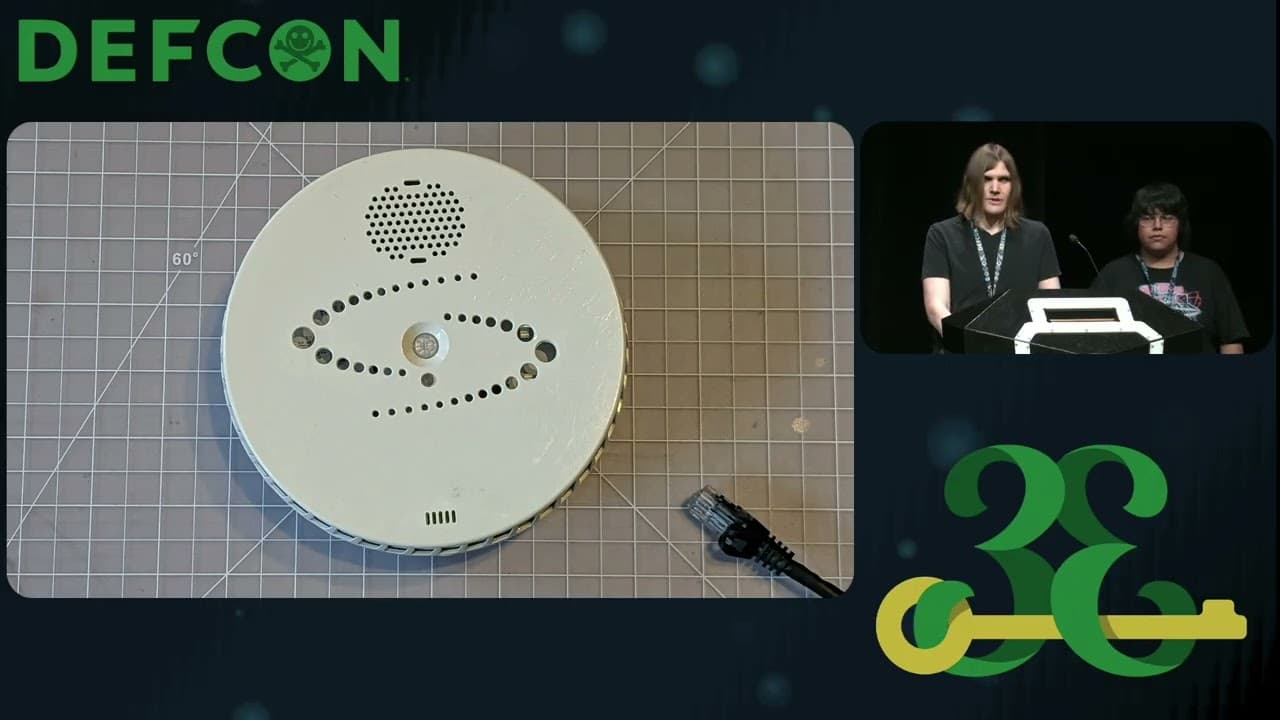
Unmasking the Snitch Puck: The Creepy IoT Surveillance Tech in the School Bathroom